Seeking God
Deacon Douglas McManaman
One of my favorite scriptural texts is from the book of Wisdom:
Resplendent and unfading is Wisdom, and she is readily perceived by those who love her, and found by those who seek her. She hastens to make herself known to those who desire her; one who watches for her at dawn will not be disappointed, for she will be found sitting at the gate (6, 12-14).
Wisdom is depicted here as a female divine person, which itself has tremendous implications that I have neither the time or space to pursue here.[1] But it is said that she is quick to make herself known to those who desire her—she goes out to meet them immediately. In fact, to desire her is to have been found already.
Now in this gospel, Jesus goes to a deserted place to be by himself, to grieve the death of John the Baptist, but soon he discovers that a crowd of people have gone in search of him. He is moved with compassion. The Greek word esplagchnisthe implies a compassion that is from the very core of the body; for the word is derived from splagchna, which means internal organs or intestines. This is a compassion that Jesus feels in his intestines. He is physically moved by those who seek him. The reason is that he is the incarnation of Wisdom (Sophia) who immediately goes out to meet those who seek her.
Not everyone in life is a seeker after the highest things, but the Lord’s compassion goes out to those who seek, who are aware of their hunger, their need, in particular, their need for him. The first beatitude in fact is about them: Blessed are the poor in spirit, those who recognize their utter need for God, who know that need and make it their prime purpose in life to find God. Those who lack the awareness of their own poverty do not seek, and because they do not seek, they do not find. We can only hope that one day they will come to know that interior poverty and begin seeking.
But what are the seekers looking for? They’re looking for a person, and this means they are seeking a relationship. Religion is fundamentally relationship.[2] In fact, life is all about relationship; life’s meaning centers around relationship. For teenagers, relationship is everything. The number one cause of suicide is lack of relationship (loneliness).[3] Pleasure is fine, but outside of relationship, it is short lived and unsatisfying. Joy, which is different from pleasure, has something essentially to do with relationship.
But even human relationships only go so far, because we are so imperfect. Our two greatest needs are to love and be loved, but we are loved imperfectly and we in turn love imperfectly, and the reason is that disordered love of self gets in the way. But we want to be loved perfectly and we would like to love perfectly, and that is why God created us for himself. As St. Augustine said on his first page of his Confessions: “You created us for yourself Lord and our hearts are restless until they rest in you”. He loves us perfectly and the more we allow ourselves to be loved by him–which is not easy to do–, the more perfectly we will be able to love others in return.
The crowd that was seeking Jesus went looking for him in a deserted place, since that’s where Jesus went. And that’s where we find him even today, in a deserted place, which is a place that most people seem to avoid and have no use for. There are two places in particular that are for the most part deserted. The first place is silence. Most people, it seems, cannot tolerate silence for any extended length of time, so they fill silent spaces with noise, usually music or television. But as Mother Teresa so often said: “God speaks in the silence of the heart”. The other deserted place where we find God is in the least of our brethren, that is, the sick, the imprisoned, the hungry, the lonely, those who cannot give us much in return for the time we give them. If we want to move the heart of God, we only need to make our way to these deserted places. It’s something to be able to move the all powerful God to action.
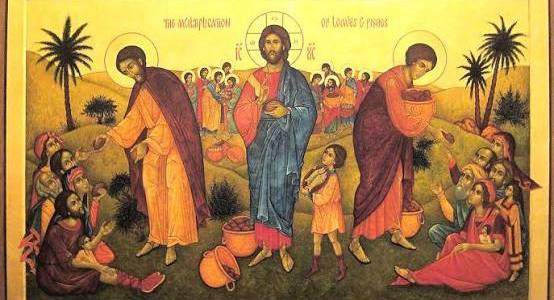
The disciples, however, are ready to send them off so that they can fend for themselves, for these people came without making proper provisions for themselves, which is sort of like how Jesus told the Apostles to be (Lk 10, 4). They didn’t think to prepare, that’s how focused they were on finding him. But Jesus tells his disciples: “feed them yourselves”, that is, don’t make them fend for themselves.
Of course, the disciples are all too aware of their limits. They don’t have enough to achieve what Jesus asks of them. What they have is inadequate. So what does he do? He tells them to give him the little they have and he’ll do the rest, and he feeds them.
And that’s the lesson. There are people in this world who are seeking the Lord, and the Lord calls us to feed them, but in our minds we can’t. We don’t have what it takes. But our purpose really is to feed one another, in particular those who come looking for the Lord, those who are in the world and searching. It’s not about waiting for them to come to us. We need the ability to figure out who among us in the world are the seekers. And when we find them and feel our inadequacy and inability to really do anything for them, we just give the Lord the little that we have in a spirit of faith and trust that he’ll do the rest. He’ll work through us in such a way that others will think we did so much for them–in our minds we’ll have done nothing at all.
So we are all called to be miracle workers. And we will be miracle workers, but we won’t know it. That’s the beauty of it. We won’t know it. Only in the end will it be revealed to us just how much we did for others, or better yet, how much the Lord did for the world through our limited efforts.
Notes
- “…if He was the warrior and the women blent into the unity of a new creation in whom there was neither male nor female because He had worked out within Himself that higher human harmony of both in which their age-long creative discord is destined finally to be resolved, that harmony was no easy miracle. In this, as always, He learned obedience by things that He suffered, and worked out His harmony as we must, after His example, work out ours, using the sex relationship and the poignancy of its appeal as one of our chiefest means of grace. It is in this perfect unity in Him of the Warrior and the Woman that I find the keystone to the quality of His life. He was the man woman, the mother father, the creative warrior complete.” G. Studdert Kennedy. The Warrior, the Woman and the Christ: A Study of the Leadership of Christ. London: Hodder and Stoughton, 1929, pp. 159-161. Also, Julian of Norwich writes: “I saw that the Second Person, who is our Mother in essence, that same dearworthy Person has become our Mother in flesh. … the Second Person of the Trinity is our Mother in human nature in our essential creation. In Him we are grounded and rooted, and he is our Mother in mercy by taking on our fleshliness. And thus our Mother is to us various kinds of actions (in Whom our parts are kept unseparated) for in our Mother Christ, we benefit and grow,…” Revelations of Divine Love. Trans. Father John Julian. Massachusetts: Paraclete Press, 2011. Reading 140.
- “Religion is the relationship between God and human beings. We can think about God in various ways, but it is perhaps most appropriate to view God as the foundation of the universe; and by “human beings” I am referring to our individual consciousnesses. Various religions come into being in accordance with different ways of thinking about the relationship between God and humans. But what sort of relationship is the true religious relationship? …William Robertson Smith stated that religion does not emerge from fear of an unknowable power but from loving reverence for a God who has a blood relationship with oneself. Religion is not an individual’s optional relation with a supernatural power, but a communal relationship between members of a society and the power that maintains the peace and order of the society. At the base of all religions must be a relationship between God and humans in which they share the same nature-that is, a relationship like that between father and child. But for God and the human to share the same losses and gains and for God to save and protect us is not yet true religion. God must be the foundation of the universe and our own foundation as well. To take refuge in God is to take refuge in that foundation. God must also be the goal of the myriad things in the universe and therefore the goal of humans as well. Each person finds in God his or her own true goal. Just as the hands and feet are parts of the human, the human is a part of God. Our taking refuge in God seems in a certain respect to be a loss of the self, but in another respect it is the way we find the self. …God is the source of life, and we live only in God. In this respect alone is religion filled with life and does the feeling of true piety arise. If we merely resign and entrust ourselves to God, then we have yet to rid ourselves of the scent of the self and to realize the heart of true piety. That one finds the true self in God might be seen as emphasizing the self, but this is actually the reason for abandoning the self and praising God. Kitaro Nishida. An Inquiry Into The Good. London: Yale University Press, 1990, pp. 153-154.
- Harry Stack Sullivan writes: “loneliness in itself is more terrible than anxiety.” See Harry Stack Sullivan, The Interpersonal Theory of Psychiatry (W. W. Norton & Co., 1953), p. 262. Ann Ulanov writes: “Without lovingness released into human relationship, we suffer a deep loneliness that drives us into madness. In defense against that loneliness where we receive neither self nor other, we resort to polarization. Rather than preserve the tensions of agreement and difference, the similarities and dissimilarities of female and male sexuality, we either split them into opposing polarizations or substitute divisive politicizations for them”. Ulanov, Ann Belford. Receiving Woman – Studies in the Psychology and Theology of the Feminine. Philadelphia: Westminster Press, 1981. Kindle Edition.