Seeking God

Deacon Douglas McManaman

One of my favorite scriptural texts is from the book of Wisdom: 

Resplendent and unfading is Wisdom, and she is readily perceived by those who love her, and found by those who seek her. She hastens to make herself known to those who desire her; one who watches for her at dawn will not be disappointed, for she will be found sitting at the gate (6, 12-14).

Wisdom is depicted here as a female divine person, which itself has tremendous implications that I have neither the time or space to pursue here.[1] But it is said that she is quick to make herself known to those who desire her—she goes out to meet them immediately. In fact, to desire her is to have been found already. 

Now in this gospel, Jesus goes to a deserted place to be by himself, to grieve the death of John the Baptist, but soon he discovers that a crowd of people have gone in search of him. He is moved with compassion. The Greek word esplagchnisthe implies a compassion that is from the very core of the body; for the word is derived from splagchna, which means internal organs or intestines. This is a compassion that Jesus feels in his intestines. He is physically moved by those who seek him. The reason is that he is the incarnation of Wisdom (Sophia) who immediately goes out to meet those who seek her.

Not everyone in life is a seeker after the highest things, but the Lord’s compassion goes out to those who seek, who are aware of their hunger, their need, in particular, their need for him. The first beatitude in fact is about them: Blessed are the poor in spirit, those who recognize their utter need for God, who know that need and make it their prime purpose in life to find God. Those who lack the awareness of their own poverty do not seek, and because they do not seek, they do not find. We can only hope that one day they will come to know that interior poverty and begin seeking. 

But what are the seekers looking for? They’re looking for a person, and this means they are seeking a relationship. Religion is fundamentally relationship.[2] In fact, life is all about relationship; life’s meaning centers around relationship. For teenagers, relationship is everything. The number one cause of suicide is lack of relationship (loneliness).[3] Pleasure is fine, but outside of relationship, it is short lived and unsatisfying. Joy, which is different from pleasure, has something essentially to do with relationship. 

But even human relationships only go so far, because we are so imperfect. Our two greatest needs are to love and be loved, but we are loved imperfectly and we in turn love imperfectly, and the reason is that disordered love of self gets in the way. But we want to be loved perfectly and we would like to love perfectly, and that is why God created us for himself. As St. Augustine said on his first page of his Confessions: “You created us for yourself Lord and our hearts are restless until they rest in you”. He loves us perfectly and the more we allow ourselves to be loved by him–which is not easy to do–, the more perfectly we will be able to love others in return. 

The crowd that was seeking Jesus went looking for him in a deserted place, since that’s where Jesus went. And that’s where we find him even today, in a deserted place, which is a place that most people seem to avoid and have no use for. There are two places in particular that are for the most part deserted. The first place is silence. Most people, it seems, cannot tolerate silence for any extended length of time, so they fill silent spaces with noise, usually music or television. But as Mother Teresa so often said: “God speaks in the silence of the heart”. The other deserted place where we find God is in the least of our brethren, that is, the sick, the imprisoned, the hungry, the lonely, those who cannot give us much in return for the time we give them. If we want to move the heart of God, we only need to make our way to these deserted places. It’s something to be able to move the all powerful God to action. 

The disciples, however, are ready to send them off so that they can fend for themselves, for these people came without making proper provisions for themselves, which is sort of like how Jesus told the Apostles to be (Lk 10, 4). They didn’t think to prepare, that’s how focused they were on finding him. But Jesus tells his disciples: “feed them yourselves”, that is, don’t make them fend for themselves. 

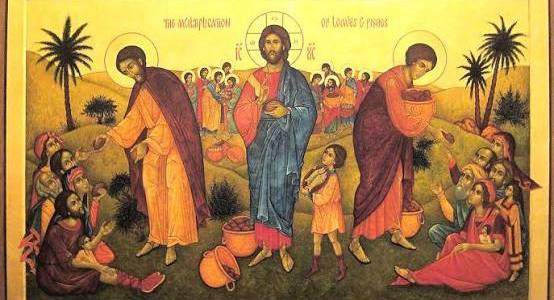
Of course, the disciples are all too aware of their limits. They don’t have enough to achieve what Jesus asks of them. What they have is inadequate. So what does he do? He tells them to give him the little they have and he’ll do the rest, and he feeds them. 

And that’s the lesson. There are people in this world who are seeking the Lord, and the Lord calls us to feed them, but in our minds we can’t. We don’t have what it takes. But our purpose really is to feed one another, in particular those who come looking for the Lord, those who are in the world and searching. It’s not about waiting for them to come to us. We need the ability to figure out who among us in the world are the seekers. And when we find them and feel our inadequacy and inability to really do anything for them, we just give the Lord the little that we have in a spirit of faith and trust that he’ll do the rest. He’ll work through us in such a way that others will think we did so much for them–in our minds we’ll have done nothing at all. 

So we are all called to be miracle workers. And we will be miracle workers, but we won’t know it. That’s the beauty of it. We won’t know it. Only in the end will it be revealed to us just how much we did for others, or better yet, how much the Lord did for the world through our limited efforts.

Notes

  1. “…if He was the warrior and the women blent into the unity of a new creation in whom there was neither male nor female because He had worked out within Himself that higher human harmony of both in which their age-long creative discord is destined finally to be resolved, that harmony was no easy miracle. In this, as always, He learned obedience by things that He suffered, and worked out His harmony as we must, after His example, work out ours, using the sex relationship and the poignancy of its appeal as one of our chiefest means of grace. It is in this perfect unity in Him of the Warrior and the Woman that I find the keystone to the quality of His life. He was the man woman, the mother father, the creative warrior complete.” G. Studdert Kennedy. The Warrior, the Woman and the Christ: A Study of the Leadership of Christ. London: Hodder and Stoughton, 1929, pp. 159-161. Also, Julian of Norwich writes: “I saw that the Second Person, who is our Mother in essence, that same dearworthy Person has become our Mother in flesh. … the Second Person of the Trinity is our Mother in human nature in our essential creation. In Him we are grounded and rooted, and he is our Mother in mercy by taking on our fleshliness. And thus our Mother is to us various kinds of actions (in Whom our parts are kept unseparated) for in our Mother Christ, we benefit and grow,…” Revelations of Divine Love. Trans. Father John Julian. Massachusetts: Paraclete Press, 2011. Reading 140.
  2. “Religion is the relationship between God and human beings. We can think about God in various ways, but it is perhaps most appropriate to view God as the foundation of the universe; and by “human beings” I am referring to our individual consciousnesses. Various religions come into being in accordance with different ways of thinking about the relationship between God and humans. But what sort of relationship is the true religious relationship? …William Robertson Smith stated that religion does not emerge from fear of an unknowable power but from loving reverence for a God who has a blood relationship with oneself. Religion is not an individual’s optional relation with a supernatural power, but a communal relationship between members of a society and the power that maintains the peace and order of the society. At the base of all religions must be a relationship between God and humans in which they share the same nature-that is, a relationship like that between father and child. But for God and the human to share the same losses and gains and for God to save and protect us is not yet true religion. God must be the foundation of the universe and our own foundation as well. To take refuge in God is to take refuge in that foundation. God must also be the goal of the myriad things in the universe and therefore the goal of humans as well. Each person finds in God his or her own true goal. Just as the hands and feet are parts of the human, the human is a part of God. Our taking refuge in God seems in a certain respect to be a loss of the self, but in another respect it is the way we find the self. …God is the source of life, and we live only in God. In this respect alone is religion filled with life and does the feeling of true piety arise. If we merely resign and entrust ourselves to God, then we have yet to rid ourselves of the scent of the self and to realize the heart of true piety. That one finds the true self in God might be seen as emphasizing the self, but this is actually the reason for abandoning the self and praising God. Kitaro Nishida. An Inquiry Into The Good. London: Yale University Press, 1990, pp. 153-154.
  3. Harry Stack Sullivan writes: “loneliness in itself is more terrible than anxiety.” See Harry Stack Sullivan, The Interpersonal Theory of Psychiatry (W. W. Norton & Co., 1953), p. 262. Ann Ulanov writes: “Without lovingness released into human relationship, we suffer a deep loneliness that drives us into madness. In defense against that loneliness where we receive neither self nor other, we resort to polarization. Rather than preserve the tensions of agreement and difference, the similarities and dissimilarities of female and male sexuality, we either split them into opposing polarizations or substitute divisive politicizations for them”. Ulanov, Ann Belford. Receiving Woman – Studies in the Psychology and Theology of the Feminine. Philadelphia: Westminster Press, 1981. Kindle Edition. 


A More Sober View of Priesthood

by: Deacon Douglas McManaman

I was driving home from visiting one of my brothers in a town north of Toronto and noticed an article by Janet Smith about the nephew (Kevin Wells) of the priest who, when I was 17 years old and hitchhiking with my 5-String banjo to Nashville, TN, gave me a lift from Columbus, Ohio and took me to Erlanger, Kentucky (Monsignor Tom Wells). I asked my wife to read it to me in the car while I was driving.

I found that I did not agree with either of them in what they were writing (re: priests who belong to the SSPX). But a memory returned to me while the article was being read to me, a memory that contains what I believe is an important point about the priesthood that I think is more relevant today than years earlier. I remember complaining to Father Wells about the priests in Canada, that they are not like him and how ridiculous it was that for me to return to the Church, I had to be placed on a highway outside of Columbus, Ohio to encounter a priest who was driving from Washington DC on his way to Kentucky, because between Toronto and Nashville, there just weren’t any around to do the job that Father Wells was able to do. That was the general idea of what I was saying to him, if I remember correctly. In any case, what I do clearly remember is that he disagreed with me. And he was adamant. He said to me: “That was a graced moment”. He kept objecting and insisting that the two or three hour period in the car on the way to Kentucky was a graced moment.

Yes, I thought, it was indeed a graced moment, but I didn’t quite understand how that was inconsistent with the point I was making. It took some years for me to get the point–probably because I was blinded by “hero worship”, which in Jungian terms is the projection of the Hero archetype from my own unconscious mind to an individual person, in this case, Kevin’s uncle, Monsignor Tom Wells. He knew something about himself that I did not. What was that? Well, in my eyes Father Wells was larger than life, as all heroes are, but he knew better. He knew that he was not larger than life, and that what resulted from that car ride was the result of divine grace (a graced moment), not Father Wells. In other words, grace was present in me in such a way that I was disposed to see and understand things that were happening on a different level–Father Wells may not have even been aware that anything was happening on another level–in fact, given his delight at the marvels of divine providence months later, it is probably the case that he wasn’t. He was just driving the car, answering my questions to the best of his ability, most importantly relating to me at an eye to eye level (no condescension, pretension, nor airs), being the generous and joyful guy that he was. Had it not been a graced moment, had I not been disposed a certain way by that grace while Father Wells remained the same joyful and generous priest that he was, then life would have gone on and I would not have returned to the Church but would probably be playing in some Bluegrass band somewhere in the U.S. Father Wells had no power to change me, and he knew it. He knew it because he said that he in fact was not responsible for my return to the Church. Grace was. God can use anyone. As Jesus said: “I tell you that out of these stones God can raise up children for Abraham” (Mt 3, 9). He chose to use Father Wells as an instrument, but God could have used anybody. The instrument certainly has some importance–you can’t pick up a watermelon with a plastic fork–, but without the disposition brought about by divine grace–which depends entirely on the will of God at the moment according to the plan of providence–, that journey to Nashville would have been no different than any other journey.

And this is the problem I had with the title of Kevin’s book that I reviewed years ago: The Priests We Need to Save the Church. I was uncomfortable with the title, but decided not to give it too much thought at the time nor mention it to him. But the Church does not need saving. The Church is Holy and Immaculate, because She has been saved by Christ, and there are no priests who are going to save anyone, much less the Church. Any ordained priest who thinks he is going to save anyone is suffering from a bad case of grandiosity. This is why I no longer have the patience to read certain conservative Catholic journals–because most if not all of their writers seem to believe that they are vessels of truth that the world and the Church desperately need. In short, they are delusional. They are no more vessels of truth than your typical columnist from the National Catholic Reporter–and there are some very good writers there.

In the past, shortly after my return to the Church in 1979, there were days when leaving the church after mass I said to myself: “What a pathetic homily!”, when not even 10 seconds later I see a man going up to the pastor to say: “That was a great homily, Father. It touched me deeply”. Many times I thought a particular pastor was a dud, only to learn later how many other people in the parish thought otherwise and how much he did for them. Recently I was out with someone who has quite a harrowing life story, a tremendous near death experience, and in his mind the parish he belongs to is feeding him like there’s no tomorrow and he does not want to move. I didn’t dare tell him what I know about the parish and the pastor. Obviously, the Lord is doing something for these people, despite their pastor and his refusal to take advantage of all the gifted people ready to serve. He’s a stifler, but as Father Wells would say, “God is in control”, and He knows what He’s doing in allowing this, that, and the other thing. But his pastor is certainly not responsible for the good that seems to be happening outside of my purview, any more than a wrench is responsible for my new car’s smooth and reliable performance.

I move some people with my homilies and leave others unmoved, and my priest friends will move others and leave many unsatisfied. We are not all alike, not all at the same place, and certainly not all “spiritually starved”. No parish needs me, and Father Wells would certainly agree that no parish needed him. They need Christ, and I’m not Christ, and neither is he. I’m a very limited human being with a very limited grasp on things, and some people may benefit from my particular way of doing things, but not everyone. And I am certainly not going to be responsible for the salvation of anyone’s soul. God alone will be. In fact, my efforts at saving anyone may very well do more harm than good if those efforts are accompanied by inordinate zeal. And looking back at my life, I do often shake my head at myself, but God must know that at every stage of my life, I’m profoundly limited and continually make mistakes. Why? Because He knows everything. More than that, He is all powerful, so He can and will accomplish all that He wants. So why would I worry? And why are any of us worrying? Why do so many of us behave like a bunch of frantic neurotics with a seriously flawed Manichean worldview that to us appears as orthodoxy? How many times did Jesus say: “Don’t worry”? Did he not say “Take heart, I have overcome the world” (Jn 16, 33)? Young priests fresh out of the seminary have not been chosen to save the Church. After 40 or more years in the priesthood, if they’ve learned anything at all, they are going to look back and say to themselves: “I knew nothing. I was not the slightest bit superior to anyone, and looking back I have to thank so many people for putting up with my obnoxious delusions rooted in the inexperience that is part and parcel of youth. The problem is I can’t, because most of them are dead and buried”.


Go forth, the Mass is ended!

Deacon Douglas McManaman

I received a text about the closing remarks of an Archbishop of a major U.S. city. A number of people were rather upset that the Archbishop would point to the altar and say to the congregation: “The consecration is not the most important part of the Mass, but rather the “sending forth”. I was asked to comment.

My first reaction was that this is a strange thing to be upset about; after all, the word ‘Mass’ is from the Latin missa, which means “dismissal” or, as the bishop indicated, “sending forth” (from the Latin verb mittere: to send, to discharge, to release). My friend took issue with my reply and began to argue: “Why not just do social work? Forget the Church and the “silly Eucharist”, he said. “It’s not that important anyways, at least not as much as sending forth”.

But the Archbishop did not say that the consecration is not important. Moreover, the movement outwards can hardly be classified as “social work”. Archbishop Romero, for example, was hardly a social worker; neither could Mother Teresa be classified as such, nor Mother Cabrini, Don Bosco or St. Vincent de Paul, etc. It seems to me, however, that there is a tendency among some clergy and laity to reduce Catholicism to the sanctuary. And this seems to be a perennial problem. In the early 20th century, English poet and chaplain of the British Army during WW1 G. Studdert Kennedy wrote:

The cry that is often raised, that we are going to secularize religion and take the clergy away from their purely “spiritual work”, is the cry of the man who dare not face the Cross. He wants to keep his Christ forever standing amid the lilies of the altar, with the sweet incense of worship rising around him, a weekly refuge from the distraught and vulgar world. He wants to lock Christ up in the Tabernacle, to keep Him in the silence of the secret place, where men must go down on their knees before they touch Him. But Christ wants to come out into the market-place, and down to the streets; He wants to eat and drink with prostitutes, to be mocked and spit upon by soldiers. He wants to call the dishonest trader from his office desk; to stand at his lathe beside the workman; and to bend with the mother over the washtub in the city of mean streets. He wants to go out into the world, that beauty and goodness and truth – beautiful things, good people, and true thought – may grow up around Him wherever He goes. You cannot keep Christ in your churches; He will break them into pieces if you try. He will make for the streets in spite of you, and go on with His own work; defying dead authorities, breaking down tyrannies, destroying shams, declaring open war against a Godless world. And wherever He goes the true Church will go with Him – the Church of those who are forgiven because they are bearing the sins of the world, and have learned how to forgive.

For me, that says it all and says it best. The Archbishop is simply emphasizing the fact that the Mass is ordered outwards, towards the world. The bread and wine that we offer becomes Christ in order that we become Christ, so that when we are sent out, we may bring Christ into the world, and that sending forth includes the priest who says Mass. In other words, it is not a matter of “you go forth” while “I stay here” among the lilies and the incense–although some very conservative clergy argue that “going forth” is for the laity only, while the priest remains inside. Things haven’t changed all that much since the 1920s. Whoever becomes Christ after consuming him will be moved to go out into the market-place, not to shop for dainty pastries and other fine delicacies, but to “eat and drink with prostitutes”, to mix it up with those whom Christ redeemed. Not everyone is so moved: “I don’t want to smell like sheep” protested one priest to a fellow Deacon, upset that Pope Francis would ever suggest such a thing.

The Mass is a beginning, not an ending; it is a means, and a means is subordinated to the end, which in this case is the “Christification” of the world, or rather the universe as a whole. The consecration is the beginning of that Christification of ordinary matter. The Mass is a movement, and the most important part of a movement is the final cause. This has to be emphasized for those who would like everything to revolve around the sanctuary, as though what takes place there is the sole purpose of the Christian life. 


Charisms, the Laos, and Listening 

Deacon Douglas McManaman 

“I thank you, Father, Lord of heaven and earth, because you have hidden these things from the wise and the intelligent and have revealed them to infants.”

This is such an important line of Scripture, for what it reveals is that the prophecy in the Book of Joel has come to fulfillment: 

And it shall come to pass afterward, that I will pour out my Spirit on all flesh; your sons and your daughters shall prophesy, your old men shall dream dreams, and your young men shall see visions. Even upon your male and female servants, in those days, I will pour out my spirit (Jl 3, 1-2).

In other words, the separation between the religious and educated elite on the one hand and the common people without that formal training in the Torah on the other will be obliterated. And it has been, with the coming of Christ. God reveals himself to “minors” (Gk: nepiois). In other words, the humble and unpretentious—but he hides himself from the learned and the sophisticated. And of course this theme is repeated throughout the New Testament: Jesus has table fellowship with hated tax collectors, sinners, and other outcasts, etc. The term “sinners” generally refers to those who do not observe the Torah, and the reason is they don’t know the Torah, for they cannot study the Torah because of the demands of their daily labor. And yet they recognized Christ, while the religious elite, the highly educated Pharisees and Scribes, did not have the eyes to recognize him. Paul continues this theme in his letter to the Corinthians: 

Brothers and sisters, think of what you were when you were called. Not many of you were wise by human standards; not many were influential; not many were of noble birth. But God chose the foolish things of the world to shame the wise; God chose the weak things of the world to shame the strong. God chose the lowly things of this world and the despised things—and the things that are not—to nullify the things that are, so that no one may boast before him. (1 Co 1, 27-28)

How does this work? There are seven personal gifts of the Holy Spirit and a larger number of charisms. The charisms are given for the building up of the body of Christ while the personal gifts are for one’s own personal holiness: wisdom, knowledge, understanding, piety, counsel, fortitude, and the fear of the Lord. But each of us has also received at baptism either one or more charisms that have been given in view of our specific vocation. A charism is a specific way the Holy Spirit manifests himself through you, for the sake of others, and you may not even know when or whether that is actually happening. St. Paul provides a non-exhaustive list of a number of charisms: the gift of healing, the gift of miracles, the gift of prophecy, words of knowledge, etc.,. (1 Co 12, 27-31; Rom 12, 1ff). But Paul also includes some less spectacular charisms, such as the charism of teaching and administration (1Co 12, 28). I try to get this across to my students who are studying to be teachers: “You have a charism”, I tell them, “but like any gift, you have to unwrap and open it”. A charism is not the same as a highly charged personality (charisma)–students often confuse the two. As an example of a teaching charism, consider a former colleague of mine who was technologically challenged, computer illiterate, could barely formulate an email when I first met him and used an overhead projector till the end of his career. Nevertheless, he was the most influential teacher that I knew in my 32 ½ years of teaching. The students were drawn to him, they listened to him, even the most rebellious. He loved his students, prayed for them every morning, loved his subject matter and continued to study it, and he was a joyful teacher. He was an enigma to many in the education system, because he never adopted the latest trends in education, yet the line up of parents eager to meet and thank him on parent/teacher interview night was always the longest. 

I have worked with many gifted administrators over the years, and one in particular had a tremendous charism of administrative leadership. She had great faith and a deep prayer life, and she had kavod, a Hebrew word that is typically translated as glory but really means weight–not literally as in poundage, but a kind of authority, a gravitas. Students respected her, and they knew she loved them, even when she was disciplining them.  

But every baptized person has specific charisms that have to be gradually opened. I’m always impressed with our parishioners at our parish bible study; although they’ve never formally studied theology, the ones in my small group exhibit insight and wisdom that is often remarkable. I know truck drivers and laborers who have no post secondary degrees, but who say the wisest things, revealing again deep insight into the things of God. Where do they get such wisdom and insight? The Holy Spirit comes to their aid. And what is particularly interesting is that they don’t realize that what they say is often deeply insightful–they always second guess themselves. But there’s the humility, and God reveals himself to the humble, to mere children who don’t have any pretensions to great knowledge. 

Because of that very wide outpouring of the Holy Spirit, there are very specific charisms tailored to the vocation that God calls you to, and so they won’t appear in the letters of Paul. Whether you are a police officer, a school janitor, or an accountant, you are given the charism by which the Holy Spirit will manifest himself through you in a way that builds up the body of Christ. And so, there is a big difference between a nurse who has a nursing charism and one who does not. Those with a charism exude a supernatural compassion, intelligence, meticulousness, and a sense that they genuinely care about their patients, making them feel as if they matter. There’s a significant difference between a court judge with a judicial charism and one without. They will exude a degree of practical wisdom, intuition, and integrity, as did someone like St. Thomas More–everyone knew that More was different from the rest. If you are a gifted entrepreneur, God wants to elevate that gift so that you will become one who creatively moves this world forward, without perpetuating the oppression of the weak, but reversing that trend. 

With a charism tailored to your natural talents, you will acquire the wisdom to see the world from a very specific angle, and so you will come to understand the faith from that angle, and the result is that you will have insights that I will lack, because I lack that experience and that specific angle. That is why both Francis and Leo place great emphasis on synodality, that is, listening to the faithful, having synods that include women, lay people, non-clerics, in which bishops are given very specific instructions not to interrupt, but to listen attentively. To do so is to listen to the Church.[1] In her brilliant work on the power of listening, Nancy Kline writes: “Beneath the fear of being punished for thinking for themselves, most people have ideas that matter, ideas that would make a difference if they could be developed fully. People, regardless of their position or status, can think of things that move discussions to whole new levels of sparkle and resolution. Individuals you would never suspect of being interesting have absorbing stories to tell and disturbing insights that would humble even the most long-winded of us right out of our self-importance and rush. If the conditions are right, the huge intelligence of the human being surfaces. Ideas seem to come from nowhere and sometimes stun us.”[2]

One of the interesting things about Vatican II is that the first draft of the Preparatory document for Lumen gentium (entitled Schema de Ecclesia) was overwhelmingly rejected by the Council Fathers and sent back to be re-written. It was rejected for its clericalism and a top down hierarchical view of the Church. In other words, it presented the Church as primarily a juridical bureaucracy and treated lay Catholics merely as passive subjects. If we look at the final document of Lumen gentium, however, we notice the emphasis on the Church as the People of God, the laos (Gk: the common people), which appears before the treatment of that part of the Church that is the hierarchy (Ch. 3). That was a monumental shift in emphasis at the time. The Church is not primarily the society of the ordained; rather, it is a charismatic body, as Cardinal Suenens pointed out. He writes: 

…the Holy Spirit is not given to pastors only but to each and every Christian. …In baptism, the sacrament of faith, all Christians receive the Holy Spirit. All Christians, “living stones”, as they are called, are to be built into a “spiritual dwelling”. Therefore the whole Church is essentially a truly “pneumatic” or spiritual reality, built on the foundation not only of the Apostles, but–as Ephesians 2, 20 says –also of prophets. In the Church of the New Testament God “gave some to be apostles, some prophets, some pastors and teachers” (Eph 4, 11; see 3, 5).

The Holy Spirit shows himself in the Church in the great number and richness of his spiritual gifts, gifts which Scripture calls pneumatika or charisms. Certainly in the time of St. Paul even very extraordinary and marvelous charisms such as “ecstatic utterance” or charisms of healings were shown forth in the Church. But we should not think that the charisms of the Spirit consist exclusively or even principally in these phenomena which are more extraordinary and marvelous. St. Paul speaks, for example, of the charism of wise speech and knowledge, of the charism of faith, or the charism of teaching (Rom 12, 7; 1 Cor 12, 28ff, 14, 26), of comforting speech, and administration, of the charism of distinguishing true spirits from false, of the charism of helping others and guiding them and so on. 

Thus to St. Paul the Church of the living Christ does not appear as some kind of administrative organization, but as a living web of gifts, of charisms, or ministries. The Spirit is given to every individual Christian, the Spirit who gives his gifts, his charisms to each and every one “different as they are allotted to us by God’s grace” (Rom 12, 6). … Each and every Christian, whether lettered or unlettered, has his charism in his daily life, but–as St. Paul says – “All of these must aim at one thing; to build up the Church” (1 Cor 14, 26, see 14, 3-5).  … A statement about the Church, then, which would speak only of the Apostles and their successors and fail to speak about prophets and teachers would be defective in a matter of the highest importance.”[3] 

The fundamental problem, I believe, is that many people are afraid of discovering their gifts and charisms. It is easier to engage in hero worship, to project our own inner gold outward onto others. It can be frightening to think that God pays that much attention to me, calls me, and has gifted me for a mission. That this is normal, we need only recall Moses’ initial resistance to God’s call (Cf. Exodus, chapters 3 & 4), or that of Jonah, Jeremiah, or Gideon. They all saw themselves as inadequate, small and weak, unfit for the task, but this is precisely why God chose to use them as his instruments. They didn’t have large egos, which can get in the way and stifle the work of the Holy Spirit. We are afraid that if I give God my finger, he will take my entire hand. And that’s true, God will take the hand and much more besides, but the good that will be accomplished through us will be incalculable and our joy will be complete.


Notes


1. Michael Higgins writes: “Francis defined a synodal church in his address on the 50th anniversary of the Synod of Bishops in 2015—quite early in his papacy—as a church “which listens, which realizes that listening ‘is simply more than hearing.’ It is a mutual listening in which everyone has something to learn. The faithful people, the college of bishops, the Bishop of Rome: all listening to each other, and all listening to the Holy Spirit, the ‘Spirit of truth’ (Jn 14:17), in order to know what he ‘says to the Churches’ (Rev2:7)…. In his 2020 encyclical Fratelli tutti he invoked the image of the polyhedron to represent “a society where differences coexist, complementing and reciprocally enriching one another, even amid disagreements and reservations. Each of us can learn something from the others.” The synodal church as a polyhedron is a church more reminiscent of the pre-Constantinian era, a time of institutional humility and simplicity, shorn of the accoutrements of power, disengaged from political ideologies, with no ties to either the
ancien regime or the ascendant orthodoxies of the current era. In fact, Francis welcomed a change of era, a cambio de epoca, as he called it, with all that it portends: its uncertainties, its possibilities, its unpredictable eruptions of the Holy Spirit.” Pontifex Minimus: Pope Francis Institute talk—June 26, 2026 (part 2), https://mailchi.mp/b506f9ca07d2/pontifex-minimus-the-popes-visit-highlights-his-gift-for-meaningful-engagement-12849577?e=dd69433d0a

2. Nancy Kline. Time to Think: Listening to Ignite the Human Mind (pp. 36-37). (Function). Kindle Edition. She also writes: “Attention, the act of listening with palatable respect and fascination, is the key to a Thinking Environment. Listening of this calibre is enzymatic. When you are listening to someone, much of the quality of what you are hearing is your effect on them. Giving good attention to people makes them more intelligent. Poor attention makes them stumble over their words and seem stupid. Your attention, your listening is that important. We think we listen, but we don’t. We finish each other’s sentences, we interrupt each other, we moan together, we fill in the pauses with our own stories, we look at our watches, we sigh, frown, tap our finger, read the newspaper, or walk away. We give advice, give advice, give advice. Even professional listeners listen poorly much of the time. They come in too soon with their own ideas. They equate talking with looking professional. …Listening to each other, if you want to think for yourselves, requires discipline and the most profound attention for each other. Ibid., p. 37-38. 

3. Cardinal Leon Suenens. “The Charismatic Dimension of the Church”. Council Speeches of Vatican II, edited by Hans Kung, Yvest Congar, Daniel O’Hanlon. Paulist Press, New York: 1964, p. 29-32.