Complicity
Deacon Douglas McManaman
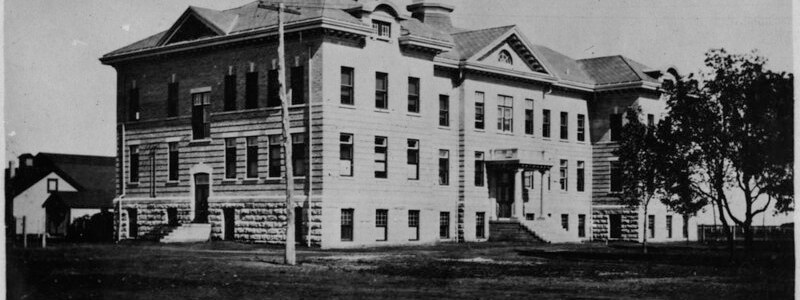
Recently I encountered a woman who said to me that many people have left the Church as a direct result of the news of the unmarked graves on the property of the old Kamloops Residential School in British Columbia–her husband being one of them. Of course, there is no denying that the Residential school system, at its origin, constituted a fundamental violation of the basic human rights of the Indigenous peoples of Canada. In 1883, John A. MacDonald wrote:
When the school is on the reserve the child lives with its parents, who are savages; he is surrounded by savages, and though he may learn to read and write his habits, and training and mode of thought are Indian. He is simply a savage who can read and write. It has been strongly pressed on myself, as the head of the Department, that the Indian children should be withdrawn as much as possible from the parental influence, and the only way to do that would be to put them in central training industrial schools where they will acquire the habits and modes of thought of white men.
Despite the fact that a number of First people had positive and memorable experiences in their Residential schools, the entire system originated in and existed under the umbrella of this utterly racist conceptual frame of mind and culturally genocidal purpose. It goes without saying that the Church should never have cooperated with the Canadian government in this. But they, along with the rest of the country, did cooperate with it.
In this light, why would I want to belong to such an organization as the Roman Catholic Church? I guess it is the same reason that I choose to belong to this country, Canada, which obviously has a very sordid history–it is not on account of this country’s sins that I wish to belong to it, but on account of the tremendous goods that this country has managed to achieve throughout its long history. In belonging to the Church, I certainly belong to an institution that has a very sordid past, but is there a nation or institution in this world that does not? Is it even possible for an individual person, a saint even, not to have a relatively sordid history? Don’t we all look back at our lives and shake our heads?
The process of coming to belong to the Church is not in any way the same as the process of coming to belong to any other institution, such as a corporation like Pepsi or Bell Canada, or a hospital or educational institution, etc. The reason is that the object of faith is not the Church as such, but Christ. For a person to believe in Christ and to enter into his death through baptism is to become, by virtue of that baptismal immersion, a part of his Mystical Body, and that person’s eyes are still on Christ, not on his Church; for he has become that Church, a member thereof, and he is taught to say every day: “Forgive us our trespasses as we forgive those who have trespassed against us”. The reason for this is that he remains a sinner, but one who has been “deified”, filled with divine grace, not by virtue of anything he has done, but simply by virtue of the unutterable mercy of God. His life is now a battle to overcome the effects of his wounded nature, namely, death, concupiscence, and the dulling of the mind. His life will therefore be one of continual reform, which is why the Church as a whole is in continual reform, for the Church is made up of sinful and flawed human beings whose minds are to a degree blinded by sin. There is no getting around this. And that is why the study of the history of the Church is a rather painful experience for the Catholic who has an idealized image of the Church, as a child has an idealized image of his own mother and father–the child chooses not to see what he simply does not want to see.
Those who choose to leave the Church because highly scandalous behaviour on the part of clergy or religious has been reported in the news, such as the operation of Residential schools and the abusive behaviour that took place in those institutions, or the clerical sex abuse scandals, etc., seem to believe that they have no complicity in the sins of the nation and the sins of the Church. But we were all complicit at the time–practically everyone operated within the arrogance of a Eurocentric worldview that looked down upon Indigenous culture, a worldview that kept us from appreciating its beauty and value, and we are all complicit today in the perpetuation of the injustices that First people continue to endure, such as lack of clean drinking water on the reserves among other things. And we are complicit in the injustices that Canadian young people and young families are forced to endure (i.e., housing prices and the cost of living) as a result of political and economic decisions made by an unjust and incompetent government that we put into power and kept in power. This notion of universal complicity is not a new concept, by any means. In 1923, G. Studdert Kennedy wrote:
Not long ago, a man was sentenced to ten years penal servitude for holding up a post office and shooting at a policeman. He was one of the army of unemployed in London. He had a wife and two children; he paid 8s. 3d [8 shillings, 3 pence] a week for two rooms in Whitechapel, which were so dark that the gas had to be kept burning all the time; he had fought in the army and been wounded, and he had done 10 weeks work in 18 months. He was not a good character, being weak and easily led; but in any decent community rightly ordered, he would in all probability have led quite a decent life. But in “justice“ he is to serve ten years. I am not disposed to rail at the courts – I think the sentence was inevitable for the protection of society, but purely for that reason, and not because it is just. He is suffering as much for the sin of the world, for your sin and mine, as for his own (The Wicket Gate, p. 73).
A person who leaves the Church or refuses to have anything to do with the Church because of her past sins has, at the very least, committed the fallacy of judging the past by the standards of today; to do so is to misunderstand the nature of human progress. I am what I am today because of the imperfections and mistakes of my past, and what I know today was the result of a decision to continually reflect upon my life as it was unfolding and as it unfolded. In other words, it was a result of a continued reflection upon my experiences, which are now past. All of us are expected to grow from experience, but how can a person be changed for the better unless he was in some ways worse than he is today? This means that if we are changing for the better, as we have a responsibility to do, then we can reasonably expect to experience disappointments when looking back on our lives. Individually, we cannot help but judge our own past by the standards we currently live by, but it seems we have no choice but to forgive ourselves, because the standards we hold up for ourselves today are the result of that experience and our own decision to reflect upon it, in light of moral principles we have discovered along the way–not to mention the resolution to improve. But for some reason we judge others’ histories with much less patience than we do our own; we overlook that the growing process is the same for everyone, every nation, and every institution. And of course, that does not necessarily cancel our responsibility for certain past decisions–one may still have to make reparation for a decision made long ago, perhaps a criminal decision or simply an immoral decision that left another or others profoundly hurt. But why would I walk away from the Church that Christ established— the Church that abandoned him on Holy Thursday night—, for being exactly the kind of developing organism that I have always been and cannot otherwise be?
 A Catholic Philosophy and Theology Resource Page by Deacon Douglas McManaman