
There are none so blind

Reflection for the 4th Sunday of Lent

@Where Peter Is

Deacon Douglas McManaman

Many years ago people would often ask me whether I thought this person or that person in the seminary was going to make a good priest, and I would readily offer my opinion. I’ve since refused to answer such questions only because I’ve been wrong far too often. This person, who I thought would make a great priest, turned out not to be, and that person who I thought would not last very long turned out to be a fine and committed priest. The fact of the matter is we simply don’t have all the information required to make a secure and accurate judgment, whether we are talking about the quality of future priests or just people in general. We are always information deficient, but we tend not to realize it. We are inclined to believe that “what you see is all there is” (availability heuristic), which is a very pervasive cognitive bias.

I used to teach the Theory of Knowledge to International Baccalaureate students, and when teaching young adults, one has to provide lots of examples, so I began to pay attention to the mistaken inferences that I would make on a daily basis and would use these as examples to illustrate the precarious nature of inductive inference. It is remarkable how many mistaken inferences we typically make every single day, but without realizing it, and that is another common bias of ours–we tend to quickly forget the times we were wrong, but the instances when we were right stand out in our memory like neon lights. Take a simple matter like forming a judgment on why a student has been late to class five days in a row: “Well, because he doesn’t really care about his education”, or “He doesn’t like my class, he’s bored”, etc., and then a short time later we discover that his mother is dying of cancer and he has to take his younger sister to school every morning, so he just can’t manage to get to school on time, let alone concentrate. These things happen all the time with us. 

The first reading is a good illustration of this. David is regarded as having the lowest social standing in his family; his father and brothers thought he was the least likely to be chosen king, so they left him in the fields to do the menial work of a shepherd; he was not even included in the lineup for the prophet Samuel. Of course, this is the person whom God chose to be king of Israel. The Lord said to Samuel with regard to Eliab: “Do not judge from his appearance or from his lofty stature, because I have rejected him. Not as man sees does God see, because man sees the appearance but the Lord looks into the heart.”

One serious problem with human beings is that we don’t like the feeling of not knowing; we insist on the feeling of possessing certain knowledge, which inclines us to settle upon unwarranted conclusions, only to vigorously defend them even when evidence is eventually brought forth that strongly suggests our judgment is mistaken. And so, it is very important to cultivate a healthy skepticism in the face of our own truth claims and remain ready to alter them if evidence demands it. Openness or open-mindedness (docility) is a very important virtue, one not easy to cultivate, especially for religious people, ironically enough.

Consider the judgment that the disciples pronounced on the man born blind, in today’s gospel reading: “As Jesus passed by he saw a man blind from birth. His disciples asked him, ‘Rabbi, who sinned, this man or his parents, that he was born blind?’” This is a good example of the need to have an answer to a difficult question. Suffering is a great mystery, but it makes things so much easier if we can convince ourselves that this person is suffering misfortune because of his sins or the sins of his ancestors. Suddenly I don’t feel guilty for not making the effort to help this person, after all, his condition is a kind of punishment from God. This is a primitive mode of thinking that has not entirely disappeared. I remember quite clearly a number of people who insisted that the Covid 19 pandemic was a divine chastisement on the world for its sins. But how would one know this? How do we distinguish between the daily misfortunes that befall us personally and those that affect others or the world at large? Is a flat tire a punishment from God? Is a death in the family a punishment from God? Thankfully, Jesus corrected the disciples: “Neither he nor his parents sinned; it is so that the works of God might be made visible through him.”

There’s an old proverb: “There are none so blind as those who will not see”. So much of our mistaken beliefs are rooted in a desire for them to be true, and so we attribute great weight to evidence that confirms them. We see this in the conversation between the man born blind and the Pharisees. They asked him how he was able to see. He told them. They asked him what he thought of the man who opened his eyes. “He is a prophet”, was his reply. 

But they didn’t quite like what they were hearing. In fact, they began to doubt that was born blind, so they called his parents in and asked them. They, however, were astute and knew that if they said something the Pharisees did not want to hear, they would be made to pay in some way. They acknowledged that this was their son and that he was born blind, but to the question: “How does he now see?” they said: “Ask him, he can speak for himself”.  So, the Pharisees called him back again and said: “We know that this man (Jesus) is a sinner.” The man replied: “If he is a sinner, I do not know”. He readily acknowledges his ignorance, but not the Pharisees; in their own eyes, they know. The man continued: “All I know is that I was blind and now I see”. So they asked him again: “How did he open your eyes?” At this point, it is becoming comical. The man said: “I told you already and you did not listen. Why do you want to hear it again? Do you want to become his disciples, too?”

The man born blind has a sense of humor, and what he says to the Pharisees at this point is rather brilliant: “This is what is so amazing, that you do not know where he is from, yet he opened my eyes. We know that God does not listen to sinners, but if one is devout and does his will, he listens to him. It is unheard of that anyone ever opened the eyes of a person born blind. If this man were not from God, he would not be able to do anything” (Jn 9, 30-33).

Of course, this is not what the Pharisees wanted to hear, so before throwing him out they managed to assure him of his place: “You were born totally in sin, and are you trying to teach us?” Note the irony. Who is really blind here? Those who will not see. 

St. Paul says that God chooses the weak of this world to shame the strong. To the Corinthians he writes:

Consider your own calling, brothers. Not many of you were wise by human standards, not many were powerful, not many were of noble birth. Rather, God chose the foolish of the world to shame the wise, and God chose the weak of the world to shame the strong, and God chose the lowly and despised of the world, those who count for nothing, to reduce to nothing those who are something, so that no human being might boast before God (1 Cor 1, 26-29).

And of course, the prime example of this is our Blessed Mother, who was nothing in her own eyes: “The Lord has looked upon the nothingness (tapeinōsis) of his handmaiden” (Lk 1, 48). That is why Mary was able to listen to Simeon and the prophet Anna at the Presentation in the temple. She was impressed by what they were saying to her; she could listen to them, because she was not elevated in her own eyes. 

It’s a very dangerous place to be in to see ourselves as something. Like water, God seeks the lowest place–that’s why basements flood, not the upper levels. God is always found in the lowest places. And Mary has the highest place, she is the Queen of Angels, only because she held the lowest place in her own eyes.
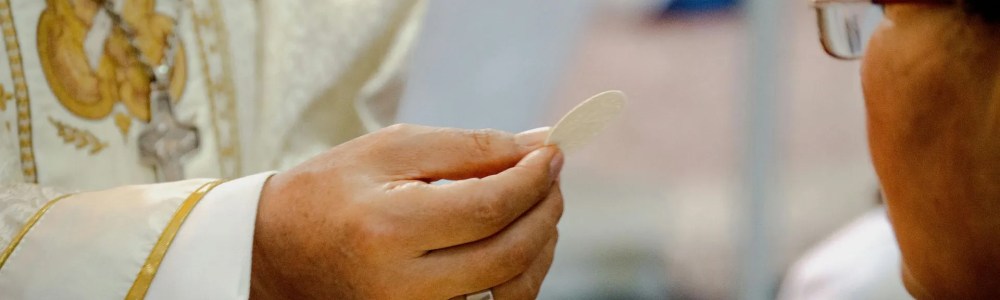
Miscellaneous Thoughts on Receiving Communion

Deacon Douglas McManaman

In the last little while, visiting a number of parishes, I have noticed that some parishioners–not many to be sure–will deliberately cross over onto another communion line in order to receive communion from the priest, as opposed to the extraordinary minister, a layman or laywoman. I inquired about this from one such person, and the reasoning, I found, had almost no coherence whatsoever. It seems to me that the very idea that one ought to receive communion from a priest and not a lay person is nothing more than liturgical snobbery. The entire Church received “holy communion” from a lay woman, namely Mary, Jesus’ own mother. That should settle the matter. But of course it doesn’t. 

Consider the optics if we were to employ Kant’s principle of universalizability to this issue. A parish priest requests help to distribute holy communion from some of the faithful, who then become extraordinary ministers of communion. The rest of the congregation, however, adopts the attitude that communion should only be received from a priest, not a laywoman or layman. The extraordinary ministers would be standing there the whole time, waiting and watching everyone line up and receive from the priest. It is safe to say that this would certainly frustrate the pastor who would like to finish the Mass at a reasonable time. 

But more to the point, is communion somehow different when it is received from the hands of a laywoman or layman? Is it less than Christ? Or, does a person receive something more, for example, a greater dignity perhaps, when he or she receives communion from a priest? If so, how does that work precisely? 

Perhaps it is about reverence, as the person I questioned insisted it is. And so, is it the case that if I wish to show greater reverence to Christ, I should receive communion from the hand of a priest as opposed to the hand of a laywoman or layman? Again, if so, how does that work? To show reverence to Christ pleases him; to show greater reverence to Christ pleases him more. And so I approach the communion minister, I bow or make some reverential gesture, receive the host and then move on, but if I were to receive from the hand of an ordained priest, somehow Christ is more pleased with me, because I’ve shown him greater reverence? I have not yet been able to figure this out, even with the help of one who insists on receiving communion only from a priest.

Moreover, “communion” means just that: “union”, not only with Christ, but with the entire worshipping community. Of course, there is diversity within that community and that should not be suppressed (diverse talents, experiences, angles on life, spiritualities, etc.), but liturgically some people insist on doing their own thing, and the result is that some are kneeling, most are standing, some receive on the tongue, and some–thankfully most–receive on the hand, some only from the priest, and some–thankfully most–from either a priest or layman/woman, whoever is available at the moment. Is it the case that some people have a need to separate themselves from the “commoners”? Whatever way we slice it, I can’t help but suspect that this is another instance of Phariseeism (from Aramaic perishayya, “separated ones”).

Christ ate with sinners and tax collectors, shared meals with them, thereby entering into a profound communion with them–given the Jewish understanding of what it means to share a meal–, thereby becoming ritually unclean in the eyes of the religious leaders, which is why they despised him. Jesus was not concerned about ritual purity, as we see from the parable of the Good Samaritan, and he despised the elitist and condescending arrogance of the Pharisees, referring to them as whitewashed tombs full of the bones of the dead and every kind of filth. His attitude appears to me to be the complete opposite of the semi-elitist attitude that insists on receiving communion from an ordained priest only, as though it were “below me” to receive from an ordinary layperson, as it was below the religious leaders to share a meal with those ignorant of the Torah. 

But I’ve been assured that this is not the sentiment. But then I am asked: Are not the priests’ hands anointed at his  Ordination? They are, but so are the hands of those who receive the anointing of the sick, and so too the heads of babies who are baptized. Confirmandi are anointed on the forehead at Confirmation. Anointing represents Christ (Gk: Christos, anointed one), and oil symbolizes strength, wealth and royalty. All of us have been anointed (in Baptism and Confirmation), and all of us share in the Royal Priesthood of the Faithful. The congregation is a congregation of priests, because Israel and the New Israel (the Church) is a “priestly people” (Exodus 19, 6). The laos (people) have been “set apart”. As our first Pope said:  “But you are a chosen people, a royal priesthood, a holy nation, a people set apart for God’s own possession, to proclaim the virtues of Him who called you out of darkness into His marvelous light” (2 Peter 2, 9). That a baby’s head has been anointed with sacred chrism, endowing that child with a new identity, namely that of priest, prophet and king, does not in any way necessitate different behaviour on the part of others towards the baby. Some will zero in on that aspect of the ordination ceremony in which a priest’s hands are anointed and deduce that this somehow suggests that we should behave differently towards him–i.e., choose his communion line–and that doing so is “more reverent towards our Lord”. Somehow his hands add something to the significance of my receiving communion, but what exactly that is, I have no idea at this point.

I cannot help but think that this is another symptom of the disease of clericalism that Francis so often spoke out against. He explicitly warned the laity not to put priests on pedestals, and yet how this decision to receive only from the hand of a priest is not an instance of just such a practice is beyond me.  

Perhaps this practice of receiving communion only from an ordained priest is a subtle but real repudiation of the layperson’s sharing in the royal priesthood of the faithful. After all, the procession begins when the faithful leave their homes to go to the Church to celebrate Mass. The formal procession at the start of the Mass is merely a continuation of the procession that the people began when leaving their houses. The offertory is precisely the offering of this priestly people, an offering of their sufferings, their labor, their treasure, etc., and it takes the form of bread and wine (the parish purchases the bread and wine out of the treasury that comes from the people). The ministerial priest offers the bread and wine on behalf of this priestly people, the congregation. Christ receives that offering and changes it into himself, returning it to us, saying: “take and eat”. The priest is merely an instrument, an unworthy instrument as Pope Benedict XVI would often remind us. It is Christ who consecrates, it is Christ who is the single priest and victim. The ministerial priest is acting in persona Christi, which means that it is really Christ who is the agent who changes the offering (bread and wine) into himself–just as it is Christ, not the priest or deacon, who gives life in baptism and infuses the theological virtues of faith, hope, and charity into the soul of the baptized, among other things. 

The function of a ministerial priest is different from the function of those who belong to the common priesthood of the faithful, but it is a function that is entirely at the service of the priestly people that is the congregation. One can certainly say that the priest is “set apart” for a specific work, and that is true, but he is set apart to serve the entire people who have been set apart from the world, who have become a holy nation, a kingdom of priests. The significance of his vocation cannot be understood apart from this community. In other words, his priestly function cannot be understood except within the larger context of the priestly nature of the community. I’m reminded of Pius X, when people were kissing his papal ring, his mother said to him: “Keep in mind that you wouldn’t be wearing that ring if it were not for this ring here” (pointing to her wedding ring). The ministerial priest is “set apart” to act on behalf of the priestly congregation, which is “a people set apart”. 

Peter himself gives us a clue to the resolution of this issue: “As Peter was about to enter, Cornelius met him and fell at his feet to worship him. But Peter helped him up. “Stand up,” he said, “I am only a man myself” (Acts 10, 26).

Some people look upon the clergy not as lowly common servants (feet washers), but as members of the British Royal Family, as it were, and within such a mindset, one will only hear the gospel within the framework of an old monarchical ecclesiology, which keeps a person from understanding the gospel’s radical nature.  

I’ve tried to understand this issue from various angles, but the reasoning continues to make as much sense to me as a person who believes, deep within his heart, that eating potato chips is an offence to koala bears, so instead he chooses to eat corn chips. 

Have Mercy On Me, A Sinner

Homily for the 30th Sunday in Ordinary Time
Deacon Douglas McManaman

My ministry as a deacon is to the sick, especially those who suffer from mental illness. I remember visiting a patient many years ago in the mental health unit of a hospital, and I recall very clearly that he was telling me that he “feels” horrible about himself. He also has thoughts running through his head that he cannot control or get rid of, and these thoughts cause him to feel horrible about himself, that he is twisted, unclean and tainted. At that moment, something occurred to me. I said: “I was talking to my students about Aristotle today, something he said in his Nicomachean Ethics: You are not what you feel, and you are not what you think. In other words, the opinions you hold do not define your character. Rather, you are what you will. Your character is determined by what you will to be. So you may feel that you are a horrible person, and you may have all sorts of thoughts running through your head that you cannot control, thoughts that suggest you are a terrible human being, but you are what you will. So, what do you want to be? The answer to that question will tell you who you really are. 

Well, I did not expect those words to have had an impact on him, but his eyes opened wide. He was delighted to hear that. God sees right into the heart, that is, he knows what constitutes your deepest desire, and so he knows who you really are, even if the rest of us do not. And since this patient desperately wants to be something completely other than what he feels himself to be and what he thinks himself to be, then he is profoundly good.

I never saw him again after that, but a couple of months later I received a card, a thank you note. It was from this patient; that was the first and last time I ever received a thank you note from a hospital patient. That simple ancient insight made all the difference in the world to him.

The tax collector in today’s gospel reminded me of this patient of mine. He felt horrible about himself, but his deepest desire was revealed in his prayer: “Lord, have mercy on me, a sinner”.

When the sun comes out and its rays penetrate through a window, we see how dirty the window really is, the spots, the grime and dirt, etc., but at night time, we don’t see those spots, for they are not visible. At night, the window looks clean. But of course it isn’t; it’s dirty, which we can only see during the day when the rays of light penetrate through the window. So too, God is light from light, as we say in the creed, and when God draws us close to himself, we see our spots, the grime and dirt. If we are not close to God, then we are in the dark, and the result is we cannot see our own dirt, grime and spots. Instead, we believe that we are clean, and we feel good about ourselves, and then it is much easier to look with contempt upon another. 

The Pharisee saw himself as okay; he was very pleased with himself. He had no shame in the presence of God, no sense of having fallen short in any way, because for the Pharisee, holiness is about religious works: “I fast twice a week and give a tenth of my income”, he said. But we are not saved by the works of the law, as Paul says. He writes: “For by grace you have been saved through faith, and this is not from you; it is the gift of God; it is not from works, so no one may boast.” (Eph 2, 8) The tax collector, on the other hand, saw nothing but his own sins: “God, be merciful to me, a sinner”. And that’s why the tax collector went down to his home justified. It was the light of divine grace that allowed him to recognize his own sinfulness. He had no contempt for others, only contempt for himself. 

Holiness is charity. Holiness is love. What we see in the Pharisees is sanctimony, which is a false holiness. In the Parable of the Last Judgment, the Son of Man does not say to us: “You did not genuflect properly; you didn’t dress properly for Mass; you weren’t reverent enough”, etc.,. No, he’s going to say “I was hungry and you gave me something to eat, thirsty and you gave me something to drink, lonely and you visited me”, and so on. That’s reverence. Jesus berated the Pharisees for desiring seats of honor and delighting in titles and having people fawn all over them. We are going to be judged on how we serve those who are forgotten, those who have no importance, no social standing. That’s holiness; that’s genuine religion. The reason is that this is precisely where Jesus hides himself, as Mother Teresa would always say. Jesus disguises himself in the poor and the neglected. But century after century, Christians like to forget this and instead busy themselves with all sorts of piety. But piety, if it is genuine, will allow us to see and recognize Jesus in his various disguises. And if we truly love him, we will develop the ability to notice him in those who are forgotten and neglected, and we will love him in those who do not love themselves, who do not delight in themselves, but who doubt themselves and would never think to compare themselves to others.