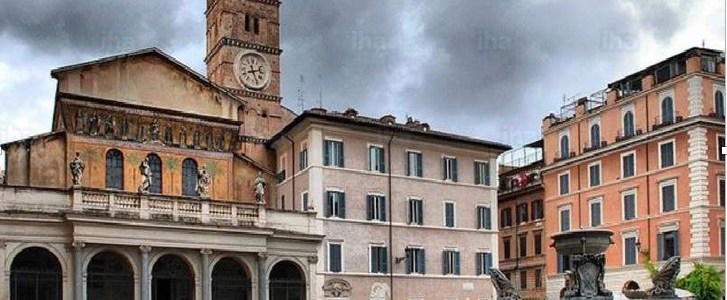
Thoughts on the Trastevere
I have a picture of the piazza di Santa Maria, which is in the heart of the Trastevere (Rome), on my computer. I am familiar with this piazza, I’ve been there a number of times. In fact, if one were to drop me off anywhere in Rome, I would be able to find my way there. I’ve been inside the Basilica di Santa Maria, in Trastevere, which is one of the most beautiful Churches in Rome. So when I gaze at this picture, I think back to the time I spent there.
Each time I gaze at the picture, however, I notice a detail or two that I did not notice while there. There is so much about this small area that I was not explicitly aware of. I often gaze at the apartments surrounding the piazza; I was not aware of the number of apartments there are–in fact, I still don’t really know, I haven’t counted–, nor do I know who owns those apartments, whether they are rented out or not. I do not know the apartments from within, I’ve never been inside them, and I don’t know the occupants, what they do, where they came from, I don’t know the two restaurants on the street level, I’ve never eaten there, nor have I worked there, so I don’t know the employees or the owner, what it is like to work there every night, etc., I don’t know what kind of plants are in the pots, nor do I know anything about the architecture of those buildings, how they were designed, nor the kind of drywall used for the interior, I do not know the kinds of materials used on the outside of the apartments, I do not know about the wiring (the quality of wire used, nor how the building was and is now wired, whether or not it has changed, etc.), nor do I know anything about the plumbing (the kind of metal pipe used, the plans for the plumbing), etc. I have been inside the Church, but there is so much to know about the interior, such as the ceiling and when it was built, the art, who produced it and when, the floor of the Church, who designed it and when and under what circumstances; I do not know about the geological features below the ground on that small piazza. In short, there is so much about the history of that piazza that I am unaware of and will always be unaware of; there is a veritable cognitive inexhaustibility about that little place that I am, nevertheless, familiar with. I could spend more time there and if I did so, my understanding of it would gradually increase, especially if I had access to a historian, a geologist, an architect, and a carpenter perhaps. After a time, I would very likely not look at that piazza the same way again, just as we do not look at anything we come to know more fully the same way as we did initially.
The world is like that; science is like that. In the 1950s, we had no idea that there was so much more to the cell than what we thought at the time, i.e., a membrane, a nucleus, protoplasm, etc. We now appreciate that the complexity of a cell far exceeds that of a computer. How much more is there to the physics of a simple water molecule than what most of us currently know about water? How much more is this true of human nature? Consider what cognitive psychology has discovered about the epistemic conditions that are behind the day to day judgments we make, almost entirely unaware of the influences that have shaped those judgments? I know what I know, but I tend not to be aware of how much I do not know and how much more there is to know about the very things I know. I can make myself aware of it to some degree as I have done here, but the details will always escape me, for if I understood the extent and the details, I would not be ignorant of them. I can only know my ignorance generally.
The same is true of people. How much about these students before me do I not know? How much more is there to know about them?
Now all these new pieces of information that are gradually acquired as my experience is enlarged are data, as it were, that become part of the limited set of data we already have, on the basis of which we draw our conclusions about the real. I come to a conclusion about the student in front of me (or any person, for that matter) or the city I’ve been to twice, etc., on the basis of the evidence I have up to this point, that is, the data, the theses that constitute the set I now possess. I draw a conclusion about this person, or about Italy, the Trastevere, the food, etc., on the basis of the data I have acquired. New data might corroborate a judgment, it might enrich it, but new data may also render my current set of data internally inconsistent, which in turn affects the plausibility of the data I have. In other words, some theses will have to be dropped, for their plausibility has been drastically reduced. I have to adjust, that is, accommodate the new data, throw out certain theses, etc. For example, I may learn that this student before me is actually abusive to her parent, or I may become aware that he has autism spectrum disorder, etc. Or, thinking back to the piazza di Santa Maria, I may say to myself: I’d love to live here in one of these apartments. But with further data, I may change my mind. I look at those apartments now and certain feelings of nostalgia arise, but after years of acquiring new data (perhaps as a result of living there), that may change. I may become completely indifferent to this place; I may never want to see it again. Sometimes ignorance is bliss; for if I am ignorant, I can imagine anything I want about this place, i.e., a life that is exhilarating, but in the end the product of my imagination is unreal.
Think of growing up in a white, American, Catholic/Protestant world. The Sikh, the Hindu, the Muslim, etc., all come across as foreign. I don’t know what they believe, how they think, but they do dress differently, their symbols are different, they don’t eat the same kinds of foods. Initially at least, they appear as strange; they are an enigma. The usual course of action is to react defensively: I remind myself what it is we believe, that we see the world as it really is, that our way is right, it is the norm, and they are not part of that norm; I tend to think they should assimilate to our way of life, or way of dress and way of thinking, eating, etc. The unknown can give rise to fear. But as we come to know them, as we begin to live with them day in and day out, we begin to understand one another. Fear begins to subside, and they are not so foreign anymore; we realize that they are in many ways just like us. And they too looked at us as foreign, and they have or had the same defensive reaction. The world as they see it makes sense to them, it is right not just to them, but absolutely, and in their minds perhaps, we are the ones who have to assimilate. In other words, they can be just as dogmatic as we are. But this new encounter enriches us both with new information, and so it can enlarge our cognitive frame of mind. It is a real personal encounter that provides this new data, which may corroborate or render inconsistent the set of data we already possess and through which we see and interpret the real.
This epistemic process involved in plausible reasoning takes place within the realm of theological science as well–how could it not? There is so much about my Sikh brother that I don’t know about, and there is so much about me he does not know about, and as Socrates pointed out, there is so much about me that I don’t know about, and as the Old Testament makes clear there is so much about God that I don’t know about; as a Christian, there is so much about Christ that I don’t know about. Indeed, I can say with St. Paul that Christ lives in me and I live in him, but how much more is there to know about him? The knowledge I refer to here is connaitre, the French verb for connatural knowledge, the kind we possess for those close to us. The more I love someone, the more I enter into a kind of union with that person, and the result is the more I know him. Do I really believe my love for Christ is adequate? And so isn’t the same epistemic process at work in my knowledge of Christ? Isn’t the same process at work in a Muslim’s knowledge of Allah or a Jew’s knowledge of G_d? And, could further data upset the applecart of my own set of data, my own limited cognitive framework? Of course it can and it will, in due time. My conclusions are tentative because they are not strictly deductive; they are a matter of coherence. They are maximally plausible on the basis of the theses I have at my disposal. But the plausibility of these theses may change with further data. We see this type of growth and development–sometimes revolutionary–throughout the history of the Church. If the 10th or 14th century Church were to look into a crystal ball and see the Church in the 21st century, with its expanded understanding of human rights, the right to freedom of speech, our post-Vatican II ecumenism or pastoral approach to human beings, our understanding of the separation of Church and state, perhaps the way people dress, etc., would she be scandalized?




 A Catholic Philosophy and Theology Resource Page by Deacon Douglas McManaman