Creative and Destructive Conflict
Deacon Douglas McManaman
Also published at https://www.lifeissues.net/writers/mcm/mcm_422creativedestructiveconflict.html
The kiln tests the potter’s vessels; so the test of the just person is in tribulation.
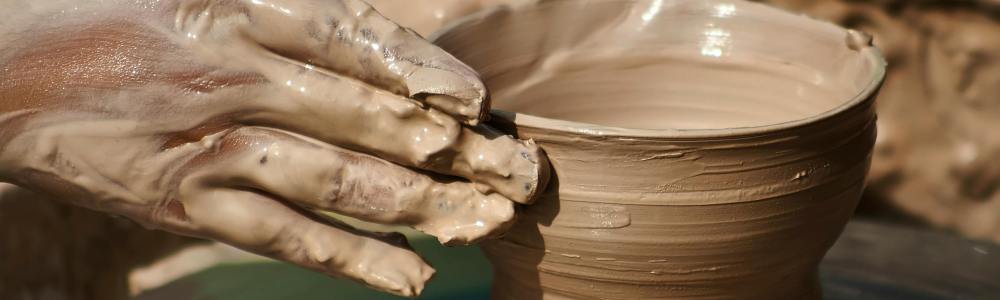
A kiln is a furnace that dries out the potter’s clay and actually transforms it into a beautiful ceramic piece. We can’t use a clay bowl or cup that has not been in the kiln; it would fall apart, for it would be too soft. And of course, we are the clay, as we read in Isaiah, “Yet, Lord, you are our father; we are the clay and you our potter: we are all the work of your hand” (Is 64, 8). And so it follows that trials, sufferings, difficulties, are part and parcel of the spiritual life.
I have found over the years that the vast majority of people mistakenly believe that religious life, life in the Church, life in Christ, the devout life, is supposed to be a life of peace and tranquility, like the quiet of a cemetery, where everything works out smoothly and without a glitch. And so when things go awry, we tend to see this as an anomaly, that something is wrong, that if we are right with God, life should proceed without a struggle. But this is a serious misconception. Life is essentially conflict, because it is movement, and all motion is at some level a struggle. Anyone who has studied evolutionary biology knows this. There is no such thing as life without conflict and struggle.
There are, however, two kinds of conflict: destructive conflict and creative conflict. Sports (play) is essentially conflict and struggle, but it is an enjoyable one because it is essentially creative. Art is a matter of creative conflict, a battle between the sculptor and the resistance of the marble that he is about to carve into a beautiful figure. A life without creative conflict becomes intolerably dull and meaningless. In fact, heaven will be an eternity of creative conflict. Hadewijch of Antwerp writes:
God will grace you to love God with that limitless Love God loves himself with, the Love through which God satisfies himself eternally and forever. With this Love, the heavenly spirits strive to satisfy God: this is their task that can never be accomplished and the lack of this fruition is their supreme fruition” (Love is Everything: A Year with Hadewijch of Antwerp, trans. Andrew Harvey, May 1st).
“Peace” and “rest” are not opposites of conflict, that is, heaven is not a life without obstacles and things to achieve.
It is destructive conflict that is the problem. However, God joined a human nature, he joined himself to our humanity, and in doing so he entered into the destructive conflict that human sin has brought about in the world. The victory of that destructive conflict is death, which without Christ has the final word over our lives. But Christ came to die, to enter into our death, to inject it with his divine life, to destroy the power of death, to rise from the dead. He was victorious over death, and so he overcame the struggle of human existence, the battle against destructive conflict.
Christ transformed the destructive conflict of death and sin in all its various instances into a matter of creative conflict, a matter of play, as it were: “When he set for the sea its limit, so that the waters should not transgress his command; When he fixed the foundations of earth, then was I beside him as artisan; I was his delight day by day, playing before him all the while, playing over the whole of his earth, having my delight with human beings” (Prov 8, 29-31). We can now share in his victory over both sin and death. He offers us his own humanity so that we might overcome our own life struggles with his strength: “I can do all things in him who strengthens me” (Phil 4, 13). The kiln that dries out all our moisture (disordered love of self) and in time transforms us into something beautiful is the particular difficulties and struggles that we have to contend with in our lives. And some people have greater struggles than others; the heat of the kiln is much hotter in their lives, and perhaps they have been in it for much longer than the rest of us. But the result is a more beautiful product from the hand of the potter. It is not the case that God wills that certain people suffer illness or tragedy; rather, God the Son joined himself to a human nature in order to draw very close to us in our suffering and trials, to give us his divine life that we might overcome the world and its conflicts with him and through him, that we might share in the joy of his victory. The greater the struggle, the greater the victory, and the greater will be the joy in that victory.
This, I believe, is the key to unlocking today’s gospel: “Can a blind person guide a blind person?…Why do you see the speck in your neighbour’s eye, but do not notice the log in your own eye?…first take the log out of your own eye, and then you will see clearly to take the speck out of your neighbour’s eye”. The spiritual life is a long and difficult road, a slow process of gradual enlightenment. I don’t know about you, but I do not like looking back at my life and being reminded of what I was back then, because I see my blindness. And of course, the blind cannot lead the blind. But the blind are leading the blind all the time. Even great saints had their blind spots. Study the history of the Church without triumphalist blinders: stupidity, arrogance, sin, oppression, envy, violence, lust for power, control, avarice, etc, is everywhere in our history. We have had great popes who did great things as well as some outrageous things; made great decisions as well as terrible decisions that were very destructive and whose repercussions are still with us today in many ways. It is a real mixture. But that’s life in the Church, as well as the life of the individual person in a state of grace. The spiritual life is conflict, a struggle, a struggle against our own blindness and propensity to sin and self seeking as well as the blindness of others and its repercussions.
But before we can take it upon ourselves to correct others, we have to spend years in the kiln, in the furnace, allowing the fire of the divine love to change us so that we may remove the plank from our eye. Recently I asked my Confirmation class about the graces they are going to receive from God upon their Confirmation, specifically the grace of mission.
“You are going to be sent on a mission; but to do what?” I asked them.
One good candidate put up his hand and said:
“To proclaim the gospel”. And of course, that’s a great answer.
“But how are you going to do that?”
“Preach”, he said.
Well, the problem is you’ll lose friends quickly. If you want to be friendless, start preaching to them. If parents want to drive their kids from the church, start preaching. The way to proclaim the gospel is by the very life you lead. The gospel is the good news of Christ’s victory over death, his resurrection. We don’t need to use words. We just need to be a person who lives in the joy of Easter, a person who has the hope of eternal life, a person who is not overcome by life’s tragedies, because we believe that Christ has overcome the world and conquered death. Others will see that in us, by how we react to life’s difficulties and struggles, even life’s tragedies–that we have risen above them in the joy of the risen Christ.
 A Catholic Philosophy and Theology Resource Page by Deacon Douglas McManaman