Miscellaneous Thoughts on Receiving Communion
Deacon Douglas McManaman
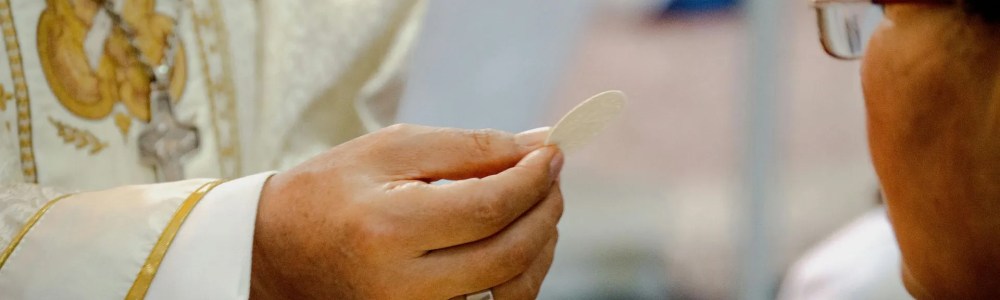
In the last little while, visiting a number of parishes, I have noticed that some parishioners–not many to be sure–will deliberately cross over onto another communion line in order to receive communion from the priest, as opposed to the extraordinary minister, a layman or laywoman. I inquired about this from one such person, and the reasoning, I found, had almost no coherence whatsoever. It seems to me that the very idea that one ought to receive communion from a priest and not a lay person is nothing more than liturgical snobbery. The entire Church received “holy communion” from a lay woman, namely Mary, Jesus’ own mother. That should settle the matter. But of course it doesn’t.
Consider the optics if we were to employ Kant’s principle of universalizability to this issue. A parish priest requests help to distribute holy communion from some of the faithful, who then become extraordinary ministers of communion. The rest of the congregation, however, adopts the attitude that communion should only be received from a priest, not a laywoman or layman. The extraordinary ministers would be standing there the whole time, waiting and watching everyone line up and receive from the priest. It is safe to say that this would certainly frustrate the pastor who would like to finish the Mass at a reasonable time.
But more to the point, is communion somehow different when it is received from the hands of a laywoman or layman? Is it less than Christ? Or, does a person receive something more, for example, a greater dignity perhaps, when he or she receives communion from a priest? If so, how does that work precisely?
Perhaps it is about reverence, as the person I questioned insisted it is. And so, is it the case that if I wish to show greater reverence to Christ, I should receive communion from the hand of a priest as opposed to the hand of a laywoman or layman? Again, if so, how does that work? To show reverence to Christ pleases him; to show greater reverence to Christ pleases him more. And so I approach the communion minister, I bow or make some reverential gesture, receive the host and then move on, but if I were to receive from the hand of an ordained priest, somehow Christ is more pleased with me, because I’ve shown him greater reverence? I have not yet been able to figure this out, even with the help of one who insists on receiving communion only from a priest.
Moreover, “communion” means just that: “union”, not only with Christ, but with the entire worshipping community. Of course, there is diversity within that community and that should not be suppressed (diverse talents, experiences, angles on life, spiritualities, etc.), but liturgically some people insist on doing their own thing, and the result is that some are kneeling, most are standing, some receive on the tongue, and some–thankfully most–receive on the hand, some only from the priest, and some–thankfully most–from either a priest or layman/woman, whoever is available at the moment. Is it the case that some people have a need to separate themselves from the “commoners”? Whatever way we slice it, I can’t help but suspect that this is another instance of Phariseeism (from Aramaic perishayya, “separated ones”).
Christ ate with sinners and tax collectors, shared meals with them, thereby entering into a profound communion with them–given the Jewish understanding of what it means to share a meal–, thereby becoming ritually unclean in the eyes of the religious leaders, which is why they despised him. Jesus was not concerned about ritual purity, as we see from the parable of the Good Samaritan, and he despised the elitist and condescending arrogance of the Pharisees, referring to them as whitewashed tombs full of the bones of the dead and every kind of filth. His attitude appears to me to be the complete opposite of the semi-elitist attitude that insists on receiving communion from an ordained priest only, as though it were “below me” to receive from an ordinary layperson, as it was below the religious leaders to share a meal with those ignorant of the Torah.
But I’ve been assured that this is not the sentiment. But then I am asked: Are not the priests’ hands anointed at his Ordination? They are, but so are the hands of those who receive the anointing of the sick, and so too the heads of babies who are baptized. Confirmandi are anointed on the forehead at Confirmation. Anointing represents Christ (Gk: Christos, anointed one), and oil symbolizes strength, wealth and royalty. All of us have been anointed (in Baptism and Confirmation), and all of us share in the Royal Priesthood of the Faithful. The congregation is a congregation of priests, because Israel and the New Israel (the Church) is a “priestly people” (Exodus 19, 6). The laos (people) have been “set apart”. As our first Pope said: “But you are a chosen people, a royal priesthood, a holy nation, a people set apart for God’s own possession, to proclaim the virtues of Him who called you out of darkness into His marvelous light” (2 Peter 2, 9). That a baby’s head has been anointed with sacred chrism, endowing that child with a new identity, namely that of priest, prophet and king, does not in any way necessitate different behaviour on the part of others towards the baby. Some will zero in on that aspect of the ordination ceremony in which a priest’s hands are anointed and deduce that this somehow suggests that we should behave differently towards him–i.e., choose his communion line–and that doing so is “more reverent towards our Lord”. Somehow his hands add something to the significance of my receiving communion, but what exactly that is, I have no idea at this point.
I cannot help but think that this is another symptom of the disease of clericalism that Francis so often spoke out against. He explicitly warned the laity not to put priests on pedestals, and yet how this decision to receive only from the hand of a priest is not an instance of just such a practice is beyond me.
Perhaps this practice of receiving communion only from an ordained priest is a subtle but real repudiation of the layperson’s sharing in the royal priesthood of the faithful. After all, the procession begins when the faithful leave their homes to go to the Church to celebrate Mass. The formal procession at the start of the Mass is merely a continuation of the procession that the people began when leaving their houses. The offertory is precisely the offering of this priestly people, an offering of their sufferings, their labor, their treasure, etc., and it takes the form of bread and wine (the parish purchases the bread and wine out of the treasury that comes from the people). The ministerial priest offers the bread and wine on behalf of this priestly people, the congregation. Christ receives that offering and changes it into himself, returning it to us, saying: “take and eat”. The priest is merely an instrument, an unworthy instrument as Pope Benedict XVI would often remind us. It is Christ who consecrates, it is Christ who is the single priest and victim. The ministerial priest is acting in persona Christi, which means that it is really Christ who is the agent who changes the offering (bread and wine) into himself–just as it is Christ, not the priest or deacon, who gives life in baptism and infuses the theological virtues of faith, hope, and charity into the soul of the baptized, among other things.
The function of a ministerial priest is different from the function of those who belong to the common priesthood of the faithful, but it is a function that is entirely at the service of the priestly people that is the congregation. One can certainly say that the priest is “set apart” for a specific work, and that is true, but he is set apart to serve the entire people who have been set apart from the world, who have become a holy nation, a kingdom of priests. The significance of his vocation cannot be understood apart from this community. In other words, his priestly function cannot be understood except within the larger context of the priestly nature of the community. I’m reminded of Pius X, when people were kissing his papal ring, his mother said to him: “Keep in mind that you wouldn’t be wearing that ring if it were not for this ring here” (pointing to her wedding ring). The ministerial priest is “set apart” to act on behalf of the priestly congregation, which is “a people set apart”.
Peter himself gives us a clue to the resolution of this issue: “As Peter was about to enter, Cornelius met him and fell at his feet to worship him. But Peter helped him up. “Stand up,” he said, “I am only a man myself” (Acts 10, 26).
Some people look upon the clergy not as lowly common servants (feet washers), but as members of the British Royal Family, as it were, and within such a mindset, one will only hear the gospel within the framework of an old monarchical ecclesiology, which keeps a person from understanding the gospel’s radical nature.
I’ve tried to understand this issue from various angles, but the reasoning continues to make as much sense to me as a person who believes, deep within his heart, that eating potato chips is an offence to koala bears, so instead he chooses to eat corn chips.
 A Catholic Philosophy and Theology Resource Page by Deacon Douglas McManaman