Religion and Relationship
Reflection for the 3rd Sunday of Lent
Deacon Douglas McManaman
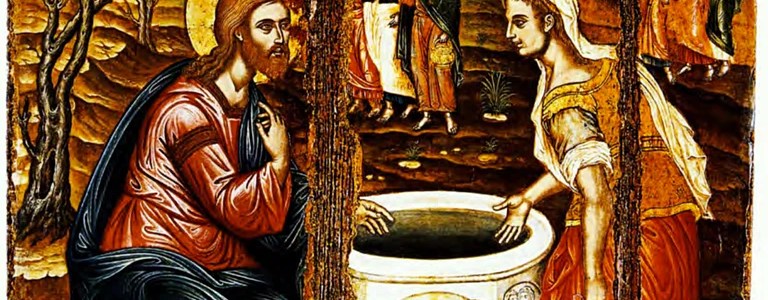
That Jesus is speaking to a Samaritan woman is quite radical; for Jews had no dealings with Samaritans. Pious Jews were known to take long detours rather than walk through Samaria. It was unheard of for a Jewish man to speak with a woman in public, especially a Samaritan woman, and the disciples marveled (ethaumasan) that Jesus was speaking to her. Moreover, that Jesus was asking her for a drink was also quite radical–he was willing to use her vessel from which to drink, which would have rendered him ritually unclean. Also, he did not condemn her, knowing that she was married five times and was currently living with a man who was not her husband, but he chose to relate to her anyways, to communicate and actually drink from her container. As we can see, Jesus was not very orthodox by Jewish standards. Relationship is more important than law–i.e., the Sabbath was made for man, not man for the Sabbath (Mk 2, 27).
But what’s particularly interesting about this conversation with the Samaritan woman is the change that took place in her during the course of it. She goes from calling Jesus “Sir”, to calling him a prophet, to becoming a witness to the Samaritan villagers that he is the Messiah, and finally, the townspeople go from believing in him on the basis of her testimony to believing in him through their own personal experience of Jesus, professing him as Saviour of the world (Sir, prophet, Messiah, Saviour of the World). And this was all due to Jesus’ decision to enter into relationship with this woman, to do something contrary to religious custom, to actually communicate with her as a human being with inherent dignity. And this was typical of Jesus—after all, he entrusted the good news of the resurrection to Mary Magdalene, chose her to be the first person sent to deliver the good news of the resurrection to the rest of the disciples. His was a very unique and revolutionary way of seeing women. Incidentally, the woman at the well is venerated as Saint Photina. She was martyred under Nero, and her name means enlightened one or “shining”, which calls attention to her missionary work, bringing the light of the Gospel to those in Smyrna and Carthage. In the Eastern rite, she is venerated with the rare title “Equal to the Apostles” (Isapostolos).
But most importantly, this gospel shows clearly that true religion is not primarily about law; it is about relationship first and foremost. Both words (religion and relationship) are from the Latin religare, which means “to bind fast”. Jesus desires to enter into relationship with this woman, to give her the living water of his own divinity, but he asks that she give him the water of her humanity. That is the exchange he offers each one of us: “I will give you my divinity if you give me your humanity”, to be divinized, deified (theosis), filled with the life of grace, sharers in the divine life.
For every desire we have in our lives is ultimately a desire for God. Nothing in this world can satisfy the human heart, which is restless and is always in search of rest. The problem is that the human heart’s thirst is infinite, and nothing in this contingent universe can bring it rest, nothing except God alone. St. Augustine said it on the first page of his Confessions: “O Lord, you made us for yourself, and our hearts are restless until they rest in You”. God became flesh so that we could make our way back to God in the Person of Christ. He is the living water that alone brings rest to the human heart. For most people, it takes a lifetime to finally learn this.
I mentioned in a previous reflection that a patient I was visiting in the hospital told me about a certain person who owns a 165-million-dollar estate; this patient was utterly dismayed that someone would spend so much on himself. Later in the day I decided to do a “fact check”, and indeed he does own a 165-million-dollar estate, but that’s not all; he has three other estates in Florida, all three totaling 230 million, another property in Hawaii at 78 million, another in Washington for 23 million, and some apartments in New York City totaling 80 million. It is a strange phenomenon that the more wealth we acquire, the greater our desire for more. One would think that greater wealth would be accompanied by a corresponding decrease in desire, that one is gradually reaching the point at which one no longer feels the need for more, but it seems the opposite happens; the more wealth we acquire, the desire for more continues to increase, as if we are becoming poorer. It’s as if the heart rebels against us by desiring more, as if to tell us that we’re on the wrong track.
St. Augustine says later on in the Confessions: “O You Omnipotent Good, You care for every one of us as if you care for him only, and so for all as if they were but one!” (3.11.19). This life is about coming to know that love intimately, not just in our heads, but knowing it by experience.
There’s a wonderful story of a San Francisco physician who had a friend do some house sitting for him while he was away on vacation. When he returned, he found his friend sitting on the stairs, staring out into space. As he approached him to see if he was ok, his friend stood up, screaming, and he began hitting the doctor with a tennis racquet. The doctor lost consciousness, but when he came to, his friend had a dagger; he tried to fight him off, but he was overpowered. He then saw a hallway filled with light, and he said the love coming from this light was utterly overwhelming. He said it was so overwhelming that “this life must have something to do with learning to love like that”. But then he corrected himself: “Rather, this life must have something to do with learning to be loved like that, to allow yourself to be loved by this light”. He then adds that if anyone you know died in horrible circumstances like this, “if my experience is any indication, they did not die alone; they died in a sea of love around them”.
Sin takes on a whole new meaning for us when we have personally experienced the love that God has for us. At that point, religion is no longer a matter of observing rules, and sin is no longer the violation of a law; rather, it is the rupture of a relationship. I remember the first change that took place in me when I returned to my faith as a teenager, after having had a very personal experience of God’s intervention in my life, was that I could no longer take the Lord’s name in vain, which was habitual for me at the time. I became aware that I had God’s undivided attention at every instant of the day; I was in relationship with a Person and my actions affected this Person.
To get to that point, we have to pay attention to what God is doing in our lives, individually, in my life, your life, the particular ways that God is showing you that He loves you, that he is paying attention to you, giving you his undivided attention, to become more aware of the blessings he pours out upon us at every moment, that is, allow ourselves to be loved by him and allow that love to awaken us and bring us to life. Then we begin to taste a tiny portion of the joy of heaven, for that experience is very much like finding a great treasure in a field, and we will be ready and willing to give up everything in order to purchase that field so as to never lose that treasure.
 A Catholic Philosophy and Theology Resource Page by Deacon Douglas McManaman