Thoughts on God as Pure Act of Being and Atheism

Deacon D. McManaman

God is pure act of existence. But what does this mean?  I can look at you and form a concept, an idea of what you are. In other words, I grasp something of your nature, i.e., you are a human kind of being, you have size and affective qualities, you have certain abilities and potentialities very similar and different from other kinds of beings. But I also apprehend that you exist, which is a different apprehension than the first (the apprehension of the kind of being you are). Your existence is intelligible, but I cannot form a concept of it–as I can form a concept of your nature, the kind of person you are. You are a certain kind of being that “has an act of existence”, but existence does not belong to your nature. Existence is an “act” that you have, while “human”, for example, is “what” you are (not what you have). The key point here is that your existence is not a concept; it is, nonetheless, intelligible. 

God is not a composite of essence and existence (as are you), rather, his essence is to exist. He does not “have” existence; rather, he is his own act of existing. And so God is intelligible, but we cannot form a concept or idea of God. And because God is pure act of existence, he is pure goodness and beauty, because goodness and beauty are properties of being. 

And so we need to be careful with confusing the worship of God with the worship of a conceptual framework. As pure act of being, God is intimately present to whatever has existence; God is more intimately present to you than you are to you. Being is the most interior aspect of a thing, and so God, who is the first existential and preservative cause of your being, is, of all that is within you, the most interior. How you relate to God, who is goodness itself and beauty itself, is not always clear to you, certainly not immediately clear. It becomes increasingly manifest in your dealings with other goods, such as human goods or human persons. 

The atheist typically rejects a conceptual framework, as opposed to God himself. Even the use of “himself” is dangerous because it brings God into a conceptual circle. This is not to say that it is false, but it can be misleading. God is in many ways “himself” and “herself” and infinitely more, while at the same time God is absolutely simple, for there is nothing simpler than “being itself”. 

And so when someone says he or she is an “atheist”, we have to ask what that means precisely. It very often does not mean that God is rejected–especially if the atheist has a degree of wisdom. It is usually a conceptual framework that is rejected, for a variety of reasons. The good news is that God is not a concept. God is intelligible, infinitely knowable, and incomprehensible. We believe he revealed himself in history, and this is where the construction of an elaborate conceptual framework begins, but this religious conceptual frame of mind, although not necessarily false, is always subject to reform and constant editing. God, however, is always infinitely larger than this religious conceptual framework. That is why openness to and dialogue with other religions and denominations is of the utmost importance. 

Fear and Primitive Reasoning

Deacon Douglas McManaman

Be strong, do not fear! Here is your God (Is 35, 4)

So much of what goes wrong in the world has its roots in fear. And there is so much about this world today that gives rise to fear; but this life is really about learning to depend upon God, that is, learning to fear less (fearless), and the way to do that is first to become increasingly aware that independence is relative and ultimately an illusion, and that we depend on God ultimately, and second to actually begin to rely on God. We certainly depend on one another, but ultimately everyone depends on God. And the more we surrender our lives to God, the more we learn through our own experience that God really is intimately involved in everything that happens to us and that nothing happens outside of his providential control. However, although human beings really do make a mess out of their lives when they take matters into their own hands instead of relying on God, they are still wrapped up and surrounded by God’s providence.  

My spiritual director would always say to me: “Fear is useless, what is needed is trust”. And fear is useless, at least fear without trust, because we all experience our radical limitations, but without trust we are tempted to cross those limits, that is, moral limits, and then we do things that we know to be wrong, like lying under oath, or stealing, or undermining the reputation of another, plotting to bring others down, etc. We make every effort to create an environment that is safe for ourselves, and this soon becomes a machination process in which we are willing to sideline those who get in our way. That injustice generates resentment in others, and such wounds can stay with a person all throughout his or her life. And soon everybody is carrying around a soul riddled with bullet holes, and the result is that we only think of ourselves, sort of like having a toothache–you can’t think of anything other than your own pain. 

But God does allow suffering into our lives. He does not impose it on us, but He does allow it; for suffering is the opportunity God gives us to depend on Him, to trust Him more fully, to place ourselves in His hands. When we do, we can be assured that he will act, but God does tend to “take his time”, not our time. And so, we have to be patient. That’s the problem with living in a fast-paced society–we are disposed to want things done quickly, and that just does not happen with God. The reason is that love is patient, and God is love, and he calls us to be patient: “Be patient, therefore, brothers, until the coming of the Lord. See how the farmer waits for the precious fruit of the earth, being patient with it until it receives the early and the late rains” (Jm 5, 7).  Suffering and moments of darkness are symbolized here by the image of early and late rains–there is no “precious fruit of the earth” without that suffering. 

In my experience, most people, even religious people, believe that suffering, hardship, and struggles are anomalies. Religious people in particular often assume that if we have a relationship with God, all will be smooth and relatively easy, so that if suffering enters our life, that must mean that our relationship with God has somehow been broken by something we did, some sin that we committed. This is how Israel interpreted her own suffering and hardship on a national level; on an individual level, it was assumed that those who were poor, lame, deaf or blind, etc., were forsaken by God by virtue of some ancestral or personal sin. This is a primitive way of trying to make sense out of suffering. Jesus, however, challenged this in the gospel of John: “As he passed by he saw a man blind from birth. His disciples asked him, ‘Rabbi, who sinned, this man or his parents, that he was born blind?’ Jesus answered, ‘Neither he nor his parents sinned; it is so that the works of God might be made visible through him’” (Jn 9, 1-3).

Unfortunately, many people still tend to think this way, because they want to make sense out of suffering, and if I can convince myself that a person is suffering because of something sinful he has done, well then I don’t feel so bad–on some level I convince myself that he deserves it. If we carefully read the book of Job, we see that Job’s friends were reasoning precisely along these lines, which is why in the end God rebuked them for this (See Jb 42, 7-9).  

We have to be very careful with this kind of reasoning, which is still rather prevalent. Some people take many sections of the Old Testament literally and believe that God does in fact destroy otherwise innocent people (i.e., Amalekite children, David’s infant son, etc.) as a punishment for the sins committed by others. We have to keep in mind that Israel, in her infancy, thought as a child does, namely, egocentrically: if something bad is happening to a child, for example, if the child is being abused by a parent, or the child’s parents are going through a separation and divorce, that child believes this is all happening because “I am bad”. It takes years for a person to escape from this mythology–and he or she may need help (a trained therapist) to overcome such harmful and subconscious beliefs, otherwise they may carry that conviction into their adult lives, feeling and believing on some level that they are deeply flawed, and without knowing why. Such people typically carry around a great deal of anger. We see precisely this kind of thinking on a national level in the Hebrew Scriptures, but Israel is a nation in history, a nation that through time grew in her understanding of God as a result of that historical relationship. The way Israel thinks about herself and God later in her history is very different from the way she thought earlier.

However, God reveals his true face in the Incarnation of the Son, that is, in the Person of Christ. God’s response to human sin was pure grace. He does not impose suffering but enters into human suffering, for he joined a human nature to himself and entered into our darkness, so that when we suffer, we may find him in the midst of that suffering. He came to sanctify our suffering and death, to inject it with his life. That is why the Old Testament must always be read in the light of the New, that is, in the light of Christ’s life, death, and resurrection. 

Finally, John the Baptist, the greatest of those born of women, is suffering in the darkness of a prison cell, awaiting his execution. He does not suffer by virtue of some sin; rather, he is suffering because of his heroic virtue, that is, his decision to speak out against Herod, who after visiting his brother in Rome, seduced his wife and married her after dismissing his own wife. John rebuked Herod for this, and Herod responded by throwing him into the dungeons of the fortress of Machaerus, near the Dead Sea. In that darkness, John was tempted to doubt. Initially, he pointed out rather definitively that Jesus was the lamb of God, but in this dark and final period in prison, he sent his disciples to ask Jesus: “Are you the One who is to come, or, must we go on expecting another?” Jesus sent John’s disciples back with the evidence: the blind are given their sight, the lame are walking, lepers are being cleansed, the deaf are hearing, and the dead are being raised and the poor are receiving the good news. What Isaiah prophesied in the first reading is being fulfilled in the Person of Christ himself. And if the lame, the poor, the sick, the deaf, etc., were thought to be forsaken, abandoned, and rejected by God, then what is happening here can only be interpreted as a vindication of the poor, that the kingdom of God has come upon them in the Person of Christ. He overthrows the kingdom of darkness, and the true face of God is being revealed not a God who punishes retributively,[1] but a God who forgives and loves, who loves us so much that he will take on our sufferings, join us in our deepest darkness so that we may not suffer alone. He enters into the worst possible darkness that a person can experience: “My God, my God, why have you forsaken me”. He tastes the furthest extremity of God forsakenness, the depths of hell, in order to fill it with his light and love. That is the good news of our salvation. 

1. When the New Testament speaks of divine punishment, the Greek word employed is kolasis, which is best translated as “chastisement”. Timoria is the Greek word for retribution or retributive punishment, but we do not find this word in the New Testament associated with divine punishment. Kolasis, on the contrary, is a horticultural term that refers to pruning, as in pruning a plant. One prunes a plant for the good of the plant. In other words, divine punishment is ordered to the good of the “chastised” and is consistent with the divine love.


    Perfect Victory

    Homily for the 2nd Sunday of Advent
    https://www.lifeissues.net/writers/mcm/mcm_437perfectvictory.html
    Deacon Douglas McManaman

    Anyone who uses social media and follows American politics is acutely aware of how divided we have become as a nation. This division is also evident in a number of Catholic journals, especially those that allow comments. YouTube videos often bear the legend “so and so gets humiliated”, or “____________ gets schooled by __________”, or crushed, demolished, destroyed, and so on. Such videos are not about listening to the finer points of an issue in order to inch our way closer to the truth; rather, the attitude is so often “demolish the enemy”, and the enemy, needless to say, are those who disagree with us. In the end, victory leaves us with one apparent winner and one loser; the winner gloats, and the loser is humiliated and goes off with his proverbial tail between his legs. Moreover, there is a tremendous lack of civility today on social media, especially when it comes to politics. 

    However, the first reading for the 2nd Sunday of Advent provides a very different vision of what a genuine victory is. I’m referring specifically to the last section of the first reading from Isaiah (11, 6-8):  

    The wolf shall live with the lamb,
    the leopard shall lie down with the baby goat,
    the calf and the lion and the fatling together,
    and a little child shall lead them.
    The cow and the bear shall graze,
    their young shall lie down together;
    and the lion shall eat straw like the ox.
    The nursing child shall play over the hole of the cobra,
    and the weaned child shall put its hand on the den of the venomous snake.

    In short, no harm shall come from those who were at one time the enemy to be feared. This reading from Isaiah is a vision of the eschatological harmony that we can look forward to. And it is an entirely different vision of victory than what we typically understand by that word. There will not be one winner standing over the defeated enemy; rather, the enemies have been changed, that is, completely transformed. In short, there will be no more enemies; for they will have ceased to be such. That’s precisely what Christ’s victory is, which is the greatest possible victory. 

    I debated a lot when I was younger, and at times those debates got very heated. Back then, I was quite convinced that I won those debates, but my opponents were equally certain they did. In formal debates, it is the audience that decides the winner. If you came to the debate favoring a particular side, but the other side changed your mind, you indicate that at the end and the one who turned more people around to their side is the winner–and there is only one winner and one loser. 

    But is it possible to have two winners? Most people would say no, but it is possible. I know that in my case, on a number of occasions in my late 50s and especially in recent years, after reflecting upon certain issues for decades, I have said to myself more than once: “Gosh, so and so was right 35 years ago when I argued with him on this issue”, and “I think that person was right 20 years ago when we debated that issue”. This has happened many times in recent years, only because I still study. And it’s a marvelous experience to be sure, not unpleasant in any way, but there’s no way of getting in contact with these people to tell them: “Hey, remember the debate we had 35 years ago. You were right all along. It just took me 35 years to see it.” 

    In this case, we have two winners. And why did it take so long? Because human knowing is very limited; human intelligence is sluggish, and we depend so much on experience (empirical data), which takes time. Certain epistemic conditions were not in place at a specific point in our personal history, but after three decades, if and when those conditions are established, we see what we could not see earlier. That’s a true victory, when two opposing parties finally see eye to eye. And again, that’s why synodal listening is so important. Pope Francis understood something of the fundamentals of a sound theory of knowledge, and Pope Leo XIV continues to emphasize this essential aspect of the Church as “listening Church”. If Christ is victorious, it can only be a perfect victory, one that in the end leaves no enemies, a victory in which the enemy is entirely transformed: “Because of this, God greatly exalted him and bestowed on him the name that is above every name, that at the name of Jesus every knee should bend, of those in heaven and on earth and under the earth, and every tongue confess that Jesus Christ is Lord, to the glory of God the Father” (Phil 2, 9-11).

    The book of Revelation also envisions the same thing. The kings of the earth are depicted as opponents of God, for they side with the beast and wage war against Christ at Armageddon (Rev 16, 16), but in chapter 21, verse 24, we read: “The city had no need of sun or moon to shine on it, for the glory of God gave it light, and its lamp was the Lamb. The nations will walk by its light, and to it the kings of the earth will bring their treasure.” Christ’s victory involves the transformation of the kings of the earth, from enemies to worshippers who adore the Lamb–a perfect victory.

    And we have a role to play in this eschatological state of affairs. Christ does not usher in the kingdom of God without us. We have to do our part and work for peace. We can move this world forward or we can hold things back. It all depends on the attitude we adopt. And it begins in the ordinary ways we relate to people who do not think like we do, whether they are on the right or the left, inside the Church or on the outside. How we talk and how we listen is important. People throw around the word “truth” rather loosely, but knowledge is very hard to achieve, and “truth” is for the most part truth as we currently see it, which implies that “truth” is, for the most part, tentative. The ones who  seem to appreciate this fact are scientists who must always test their hypotheses. Outside of that circle, people tend to speak with a rhetoric of certainty. 

    In my last 20 years of teaching, close to 40% of my students were Muslim. Around 2013, I started to show the film Dancing in Jaffa–it was a Muslim girl who urged me to purchase the film and show it. The film is about a world champion ballroom dancer, Pierre Dulaine, who returns to Jaffa, Israel, where he grew up 30 years earlier, and his goal was to teach ballroom dancing to Jewish and Palestinian kids, and then to have them dance together, boy with girl, but one must be Jewish and the other Palestinian. He thought this was going to be a cakewalk, but it proved to be much more challenging than he realized–he was ready to quit on a number of occasions; many kids simply refused to dance with a Jew, or dance with a Palestinian. They just would not have it; the prejudice was deep and ingrained. But some were willing to try it, and the film has a beautiful ending, with the 11 year old Jewish and Palestinian dance couples in a competition between schools. It’s a very moving and hopeful film. 

    But it does give us a glimpse of how difficult it is to overcome deep-seated prejudice, in particular prejudice that has been picked up from parents and religious communities. And that prejudice is not only there in the Middle East, it is here too in North America. The way some Catholics still talk about Protestants and the way some Protestants still talk about Catholics, or Hindus, Muslims, and Sikhs, and of course the way Liberals talk about Conservatives and Conservatives talk about Liberals strongly suggests that we really have a long way to go and that we are probably many centuries away from true and lasting peace. But that is our task, and we especially are responsible for taking the lead since we claim to worship the Prince of Peace, who was victorious over sin and death not through any kind of aggression, military or otherwise, but through the divine weakness, Christ’s birth in poverty and his death on the cross.    

    Miscellaneous Thoughts on Receiving Communion

    Deacon Douglas McManaman

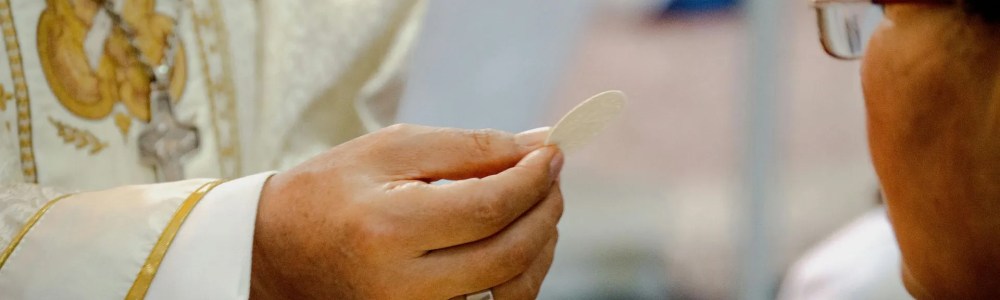
    In the last little while, visiting a number of parishes, I have noticed that some parishioners–not many to be sure–will deliberately cross over onto another communion line in order to receive communion from the priest, as opposed to the extraordinary minister, a layman or laywoman. I inquired about this from one such person, and the reasoning, I found, had almost no coherence whatsoever. It seems to me that the very idea that one ought to receive communion from a priest and not a lay person is nothing more than liturgical snobbery. The entire Church received “holy communion” from a lay woman, namely Mary, Jesus’ own mother. That should settle the matter. But of course it doesn’t. 

    Consider the optics if we were to employ Kant’s principle of universalizability to this issue. A parish priest requests help to distribute holy communion from some of the faithful, who then become extraordinary ministers of communion. The rest of the congregation, however, adopts the attitude that communion should only be received from a priest, not a laywoman or layman. The extraordinary ministers would be standing there the whole time, waiting and watching everyone line up and receive from the priest. It is safe to say that this would certainly frustrate the pastor who would like to finish the Mass at a reasonable time. 

    But more to the point, is communion somehow different when it is received from the hands of a laywoman or layman? Is it less than Christ? Or, does a person receive something more, for example, a greater dignity perhaps, when he or she receives communion from a priest? If so, how does that work precisely? 

    Perhaps it is about reverence, as the person I questioned insisted it is. And so, is it the case that if I wish to show greater reverence to Christ, I should receive communion from the hand of a priest as opposed to the hand of a laywoman or layman? Again, if so, how does that work? To show reverence to Christ pleases him; to show greater reverence to Christ pleases him more. And so I approach the communion minister, I bow or make some reverential gesture, receive the host and then move on, but if I were to receive from the hand of an ordained priest, somehow Christ is more pleased with me, because I’ve shown him greater reverence? I have not yet been able to figure this out, even with the help of one who insists on receiving communion only from a priest.

    Moreover, “communion” means just that: “union”, not only with Christ, but with the entire worshipping community. Of course, there is diversity within that community and that should not be suppressed (diverse talents, experiences, angles on life, spiritualities, etc.), but liturgically some people insist on doing their own thing, and the result is that some are kneeling, most are standing, some receive on the tongue, and some–thankfully most–receive on the hand, some only from the priest, and some–thankfully most–from either a priest or layman/woman, whoever is available at the moment. Is it the case that some people have a need to separate themselves from the “commoners”? Whatever way we slice it, I can’t help but suspect that this is another instance of Phariseeism (from Aramaic perishayya, “separated ones”).

    Christ ate with sinners and tax collectors, shared meals with them, thereby entering into a profound communion with them–given the Jewish understanding of what it means to share a meal–, thereby becoming ritually unclean in the eyes of the religious leaders, which is why they despised him. Jesus was not concerned about ritual purity, as we see from the parable of the Good Samaritan, and he despised the elitist and condescending arrogance of the Pharisees, referring to them as whitewashed tombs full of the bones of the dead and every kind of filth. His attitude appears to me to be the complete opposite of the semi-elitist attitude that insists on receiving communion from an ordained priest only, as though it were “below me” to receive from an ordinary layperson, as it was below the religious leaders to share a meal with those ignorant of the Torah. 

    But I’ve been assured that this is not the sentiment. But then I am asked: Are not the priests’ hands anointed at his  Ordination? They are, but so are the hands of those who receive the anointing of the sick, and so too the heads of babies who are baptized. Confirmandi are anointed on the forehead at Confirmation. Anointing represents Christ (Gk: Christos, anointed one), and oil symbolizes strength, wealth and royalty. All of us have been anointed (in Baptism and Confirmation), and all of us share in the Royal Priesthood of the Faithful. The congregation is a congregation of priests, because Israel and the New Israel (the Church) is a “priestly people” (Exodus 19, 6). The laos (people) have been “set apart”. As our first Pope said:  “But you are a chosen people, a royal priesthood, a holy nation, a people set apart for God’s own possession, to proclaim the virtues of Him who called you out of darkness into His marvelous light” (2 Peter 2, 9). That a baby’s head has been anointed with sacred chrism, endowing that child with a new identity, namely that of priest, prophet and king, does not in any way necessitate different behaviour on the part of others towards the baby. Some will zero in on that aspect of the ordination ceremony in which a priest’s hands are anointed and deduce that this somehow suggests that we should behave differently towards him–i.e., choose his communion line–and that doing so is “more reverent towards our Lord”. Somehow his hands add something to the significance of my receiving communion, but what exactly that is, I have no idea at this point.

    I cannot help but think that this is another symptom of the disease of clericalism that Francis so often spoke out against. He explicitly warned the laity not to put priests on pedestals, and yet how this decision to receive only from the hand of a priest is not an instance of just such a practice is beyond me.  

    Perhaps this practice of receiving communion only from an ordained priest is a subtle but real repudiation of the layperson’s sharing in the royal priesthood of the faithful. After all, the procession begins when the faithful leave their homes to go to the Church to celebrate Mass. The formal procession at the start of the Mass is merely a continuation of the procession that the people began when leaving their houses. The offertory is precisely the offering of this priestly people, an offering of their sufferings, their labor, their treasure, etc., and it takes the form of bread and wine (the parish purchases the bread and wine out of the treasury that comes from the people). The ministerial priest offers the bread and wine on behalf of this priestly people, the congregation. Christ receives that offering and changes it into himself, returning it to us, saying: “take and eat”. The priest is merely an instrument, an unworthy instrument as Pope Benedict XVI would often remind us. It is Christ who consecrates, it is Christ who is the single priest and victim. The ministerial priest is acting in persona Christi, which means that it is really Christ who is the agent who changes the offering (bread and wine) into himself–just as it is Christ, not the priest or deacon, who gives life in baptism and infuses the theological virtues of faith, hope, and charity into the soul of the baptized, among other things. 

    The function of a ministerial priest is different from the function of those who belong to the common priesthood of the faithful, but it is a function that is entirely at the service of the priestly people that is the congregation. One can certainly say that the priest is “set apart” for a specific work, and that is true, but he is set apart to serve the entire people who have been set apart from the world, who have become a holy nation, a kingdom of priests. The significance of his vocation cannot be understood apart from this community. In other words, his priestly function cannot be understood except within the larger context of the priestly nature of the community. I’m reminded of Pius X, when people were kissing his papal ring, his mother said to him: “Keep in mind that you wouldn’t be wearing that ring if it were not for this ring here” (pointing to her wedding ring). The ministerial priest is “set apart” to act on behalf of the priestly congregation, which is “a people set apart”. 

    Peter himself gives us a clue to the resolution of this issue: “As Peter was about to enter, Cornelius met him and fell at his feet to worship him. But Peter helped him up. “Stand up,” he said, “I am only a man myself” (Acts 10, 26).

    Some people look upon the clergy not as lowly common servants (feet washers), but as members of the British Royal Family, as it were, and within such a mindset, one will only hear the gospel within the framework of an old monarchical ecclesiology, which keeps a person from understanding the gospel’s radical nature.  

    I’ve tried to understand this issue from various angles, but the reasoning continues to make as much sense to me as a person who believes, deep within his heart, that eating potato chips is an offence to koala bears, so instead he chooses to eat corn chips. 

    The Evolution of the Temple

    Homily for the Feast of the Dedication of the Lateran Basilica in Rome
    Deacon Douglas McManaman

    In the first reading, Ezekiel has a vision of the temple of Jerusalem, where water was flowing from below the threshold toward the east, from the right side. The water gives life to whatever it touches. But we know from the gospel reading that the temple of Jerusalem foreshadows the true temple, which is the temple of Jesus’ body, from whose right side water flowed as a result of the open wound caused by the centurion’s lance. And that water from his side symbolizes baptism, which brings to life all who are immersed therein.  

    And so we’ve gone from the temple made of stone to the living temple of Christ’s body. But the second reading from Paul’s First Letter to the Corinthians takes this even further. He says: “Do you not know that you are God’s temple and that God’s Spirit dwells in you?” (3, 16). You and I are temples of the Holy Spirit because we have put on Christ, as Paul says in Galatians: “For as many of you as have been baptized into Christ, have put on Christ” (3, 27).  

    And so we’ve gone from the temple of Jerusalem, made of stone, which will eventually be destroyed, to the temple of Christ’s body, which was destroyed but restored in his resurrection, to the faithful, each one of whom is the temple of the Holy Spirit. But, it does not stop there. Jesus not only houses himself in the baptized, he houses himself in all those who suffer, as we read in the Parable of the Last Judgment: I was hungry and you gave me something to eat, thirsty and you gave me something to drink, lonely and in prison and you visited me. When did we see you this way? As long as you did this to the least of my brethren, you did it to me (Mt 25, 31-46).

    As Mother Teresa never tired of saying, Jesus disguises himself in the poor and suffering. They house Christ without their knowing it necessarily, and they are all around us. And not everyone who belongs to Christ is explicitly aware of the fact, and not everyone who explicitly belongs to the visible Church actually does so, for Christ said it himself: “Did we not prophecy in your name, cast out demons in your name? …go away from me, I never knew you; I do not know where you come from” (See Mt 7, 21-23; Lk 13, 27).

    Desecration of the temple incensed Jesus because desecration was rooted in a failure to discern the sacred, and that spiritual blindness was caused by the greed of the money changers. And what angers Jesus today is the same failure to see and discern the sacred (himself) in the suffering, the struggling, ordinary human persons who have lost their social standing. We don’t have to take “poor”, “thirsty”, and “in prison” literally. These terms include the sick who are poor in health, and all those oppressed at work by an emotionally abusive boss or a toxic workplace environment, or those oppressed by a mental illness, or a lonely elderly person virtually abandoned by his or her family, or a teenager who feels alienated and estranged from parents going through a divorce, or alienated by an alcoholic father or mother, and so on. Christ is housed by the suffering of this world because he identifies with them, and that’s what love does. And if this is true, it follows that a hospital room, for example, is holy ground. I know of one priest who was so convinced of this that he would take off his shoes when visiting the sick in hospital. A classroom of young students is holy ground as well; a prison cell is holy ground, and so too a street shelter. Wherever we encounter suffering human beings, we have found Christ. A Carmelite biblical scholar recently mentioned to me that when he was in the city, he gave some money to a person living on the street, who responded by calling out to him: “God bless you”. This priest is emphatic that this man’s blessing has greater significance than if it were a blessing from the Pope himself. 

    Speaking of which, Pope Leo XIV, in a recent homily, said that “we must dream of and build a more humble Church; a Church that does not stand upright like the Pharisee, triumphant and inflated with pride, but bends down to wash the feet of humanity; a Church that does not judge as the Pharisee does the tax collector, but becomes a welcoming place for all; a Church that does not close in on itself, but remains attentive to God so that it can similarly listen to everyone. Let us commit ourselves to building a Church that is entirely synodal, ministerial and attracted to Christ and therefore committed to serving the world” (30th Sunday in Ordinary Time, 26 October, 2025). Amen.

    The Widow’s Joy

    Deacon Douglas McManaman

    In this gospel (Lk 7, 11-17), Jesus does what he does best and what he enjoys doing most, which is to raise the dead to life. Some people like playing golf; some people like going fishing, some like camping, but Jesus, he likes raising the dead to life. He raised a 12 year old girl (the daughter of Jairus), he raised Lazarus from the dead, and in this gospel today he raised the only son of the widow of Nain. And he raises us from the dead as well: “But God, who is rich in mercy, because of the great love he had for us, even when we were dead in our sins, brought us to life with Christ (by grace you have been saved), raised us up with him,…” (Eph 2, 4-5). 

    Consider too that if a person is dead, he or she cannot do anything to earn that resurrection or help in the process; for he’s dead. So, if we are raised (justified), we who were dead in our sins, it was not as a result of anything we might have done. It was all his doing. That’s the God we worship, and that’s the good news. Everything is sheer gift. We don’t have to earn anything. We can’t earn anything. We just have to receive it, which can be difficult. It is difficult to open ourselves up to God’s generosity; we don’t feel we deserve it, and of course we don’t, but that’s besides the point. It’s not about us, but about his love for us. In the letter to the Colossians, we read: “And even when you were dead in transgressions and the uncircumcision of your flesh, he brought you to life along with him, having forgiven us all our transgressions; obliterating the bond against us, with its legal claims,…he removed it from our midst, nailing it to the cross” (2, 13-15).

    This is important because we have a tendency to slip back into the legalism that forgiveness is conditional upon what we do. But we are not saved by our works; we are saved by Christ’s generosity, his initiative, his incarnation and death on the cross. All our transgressions have been obliterated. The prison doors have been unlocked–we are free to go. No charges are hovering over and against us. If we could only believe that good news, our lives would change radically; we’d be living in the joy of Easter. Confession is not the sacrament in which we suddenly receive the forgiveness that was previously not there; rather, we are given the grace to open ourselves up to the forgiveness that has always been there. It is not God who has a hard time forgiving us; we have a very hard time believing that we’ve been forgiven, and the reason is our awareness that if we were in God’s place, we’d likely forgive very few people, until they earned it in some way. Our limited love keeps us from receiving God’s forgiveness of ourselves. Incidentally, that is why some people would like me or whoever is preaching to preach hard, for they would like the preacher to be a conduit of their anger at the world. That is the kind of Pope some Catholics today would like to see as well.  

    But this is a clue to the difference between the saint and the non-saint. It’s not that the one is so holy and the other is not. No, the saints have a profound awareness of their own sinfulness, like the tax collector we heard about last week (Lord, have mercy on me, a sinner), and they admit it–the saint would not think for a second that he or she is a cut above anyone. The difference is that the saint believes the good news and receives it, allows himself or herself to be touched by it. 

    There won’t be any sense that we deserve heaven nor any sense that we will be given our rightful due. That wouldn’t be heaven; it is much better than that. Heaven is unimaginable gratitude and joy, and a pale image of that joy might be the joy that the widow received in getting back her only son from the dead. Just consider the pain of losing your only child, and then your child is restored to you. That’s a small taste of the joy of heaven. Think of the sadness we felt after losing someone we were close to: a sibling, a parent, grandparent, a son, daughter, or close friend. We are all going to experience such a loss if we haven’t already, but the good news is that all that we lost will be restored to us. Their happiness, the happiness of those who have died but whom we will see again, will be our own happiness. And our love for God will be made perfect, and so God’s happiness will be our own as well, and if our love for God is perfected, our love for all who belong to him (everyone) will be perfected, and then their happiness will also become our own. It is just not possible to get our heads around the joy that awaits us. This life is precisely about preparing for the joy of heaven, but we prepare for this joy by expanding our capacity to be loved and our capacity to love.

    The first reading from Wisdom (3, 1-9) mentions the furnace and the dross. That’s kind of what suffering does to us in our lives, similar to the furnace burning off the dross so that in the end, we are left with pure gold. Human beings seem to be at their worst in times of prosperity, but we are at our best in times of suffering, which is why God allows suffering to enter our lives, that is, in order to shape us, like a blacksmith shapes the iron, by heating and pounding it into a beautiful sword, or whatever is he is making. So when we find ourselves engulfed in darkness and despair, like the widow of Nain would have experienced at the death of her only son, we need to keep in mind that sunrise always follows the darkness and a joy we cannot conceive will soon be ours. 

    Have Mercy On Me, A Sinner

    Homily for the 30th Sunday in Ordinary Time
    Deacon Douglas McManaman

    My ministry as a deacon is to the sick, especially those who suffer from mental illness. I remember visiting a patient many years ago in the mental health unit of a hospital, and I recall very clearly that he was telling me that he “feels” horrible about himself. He also has thoughts running through his head that he cannot control or get rid of, and these thoughts cause him to feel horrible about himself, that he is twisted, unclean and tainted. At that moment, something occurred to me. I said: “I was talking to my students about Aristotle today, something he said in his Nicomachean Ethics: You are not what you feel, and you are not what you think. In other words, the opinions you hold do not define your character. Rather, you are what you will. Your character is determined by what you will to be. So you may feel that you are a horrible person, and you may have all sorts of thoughts running through your head that you cannot control, thoughts that suggest you are a terrible human being, but you are what you will. So, what do you want to be? The answer to that question will tell you who you really are. 

    Well, I did not expect those words to have had an impact on him, but his eyes opened wide. He was delighted to hear that. God sees right into the heart, that is, he knows what constitutes your deepest desire, and so he knows who you really are, even if the rest of us do not. And since this patient desperately wants to be something completely other than what he feels himself to be and what he thinks himself to be, then he is profoundly good.

    I never saw him again after that, but a couple of months later I received a card, a thank you note. It was from this patient; that was the first and last time I ever received a thank you note from a hospital patient. That simple ancient insight made all the difference in the world to him.

    The tax collector in today’s gospel reminded me of this patient of mine. He felt horrible about himself, but his deepest desire was revealed in his prayer: “Lord, have mercy on me, a sinner”.

    When the sun comes out and its rays penetrate through a window, we see how dirty the window really is, the spots, the grime and dirt, etc., but at night time, we don’t see those spots, for they are not visible. At night, the window looks clean. But of course it isn’t; it’s dirty, which we can only see during the day when the rays of light penetrate through the window. So too, God is light from light, as we say in the creed, and when God draws us close to himself, we see our spots, the grime and dirt. If we are not close to God, then we are in the dark, and the result is we cannot see our own dirt, grime and spots. Instead, we believe that we are clean, and we feel good about ourselves, and then it is much easier to look with contempt upon another. 

    The Pharisee saw himself as okay; he was very pleased with himself. He had no shame in the presence of God, no sense of having fallen short in any way, because for the Pharisee, holiness is about religious works: “I fast twice a week and give a tenth of my income”, he said. But we are not saved by the works of the law, as Paul says. He writes: “For by grace you have been saved through faith, and this is not from you; it is the gift of God; it is not from works, so no one may boast.” (Eph 2, 8) The tax collector, on the other hand, saw nothing but his own sins: “God, be merciful to me, a sinner”. And that’s why the tax collector went down to his home justified. It was the light of divine grace that allowed him to recognize his own sinfulness. He had no contempt for others, only contempt for himself. 

    Holiness is charity. Holiness is love. What we see in the Pharisees is sanctimony, which is a false holiness. In the Parable of the Last Judgment, the Son of Man does not say to us: “You did not genuflect properly; you didn’t dress properly for Mass; you weren’t reverent enough”, etc.,. No, he’s going to say “I was hungry and you gave me something to eat, thirsty and you gave me something to drink, lonely and you visited me”, and so on. That’s reverence. Jesus berated the Pharisees for desiring seats of honor and delighting in titles and having people fawn all over them. We are going to be judged on how we serve those who are forgotten, those who have no importance, no social standing. That’s holiness; that’s genuine religion. The reason is that this is precisely where Jesus hides himself, as Mother Teresa would always say. Jesus disguises himself in the poor and the neglected. But century after century, Christians like to forget this and instead busy themselves with all sorts of piety. But piety, if it is genuine, will allow us to see and recognize Jesus in his various disguises. And if we truly love him, we will develop the ability to notice him in those who are forgotten and neglected, and we will love him in those who do not love themselves, who do not delight in themselves, but who doubt themselves and would never think to compare themselves to others. 

    The Good News that Our God is an Unjust Judge

    Deacon Douglas McManaman

    The gospel reading for the 29th Sunday in Ordinary time is the Parable of the Widow and the Unrighteous Judge (Lk 18, 1-8). The figure for God the Father in this parable is, interestingly enough, an unjust judge, that is, one who has no fear of God and no respect for any human being. And he refuses to listen to a widow who is pleading for a just judgment, a woman who has lost her protection (her husband) and who has lost her social standing. He simply refuses to consider the merits of her case. So why is this kind of a judge a figure for God in this parable?

    I contend that this is a very subtle proclamation of the good news of the gospel; for the unjust judge ends up granting her justice (ekdikeso), but not on the merits of her case, but merely for self-centered reasons: “so that she may not wear me out by continually coming”. In other words, “to get her off my back”.  

    The same root root word is employed by Paul in his letter to the Romans: “There is none righteous (dikaios)” (3, 10), and “For all have sinned and fall short of the glory of God and are justified (dikaioumenoi) freely by His grace through the redemption that is in Christ Jesus” (3, 23). The verb is dikaioun, to justify, to render favorable. The same word is used in 2 Corinthians when Paul says: “For our sake he made him to be sin who did not know sin, so that we might become the righteousness of God in him” (dikaiosune theou). In other words, we are the ones who were given a favorable judgement, made righteous, justified, not on the merits of our lives, but purely on the basis of God’s good pleasure. We could even say “for self-centered reasons”, like the unjust judge. In other words, the reason for our justification is nothing more than that “he wanted to”, “he felt like it”, for he is not beholden to anything above himself–there is nothing above God–nor is he beholden to any human tribunal. 

    To be the righteousness of God is to be justified, because to justify is to “make right” (jus). It means to stand in right relationship with God. We can’t do that; we have no power to justify ourselves, to redeem ourselves, to buy ourselves back from the slavery of sin. We cannot make up for sin. Only God can do that, and he does so in Christ, in his death, as a sheer gift, not as a result of anything we might have done, nor by virtue of any disposition or prior goodness on our part. All of us stand before God in need of redemption, in need of salvation, completely dependent upon one who can and does redeem us.

    So why does Jesus hold up the unjust judge as a figure for God? The reason is that from our point of view, God is often seen as unjust. Think of the parable of the laborers in the vineyard. The landowner hires laborers at different times of the day, but at the end of the day he pays the one who worked one hour the same wage as the one who worked a full day. They grumbled and saw that as a violation of justice. Consider the parable of the lost son (apollumai:  ‘being destroyed’), the son who “destroys himself” by his own choices, and the older son’s anger towards his father for his unjust royal treatment upon his return. In other words, God is like an unjust judge who pays no attention to the requirements of justice, but does what he pleases, and what pleases him above all else is raising the dead to life. If one is dead, one cannot do anything to earn that resurrection or help in the process, for one is dead. Jesus raised a 12 year old girl (the daughter of Jairus), and he raised the son of the widow of Nain, and he raised Lazarus from the dead. And he raises us from the dead as well: “But God, who is rich in mercy, because of the great love he had for us, even when we were dead in our sins, brought us to life with Christ (by grace you have been saved), raised us up with him,…” (Eph 2, 4-5). 

    God can control his anger, but he cannot control his mercy, said a long time priest friend of mine. That’s the God we worship. It would be terrible news if our justification depended upon the merits of our life, that is, terrible news if our God was a “Just Judge” who rendered judgements on the basis of how much our lives measure up to the standards of justice. 

    When a defendant awaiting a verdict stands before a court judge, he or she is typically nervous, filled with fear, a servile fear. But God calls us to grow out of servile fear and into filial fear, which is not the fear of punishment, but a profound reverence for God that is so deep that sin loses all attraction. What human judge can cause us to lose all attraction to sin and self-seeking? If we stand before God with servile fear, we haven’t learned what we should have learned in this life; we have not embraced the good news of the gospel, and that may be in part because the good news was not proclaimed to us; for what is often proclaimed is a false gospel, a gospel reduced to a transaction: “If you do this, you will get that; if you don’t do this, you will not get that”. It’s the false gospel of salvation through works, the semi-Pelagian heresy that we have to do something to earn that initial grace. But we’ve earned nothing. It’s all grace, including the grace of our cooperation.

    Jesus ends by asking: “Will not God grant justice to his chosen ones who cry to him day and night?” If we project our own limits onto God, if we see God as a God who judges us on the merits of our case, on the basis of what we actually deserve, then we won’t pray much, at least not with a great deal of hope. But if we truly believe the good news of the divine mercy–which is not easy to believe–, then we will pray with great confidence, and when we pray with confidence, we begin to see miracles, especially when interceding for others. 

    St. Paul says that it is the Holy Spirit who prays through us, for we do not know how to pray as we ought, so the Spirit intercedes for us with groanings that cannot be expressed in words (Rom 8, 26). When we pray for others, it is the Holy Spirit who prays through us, and God loves our children and all those for whom we pray infinitely more than we do, so whatever love we have for our children, it is merely a limited sharing in that love of his for them, and so we can pray for them without anxiety and uncertainty. Our God is an unjust judge. In other words, his mercy goes far beyond the demands of justice. He hears our prayers because he inspires them. And that is indeed hard to believe, which is why this reading ends with Christ saying: “When the Son of Man comes, will he find faith on earth?”, specifically, the faith that we have nothing to fear in the servile sense, faith that we will get not what we deserve, but what he wants for us, which is a never ending sharing in his own happiness, which not only lasts forever, but which expands without end, an eternal life of unimaginable surprises. And God always gets what he wants in the end.