Cloud of Witnesses

Homily for the 20th Sunday in Ordinary Time
Deacon Doug McManaman

There is a line in the 2nd reading from Hebrews that struck me, and it is the following: “Since we are surrounded by so great a cloud of witnesses, let us also lay aside every weight and the sin that clings so closely…” (Heb 12, 1-4). This notion that we are surrounded by a great cloud of witnesses is so important. The expression refers to the faithful individuals from the past, including of course those saints who have been canonized.

When I was a full-time teacher, I used to visit my best friend Father Don Sanvido of the Hamilton Diocese a couple of times every semester, to give him a break from preaching, etc. I am an early riser, and this one morning I got up just before 5 am, went to the living room of the rectory, and said my breviary. When I finished, I looked up and noticed, on a large bookshelf, Butler’s four volume Lives of the Saints. I went up to the books, closed my eyes, randomly selected a volume, opened the book and placed my finger on a randomly selected page. Wherever my finger landed, I would read the life of that saint. I landed on some 3rd century saint I’ve never heard of before. After reading about her life, less than a page of that volume, I felt tremendous inspiration. I felt awakened. So I did it once more, this time choosing a different volume, landing on a 6th century male saint. His life and character was totally different from the first woman I’d read about, but I felt inspired once again, like I had just drank a large glass of orange juice. The feeling was actually in my body.  

And this is the lie we’ve been fed for years in the world of entertainment: goodness is boring; evil is interesting. But it’s really the other way around; goodness is profoundly interesting and inspiring, while evil is nothing but an empty promise. Goodness inspires and fills, but people tend to believe the opposite. My first 10 years of teaching were in a very poor and broken neighbourhood of Toronto, but every year our students would raise over 60 thousand food items for the Food Bank at Christmas, more than any other institution in the city. At first, we’d notify the media, the local newspapers, but no one was interested. However, let there be a non-fatal stabbing in the school Cafeteria and it’s on every local news channel by 6 o’clock in the evening. 

The lives and stories of the faithful are far more interesting. Think of a typical coffee shop, a Tim Horton’s for example. Practically everyone there is a non entity to you, and you are a non entity to them. But if any one of us were to sit down at a table where some old man is having his coffee and were to ask him to spend the next hour or so telling us about himself, his life history, etc., a whole world would open up before us and his life would acquire color and significance, and we’d never see him the same way again. Consider the number of tombstones in a typical cemetery. Each one represents a massive biography that would easily exceed two thousand pages. I am convinced that in our first few thousand years in heaven, we’re going to be reading biographies–without the actual books, that is, we will be coming to know the deepest meaning of every human person in the kingdom of God. The life of each person is a unique instance and expression of the workings of divine providence. We are surrounded by a cloud of witnesses, and we hope one day to be part of that communion of saints. 

But that is a frightening thought, in many ways. I think of the third volume of the Lord of the Rings, the scene in which Gandalf comes before Theoden, King of Rohan, who is under a spell that was cast by the diabolical character, Wormtongue. Gandalf is trying to get through to the King that he needs to call his people to take up arms and join in the resistance against Saruman’s forces. The king, however, is just not awake to the danger that is approaching, but Gandalf finally breaks the spell and Theoden suddenly realizes what he has to do and gathers his men for battle. Eowen, the king’s daughter, arms herself for battle because she too is determined to fight the evil that threatens. Theoden is finally struck down in the battle of Pelennor, and as she kneels down beside her dying father, he says the following: “My body is broken. I go to my fathers. And even in their mighty company I shall not now be ashamed”. 

That is a tremendous line: “I shall not now be ashamed”. In other words, I would have been ashamed having died refusing to enter into battle and suffer for the sake of my people, but not now. We are destined to join our fathers and mothers, and the question I have often asked myself over the years is whether or not I will feel ashamed in their mighty company. Think of the courageous lives of our great saints, like St. Patrick, who in the 4th century was captured by Irish marauders and was a slave for 6 years in a region of Northern Ireland. He finally escaped and walked more than 200 miles to board a ship back to Britain. Years later, as a result of a dream he had in which the Irish were calling him to return, he actually returns as a missionary, surrounded by danger and living in hardship. Or consider the life of St. John de Brebeuf among the Hurons, in 17th century Canada, in the brutal Canadian winters, without heated vehicles, traveling in the freezing temperatures, long trips by canoe and portages over land, carrying canoes and supplies around rapids and waterfalls, living on corn mush for weeks on end. Or St. Isaac Jogues who was tortured, his hands mutilated, and yet after going back to France actually returned to the missions and ended his life as a martyr. Or St. Maximilian Kolbe, whose feast we just celebrated, who took the place of a polish sergeant chosen to die by starvation in a Nazi concentration camp in retaliation for an escaped prisoner. It took Maximillian two weeks to die of starvation. Or St. Thomas More who refused to take the oath of Parliament and was confined to the Tower of London for more than a year before being found guilty of treason. All he had to do was take a simple oath, and he would have been restored to his former position with all the perks of high office, an estate in Chelsea, a life of ease and prestige. Instead, he chose not to violate his conscience, and he had his head cut off for it–he was originally scheduled to be hung, drawn and quartered, but at the last minute the king had mercy and commuted the sentence to beheading. And then you have great saints in our day like Mother Theresa who left the comforts of the Loretto Convent to live on the streets of Calcutta. 

These are the kinds of people we are going to be in the presence of in the kingdom of God. That could turn out to be a rather uncomfortable experience, at least initially. Their lives were on fire with the fire that Jesus spoke of in Luke: “I came to bring fire to the earth, and how I wish it were already kindled!” (Luke 12, 49). God is a consuming fire and their lives were burning with it. 

And that’s what the spiritual life is about, becoming more and more disposed to be lit by the fire of the divine love for the human beings that Christ came to die for. In the end, that is the only real joy in life, the joy of loving others, as Mother Teresa worded it.  As St. John of the Cross wrote: “In the evening of this life, we will be judged on love alone”. Nothing else; not our accomplishments or awards, not our social status, not even the office we might have held in the Church. Only on love, that is, on how large the fire is that burns within us. 
The Nobility of Matter

Homily for the Solemnity of the Ascension of the Lord
https://wherepeteris.com/the-nobility-of-matter/ (@Where Peter Is)

Deacon Douglas McManaman

Recently I drove up to the cemetery to say a rosary and visit my mother’s grave site, as well as a number of other parishioners who are buried there. I thought I had the whole cemetery to myself until I saw an old man in a lawn chair smoking a cigarette, sitting next to a grave. I assumed it was his wife’s grave. Whoever he was visiting, again probably his deceased wife, he loved her and wanted to be near her, so he sat next to her grave and had a smoke. For me, it was a very touching scene.

And that’s love. We are drawn to those we love, we wish to be in close proximity to them, and when they are deceased, the next best thing, I suppose, is their grave site. I don’t mean to suggest that they are there, six feet under, but we are flesh and blood creatures, and matter gives rise to place, and we need to be in the same place as the one we love. We are not angels, or pure spirits; rather, we are composites of spirit and matter, and matter situates us in place, and if we love someone, we need to situate them in place and occupy a place next to their place. That’s why cemeteries are so important. My mother used to say she just wanted to be cremated and her ashes scattered to the wind, but one day she expressed her desire to be buried in the nearby cemetery. My sister eventually told me why she changed her mind; apparently, I told her one day that it would be nice if she were buried somewhere so I could visit regularly. I didn’t think my saying that would make a difference to her, but it did.

Now God became matter, joined matter to himself, and began to occupy place. In doing so, God elevated flesh; he elevated matter and material existence. When God became flesh, he gave matter a new dignity. Life in the body is now holy. Early Gnosticism could not understand this; for the Gnostics, matter is evil, the body is evil, which is why they denied the Incarnation of the Son of God. In their minds, it is unthinkable that God would join matter to himself. But everything God created is good, but in joining himself to matter, God actually made matter holy, that is, extraordinarily good. The flesh is holy. Your body is holy. He joined himself to the matter of humanity because he loves each one of us, and love seeks to unite with the beloved, and if the beloved is in the flesh, love seeks to unite with the beloved in the flesh. In joining a human nature to himself, God the Son joined himself to every man and woman, as it were. 

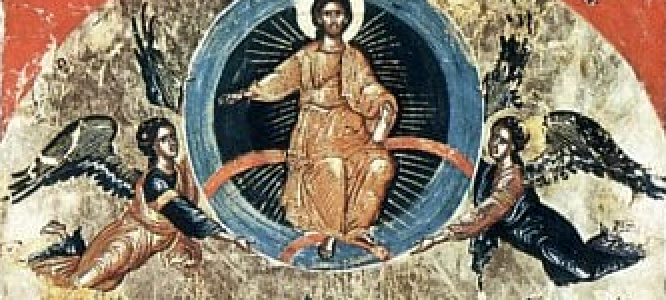
But God did more than that. In his flesh, Christ ascended to the right hand of the Father. That expression “right hand” is not to be taken literally, as if God the Father has a literal right hand. It is a symbolic expression that we still use today when we refer to someone as my right hand, like my right-hand man: my closest most intimate friend. God the Son sits at the right hand of the Father, because he is the Son, and the Father loves the Son as His eternal divine Son. But the flesh to which God the Son joined himself was not some temporary covering or shell that is disposed of after death. Rather, the flesh he assumed was forever. In his ascension, matter has been glorified, deified, for all eternity. Humanity has been lifted up to the right hand of the Father, and we are part of humanity. And every level of the hierarchy of being exists in us, that is, the mineral level, the vegetative level, the animal level, all within each human being, and so in being raised in the flesh to the right hand of the Father, all of material creation has been raised to the right hand of the Father in the Person of Christ. Pope Francis, in his Encyclical Laudato Si, wrote:

The ultimate destiny of the universe is in the fullness of God…The final purpose of other creatures is not to be found in us. Rather, all creatures are moving forward, with us and through us, towards a common point of arrival, which is God (83).

So, we have begun to sit at the right hand of the Father, in Christ who has ascended. All of humanity and all creation has begun to sit at the right hand of the Father. When the Father looks upon his Son, he sees humanity, each one of us, and when he looks upon humanity, he sees his Son, and he loves humanity with the same love by which he loves the Son, and he sees and loves all creation in loving humanity: As Christ said: “not one sparrow falls to the ground without your Father’s knowledge” (Mt 10, 29).

My daughter is a high extrovert, while my wife and I are high introverts–she was in many ways God’s practical joke on us. My wife and I would be content staying at home all the time, but since as far back as we can remember, my daughter has always been one who wanted to get out and party and see people and travel, especially where her favorite celebrities live and eat at restaurants where these celebrities eat, and so we had to go to Los Angeles, New York, Paris and London, and Rome and Capris, etc. We were forced out of our shell; if it wasn’t for her, we never would have visited these places. But what I discovered is that when I see these places that I’ve visited with her on television or in movies, like the Observatory in Hollywood, or a street in Santa Monica or New York or London, or if I am actually in one of these places without her, I actually love these places and want to visit the same places we visited when I was there with her. I thought to myself: What do I love about the Griffith Observatory in Hollywood, or Central Park in New York, or the fashion district in Rome of all places? It’s that she loves them, and she was there and I was with her, and I realized that it is her that I love in these places. She loved them, so I found that I began to love them as well. In the same way, the Son loved humanity and the matter of this creation to the point of joining to himself a human nature, becoming a part of humanity, raising up human flesh in the process. And so, the Father loves us because the Son loves us; the Father loves us because his Son was here and is still united to the flesh of humanity. 

That’s why you and I will be raised up on the last day, because we are in him, and when God looks upon us, he sees his Son in our flesh, and He cannot turn his back on his Son, so he does not turn his back on us.

My Sheep Hear My Voice

Homily for the 4th Sunday of Easter

Deacon Douglas McManaman

My sheep hear my voice. I know them, and they follow me.

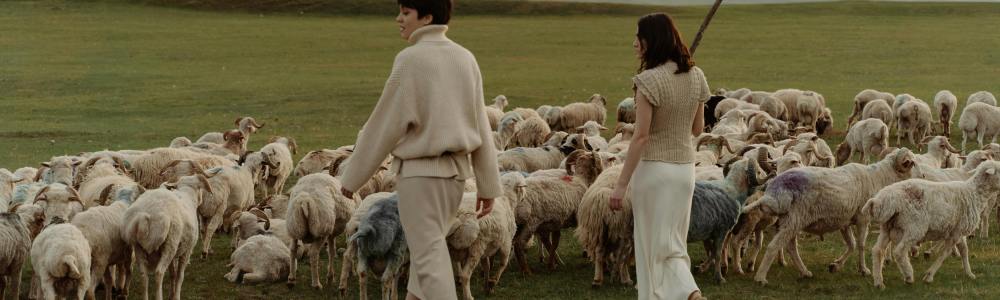
Years ago I was reading parts of Nelson Mandela’s autobiography in which he makes the interesting observation that a shepherd (or shepherdess) leads his (her) sheep from the back. This image was his model of leadership. The Vice President of a Canadian company that specializes in offering leadership training for corporations travelled to Israel to watch how a shepherd relates to his sheep in order to gain insight into the fundamental principles of leadership. And of course, the shepherd made it very clear that a shepherd typically leads from behind, not from the front. That is the first principle of leadership. But before he can lead from behind, he must invest time and ‘relational equity’ in the sheep. He must come to know each sheep individually. Owners of dogs usually recognize the distinct and unique sound of their pet’s bark. Similarly, a shepherd knows intimately the sound and behavior of each of his sheep. 

How does this translate to leadership? About 30 years ago I met a well-loved high school principal from the Dufferin-Peel Catholic District School Board, Lorne Howcroft, who said to me that being a principal is primarily about recognizing the gifts and talents of your staff and putting them up front in leadership positions, while you step back. A good principal–not to mention a good bishop–is like an umpire in a baseball game; he does not have the skills to pitch or catch high flies–that’s for the skilled athletes. In the same way, a good leader is not necessarily skilled in this or that, but will recognize the talents and gifts in the people around him and place them up front so that they may lead in that capacity for the benefit of the community. 

The second principle of good leadership is that one should only lead from the front in times of danger, or when the shepherd needs to trace out a different route. Such a frontline position, however, is only temporary; the normal course is to step back and get out of the way. Poor leaders, on the contrary, lead from the front for the most part, and run to take cover in times of danger; thus, the sheep are thereby left to the wolves, or thrown under the bus, as they say.

The third principle is “do not lead alone”. This particular shepherd in Israel led with the help of a female ewe. She was the power broker in the flock. And I will say that without a doubt, the best leaders in my life in over 35 years in education were women: the smartest and most prudent high school principal in all those years as a teacher was a woman, and the most competent Director of Education, also a woman. Misogyny, which spawns patriarchy, is really a foolish posture that has done so much to retard the development of our institutions, including the Church of course.

The next point I’d like to make has to do with the sheep who know the voice of their shepherd. There’s a wonderful YouTube Video on Cornerstone Kids that is about two minutes in length that shows a bunch of sheep grazing in a field, and three different people, one by one, approach the fence and call out to the sheep. But the sheep, as though they were deaf, don’t move–not even look up. Finally, the shepherd comes to the fence and utters the same call, and they all look up and within seconds make their way to the shepherd.

Of course, we are Christ’s sheep. All of us. We have all been anointed priest, prophet, and king at our baptism. We’ve been given the seven personal gifts of the Holy Spirit, as well as unique charisms in view of our specific vocation. All the baptized share in the Royal Priesthood of the Faithful. Our deepest identity in the Person of Christ is that we are priest, prophet, and we share in Christ’s kingship, but unfortunately the faithful for the most part do not see themselves as such. And yet there is a great deal of wisdom in the ordinary faithful of which they are not even aware. John speaks of this in the second chapter of his first letter:  

As for you, the anointing that you received from him remains in you, so that you do not need anyone to teach you. But his anointing teaches you about everything and is true and not false; just as it taught you, remain in him (2, 27).

I have to laugh sometimes when I join a table at our parish bible study, because a number of parishioners will say what they think in answer to a particular question, but they always end by saying something like: “I don’t know. What do I know?” I laugh because what she just said was so rich, detailed, and full of insight. They do know; they just don’t know they know. Occasionally I will have lunch with a parishioner who has never studied theology in his life, has no advanced degrees and drives a truck for a living. When he speaks, however, he exhibits tremendous spiritual and theological insight, and he too has no clue how much wisdom he has acquired over the years. All this is the result of the anointing that John speaks of in his first letter. 

The faithful recognize the voice of the shepherd; some more than others, perhaps. But each one also sees the world and interprets what she hears in the readings from her own unique vantage point. Among us are parents with years of experience who know about the difficulties and challenges in raising children today, and we have teachers who understand the needs of young students, a very different world from the world of our childhood; nurses with knowledge that results from extensive experience with the sick and the suffering, psychiatrists who understand mental illness and the latest developments in treating such illness and who understand a great deal about how spirituality fits in to good mental health, etc. Each one recognizes something about the shepherd from their own unique vantage point. They know Christ in a way that I don’t, and they manifest Christ in a way that I don’t. And that’s why it is so important to listen to one another, if we are to be a community that is made up of a discipleship of equals.

Womanhood and Priesthood

Deacon Douglas McManaman

At a recent bible study, I was asked how it is that Adam prefigures Christ. I don’t believe there is a simple and single answer to this question, but diving into it opens up an interesting horizon in light of which we may be able to shed light on other important questions having to do with the role of women and perhaps the ordination of women.

Those who posed the question were puzzled that Adam could prefigure Christ; for Adam is fallen, but Christ is perfect; Adam was disobedient, while Christ was obedient; Adam was married but Christ was not, and Adam was created while Christ is the eternal Person of the Son made flesh, etc.  

Jesus is the second Adam, or last Adam (Rom 5, 12-21; 1 Cor 15: 22, 44-49; Eph 1:10). All things were created “through him and for him” (Col 1, 16). The first Adam is indeed a figure of Christ. We say this because God created Adam (humanity) in his image, in the image of God he created them, male and female he created them. What this means is that there are two ways to be “Adam”, a male way and a female way. It is not Adam the male who was created in the image and likeness of God while the female was in some ways secondary. Rather, Adam is both zakar (male) and neqebah (female). These two Hebrew words imply relation to one another. Hence, the human person is fundamentally relational; in other words, the one cannot be understood without the other. Zakar and neqebah imply an “existing towards one another”, for zakar (male) means “the one who has a tip” and neqebah (female) means “the one who is punctured”. The relationship of the sexes is clearly implied; for each one individually is reproductively incomplete, but together, in the act of sexual union, they become reproductively one organism.

According to the Genesis text, it is not the male (zakar) by himself who is the image (zelem/eikon) of God, nor is it the female (neqebah) by herself who is the image of God; both of them together constitute the divine icon that is Adam. And so God in His active generosity, in His effusive act of communicating the goodness of existence to creatures, is represented in the icon of male and female, joined in the one flesh union of marriage. It is important not to overstate the passive element belonging to the female in the act of sexual union. Her ovum actively “goes out” to meet the male seed, and so her role is not entirely passive. The first parents (Adam) are one body, one flesh, who prefigure Christ, who is one body with his Church.

In the second creation story, the man is put into a deep sleep and from his side, the woman is formed. This allegorical imagery foreshadows the cross on which Christ enters the sleep of death, and from his side the Church, his bride, is born–blood and water proceed from his side, symbolizing the Eucharist and baptism; for it is through baptism that one becomes joined to Christ’s Mystical Body, and of course the Eucharist is Christ’s flesh and blood. As De Lubac famously said: “The Church makes the Eucharist and the Eucharist makes the Church.”

Christ’s existence is a relational existence. He is the Son, the Second Person of the Trinity, which is a subsistent relation. And since in the flesh, he is one Person, Christ continues to exist “in relation to…” He came to redeem his bride, the Church, the New Israel. The existence of the first Adam, as we said above, is relational, for Adam includes zakar and neqebah who exist in relation to one another (who face one another). Their relationship is nuptial, and of course the relationship between God and Israel is nuptial, and the relationship between Christ and the Church is nuptial, and heaven will be an eternal wedding banquet (Mt 22, 1-14). 

“Adam’s” existence is ordered to Christ, who is the fulfillment of humanity (Adam). We read in section 22 of Gaudium et Spes that “…only in the mystery of the Incarnate Word does the mystery of man take on light”. And so “Adam” indeed prefigures Christ, who in turn is the perfection of Adam (humanity). But “Adam” is not a man in the sense of an individual ‘male’, but ‘them’, male and female in relation to one another. The two in relation are the ‘icon’ or image of God. This is a relationship that gets disrupted or distorted as a result of the fall: “You shall have desire for your husband, but he will dominate you” (or rule over you) (Gn 3, 16). In other words, the domination and subordination of women is not part of God’s plan for creation, but is the result of sin. Male and female were created equal, “of the same stuff” (from his side). In fact, the image of woman coming from the side of the man suggests that her role is to reach down and call forth the man to what is higher, for he came from the mud of the earth, the soil, while she came from a higher place. But the history of humanity is a history of oppression, including the oppression of women. 

Now, the entire Church is woman, the New Israel, the Bride of Christ, and she has been given authority, but the exercise of this authority is to be entirely unlike that of the gentiles: “You know that the rulers of the Gentiles lord it over them, and the great ones make their authority over them felt. But it shall not be so among you. Rather, whoever wishes to be great among you shall be your servant; whoever wishes to be first among you shall be your slave. Just so, the Son of Man did not come to be served but to serve and to give his life as a ransom for many” (Mt 20, 25-28).

Furthermore, the entire Church is “priest”. In the evening prayer for Thursday within the octave of Easter, the Church prays: “Almighty God, ever-living mystery of unity and Trinity, you gave life to the new Israel by birth from water and the Spirit, and made it a chosen race, a royal priesthood, a people set apart as your eternal possession. May all those you have called to walk in the splendor of the new light render you fitting service and adoration.” Each of the baptized is anointed priest, prophet, and king, and so with regard to the royal priesthood of the faithful, gender is irrelevant–certainly not an impediment. The entire Church is a “chosen people, a royal priesthood, a holy nation, a people for God’s own possession, to proclaim the virtues of Him who called you out of darkness into His marvelous light” (1 Pt 2, 9). And so the Church as a whole is a priestly people and at the same time bride and mother (female); for it is the entire congregation that offers gifts to be consecrated. The congregation are not simply passive observers, but active agents, priests offering their gifts, their labors, their sufferings and toil, their bread and wine, placed at the foot of the altar; the ministerial priest offers it on behalf of the entire congregation, of which he too is a part. Christ receives those gifts and changes them into himself, and returns them to us as our food. In consuming the Bread of Life, we become Christ, that is, all our matter becomes Christ–the cosmos becomes Christ in us. 

So it seems there is no incongruity between priesthood and womanhood, for the entire Church is both woman and priest. Indeed, the priest is the icon of Christ, but Adam prefigures Christ, and Adam (zakar and neqebah) exists as the image or eikon of God who became flesh in Christ, “…a priest forever according to the order of Melchizedek” (Heb 7, 17). The original icon that Adam is includes both male and female. The Church cannot be understood except in relation to Christ, for she is his body, and thus woman cannot be understood except in relation to Christ. The woman that is the Church is the sacrament of Christ, and she participates in his priesthood.

One year during a Confirmation class in which we were talking about the sacraments, one clever young lady put up her hand and asked: “Why is it that men are able to receive all seven sacraments, but women have access to only six?” That was a brilliant way of formulating the question. I did not have time to go into a detailed explanation of the reason the Roman Church does not ordain women, for it would not do justice to the precise formulation of her question anyway. Moreover, it is increasingly difficult for me to see any genuinely compelling reason for the exclusion of women from the sacrament of Holy Orders. Perhaps the theology of sexual complementarity, focused exclusively on the sexual act itself according to the strict categories of activity and passivity, a model currently employed to maintain an all male priesthood, is really a theologically sophisticated rationalization of an outdated sexist divide. 

Cosmic Restoration

Deacon Douglas McManaman

Peter, do you love me? Then feed my lambs.

Today it is very common to confuse love with sentimentality. Genuine love involves willing the good of another, and that willing may be accompanied by positive sentiments or it may not be. Good feelings towards another are really not part of the essence of genuine love. A true sign of love is the willingness to sacrifice for the other. A genuine love of Christ reaches out to others; it does not stay inside, but seeks out the lost, the wounded, the poor and the oppressed, which is precisely what we see in the life of Christ. 

Another popular tendency is to confuse holiness with sanctimony. I’ve noticed that I hesitate to use the word “holiness” when teaching, because the word conjures up images of sanctimonious individuals with folded hands and a serious demeanour, but who are indifferent to social outreach. 

Holiness is love, it is charity, and love seeks the lowest place, it descends to whatever level is required in order to reach the person to be loved. A priest friend asked me recently: Where can God be found? He pointed out that if we read the New Testament carefully, we see that God is found in the sewers; always in the lowest places. God the Son descended and dwelt among us, and on Holy Saturday he descended further to the utmost regions of hell’s darkness. That is what holiness is like; that is what the divine love is like. Sanctimony, however, is something different. It does not seek the lowest place, but the highest place. And piety as well is not quite the same as holiness. A person may be devotional, reciting prayers, chaplets, novenas, observing religious laws, in love with religious things, churches, basilicas, etc., but if this is genuine piety, which is a gift of the Holy Spirit, then it will bear fruit in genuine social outreach. If it is false, it will remain closed in on itself.  

Genuine holiness is inclined to descend to the lowest places, to those places where most people are not willing to go; for if we love God, we love all who belong to God, and everything that God has created belongs to God. If we love God and not merely things associated with God, our fundamental desire that drives every one of our choices will be the desire to see God loved, adored, and glorified. That is what justice is according to the New Testament. Justice (justification) is the restoration of all things to their proper order, which is joyful and grateful subjection to God. The love of justice is the desire to see all things restored in Christ, who in turn has no other food than the praise, love, adoration, and glorification of God the Father. 

Christ loved those who were murdering him. His passion and death were the consummation of the world’s injustice. But the most perfect rectification of that injustice is to see all of Christ’s enemies turn towards him and love him in gratitude, to finally recognize him and to praise, adore, and glorify him forever. Without that, there is no justice, but perpetual injustice and disorder; with that, however, there is the perfection of justice, the perfect victory over sin, very much like the story of St. Maria Goretti. Her murderer spent 27 years in prison, asked for forgiveness and afterward became a Capuchin brother. That’s a small scale example of Christ’s victory over evil. 

And that is the universal and cosmic justice mentioned in the second reading: 

Then I heard every creature in heaven and on earth and under the earth and in the sea, and all that is in them, singing, “To the one seated on the throne and to the Lamb be blessing and honour and glory and might forever and ever! (Rev 5, 11ff). 

What is interesting about this verse is that it says every creature, every created thing (pan ktisma), in heaven, on earth, and under the earth, and in the sea, which includes not only every man and angel, but every sea creature, fish, dolphin and shark, etc., every plant, every tree, every created thing will in the end bless, honour, and glorify God forever and ever. And so the love of God includes a love and reverence for the earth and an awareness of the way each creature manifests and praises God (Dan 3, 56-82).

A genuine love of God is accompanied by the awareness that all things came to be through the Word (Logos), and so all things carry within themselves some reflection of the Word, just as every work of art has a trace of the artist in it–all creatures are inexhaustible words of the Word, and as St Paul says, every creature longs to share in the freedom of the children of God (Rom 8, 21). The entire cosmos longs for justice (redemption), which means it longs for Christ. And Christ’s resurrection is that victory over death, the perfect victory over injustice, and that victory is a process, a movement, that has begun and will in the end be achieved (Mt 13, 31-32). 

Creative and Destructive Conflict

Deacon Douglas McManaman
Also published at https://www.lifeissues.net/writers/mcm/mcm_422creativedestructiveconflict.html

A kiln is a furnace that dries out the potter’s clay and actually transforms it into a beautiful ceramic piece. We can’t use a clay bowl or cup that has not been in the kiln; it would fall apart, for it would be too soft. And of course, we are the clay, as we read in Isaiah, “Yet, Lord, you are our father; we are the clay and you our potter: we are all the work of your hand” (Is 64, 8). And so it follows that trials, sufferings, difficulties, are part and parcel of the spiritual life.

I have found over the years that the vast majority of people mistakenly believe that religious life, life in the Church, life in Christ, the devout life, is supposed to be a life of peace and tranquility, like the quiet of a cemetery, where everything works out smoothly and without a glitch. And so when things go awry, we tend to see this as an anomaly, that something is wrong, that if we are right with God, life should proceed without a struggle. But this is a serious misconception. Life is essentially conflict, because it is movement, and all motion is at some level a struggle. Anyone who has studied evolutionary biology knows this. There is no such thing as life without conflict and struggle.

There are, however, two kinds of conflict: destructive conflict and creative conflict. Sports (play) is essentially conflict and struggle, but it is an enjoyable one because it is essentially creative. Art is a matter of creative conflict, a battle between the sculptor and the resistance of the marble that he is about to carve into a beautiful figure. A life without creative conflict becomes intolerably dull and meaningless. In fact, heaven will be an eternity of creative conflict. Hadewijch of Antwerp writes:

God will grace you to love God with that limitless Love God loves himself with, the Love through which God satisfies himself eternally and forever. With this Love, the heavenly spirits strive to satisfy God: this is their task that can never be accomplished and the lack of this fruition is their supreme fruition” (Love is Everything: A Year with Hadewijch of Antwerp, trans. Andrew Harvey, May 1st). 

“Peace” and “rest” are not opposites of conflict, that is, heaven is not a life without obstacles and things to achieve. 

It is destructive conflict that is the problem. However, God joined a human nature, he joined himself to our humanity, and in doing so he entered into the destructive conflict that human sin has brought about in the world. The victory of that destructive conflict is death, which without Christ has the final word over our lives. But Christ came to die, to enter into our death, to inject it with his divine life, to destroy the power of death, to rise from the dead. He was victorious over death, and so he overcame the struggle of human existence, the battle against destructive conflict. 

Christ transformed the destructive conflict of death and sin in all its various instances into a matter of creative conflict, a matter of play, as it were: “When he set for the sea its limit, so that the waters should not transgress his command; When he fixed the foundations of earth, then was I beside him as artisan; I was his delight day by day, playing before him all the while, playing over the whole of his earth, having my delight with human beings” (Prov 8, 29-31). We can now share in his victory over both sin and death. He offers us his own humanity so that we might overcome our own life struggles with his strength: “I can do all things in him who strengthens me” (Phil 4, 13). The kiln that dries out all our moisture (disordered love of self) and in time transforms us into something beautiful is the particular difficulties and struggles that we have to contend with in our lives. And some people have greater struggles than others; the heat of the kiln is much hotter in their lives, and perhaps they have been in it for much longer than the rest of us. But the result is a more beautiful product from the hand of the potter. It is not the case that God wills that certain people suffer illness or tragedy; rather, God the Son joined himself to a human nature in order to draw very close to us in our suffering and trials, to give us his divine life that we might overcome the world and its conflicts with him and through him, that we might share in the joy of his victory. The greater the struggle, the greater the victory, and the greater will be the joy in that victory.

This, I believe, is the key to unlocking today’s gospel: “Can a blind person guide a blind person?…Why do you see the speck in your neighbour’s eye, but do not notice the log in your own eye?…first take the log out of your own eye, and then you will see clearly to take the speck out of your neighbour’s eye”. The spiritual life is a long and difficult road, a slow process of gradual enlightenment. I don’t know about you, but I do not like looking back at my life and being reminded of what I was back then, because I see my blindness. And of course, the blind cannot lead the blind. But the blind are leading the blind all the time. Even great saints had their blind spots. Study the history of the Church without triumphalist blinders: stupidity, arrogance, sin, oppression, envy, violence, lust for power, control, avarice, etc, is everywhere in our history. We have had great popes who did great things as well as some outrageous things; made great decisions as well as terrible decisions that were very destructive and whose repercussions are still with us today in many ways. It is a real mixture. But that’s life in the Church, as well as the life of the individual person in a state of grace. The spiritual life is conflict, a struggle, a struggle against our own blindness and propensity to sin and self seeking as well as the blindness of others and its repercussions. 

But before we can take it upon ourselves to correct others, we have to spend years in the kiln, in the furnace, allowing the fire of the divine love to change us so that we may remove the plank from our eye. Recently I asked my Confirmation class about the graces they are going to receive from God upon their Confirmation, specifically the grace of mission. 

“You are going to be sent on a mission; but to do what?” I asked them. 

One good candidate put up his hand and said: 

“To proclaim the gospel”. And of course, that’s a great answer. 

“But how are you going to do that?” 

“Preach”, he said. 

Well, the problem is you’ll lose friends quickly. If you want to be friendless, start preaching to them. If parents want to drive their kids from the church, start preaching. The way to proclaim the gospel is by the very life you lead. The gospel is the good news of Christ’s victory over death, his resurrection. We don’t need to use words. We just need to be a person who lives in the joy of Easter, a person who has the hope of eternal life, a person who is not overcome by life’s tragedies, because we believe that Christ has overcome the world and conquered death. Others will see that in us, by how we react to life’s difficulties and struggles, even life’s tragedies–that we have risen above them in the joy of the risen Christ. 

Catholic Tribalism

Deacon Doug McManaman

Today’s gospel reading (Wednesday of the 7th Week in Ordinary Time) is taken from Mark, chapter 9, verses 38-40. John says to Jesus that they saw someone casting out demons in Jesus’ name and that they tried to stop him, “because he was not following us”–as if it is about “following them”, and not Christ, or acting in the name of the Person of Christ. Jesus tells them straight out: “Do not stop him; for no one who does a deed of power in my name will be able soon afterward to speak evil of me. Whoever is not against us is for us”. 

It continues to puzzle me that this reading continues to fly over the heads of so many Christians today, including Catholic prelates, clergy, and very traditional Catholics who are thoroughly sectarian or tribal in their thinking. If there is one section of the gospel that rails against Catholic tribalism, it seems to me that this is the one. Had the hierarchy taken the path laid out by Pope Gregory the Great, a pastoral and administrative genius, rather than the authoritarian approach of Pope Leo the Great–not to mention Innocent III—, the history of Christianity would have looked very different than what it is now.  

When I study such great theologians as Jurgen Moltmann, or G. Studdert Kennedy, Sergius Bulgakov, or Vladimir Solovyov, Christoph Blumhardt or Gerhard O. Forde, Robin A. Parry or F. D. Maurice, etc., I lose all awareness that these people belong to another “tribe”, a different denomination, that is, that they are “Protestant”. All I sense is that we are of the same family; we are “of the same mind”, which is the mind of Christ Jesus (Phil 2, 5). 

The first reading from Sirach (4, 11-19) is also very revealing: “Wisdom teaches her children and gives help to those who seek her. Whoever loves her loves life, …Whoever holds her fast inherits glory, and the Lord blesses the place she enters. Those who serve her minister to the Holy One; the Lord loves those who love her.” My last 20 years of teaching were at a school in which close to 50% of my students were non-Catholic; many were Muslims, Hindus, Sikhs, and Buddhists, and many of these were genuine seekers of wisdom, lovers of wisdom, and they recognized wisdom whenever they encountered her. The Lord loves those who love her, and one cannot love her without divine grace, which is a sharing in the divine life. So much for Catholic triumphalism, Muslim tribalism, or any tribalism for that matter. 

I would not say that these people were “anonymous Christians”, a term made popular by Karl Rahner in the early post-Vatican II period. The best criticism of this apparently inclusive way of regarding those who are not explicitly Christian comes from Hans Kung, who writes: 

Karl Rahner’s theory of the “anonymous Christian” is in the final analysis still dependent on a (Christian) standpoint of superiority that sets up one’s own religion as the a priori true one. For, according to Rahner’s theory, which attempts to solve the dilemma of the “Outside the Church” dogma, all the Jews, Hindus, Muslims, Hindus, and Buddhists are saved not because they are Jews, Muslims, Hindus, and Buddhists, but because in the final analysis they are Christians, “anonymous Christians,” to be precise. The embrace here is no less subtle than in Hinduism. The will of those who are after all not Christians and do not want to be Christians, is not respected but interpreted in accordance with the Christian theologian’s interests. But around the world one will never find a serious Jew or Muslim, Hindu or Buddhist, who does not feel the arrogance of the claim that he or she is “anonymous” and, what is more, an “anonymous Christian.” Quite apart from the utterly perverse use of the word “anonymous”—as if all these people did not know what they themselves were—this sort of speculative pocketing of one’s conversation partner brings dialogue to an end before it has even gotten under way. We must not forget that followers of other religions are to be respected as such, and not to be subsumed in a Christian theology (Theology for the Third Millennium: An Ecumenical View. trans. Peter Heinegg. New York: Doubleday, 1988. P. 313). 

My students may not be “anonymous Christians”, but if they seek wisdom, love wisdom, and in serving her serve the Holy One who loves those who love her, then they are moved by grace, which is the indwelling of the Trinity. To be in such a state does not depend upon adopting a certain terminology or conceptual frame of mind, but on the love of her (Sophia). All things came to be through the Logos (Jn 1, 1ff), and all were created for him. Just as I can learn so much more about the Person of Christ, the Logos, by contemplating the cosmos that came to be through him and for him, so too I can learn so much more about the Person of Christ by contemplating the ancient wisdom of those who seek, love and live for the wisdom spoken about in the book of Sirach, the Sophia through whom and for whom all things came to be. 

The Feast of the Presentation

D. McManaman

The gospel reading on the Presentation is really about humility. The word humility comes from the Latin ‘humous’, which means dirt or soil. The humble are down to earth; they don’t walk high and mighty. But another English word that is derived from ‘humous’ is humour. Now what’s interesting about humour is that it hinges upon irony. You’ll notice this in the nicknames that kids give to one another. They are full of irony, which is why they are funny. The short kid is nicknamed stretch, the tall kid is given the nickname shorty, the skinny kid is nicknamed Hercules, and when I was a kid, they called me slim. 

What’s interesting about the gospel is that it is full of irony, and so it is full of humour–divine humour. St. Gregory of Nyssa calls attention to this divine irony in his sermon on the Beatitudes when he says that the judge of all creatures is subject to the judgment of mere humans, the author and sustainer of life tastes death, the all powerful is hungry for bread and dies on a cross, and so on. 

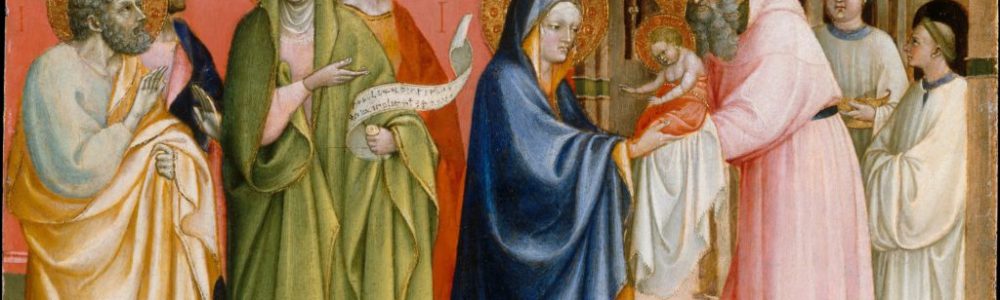
This gospel reading is also packed with irony. Jesus is presented in the temple, because the Torah says that “every male that opens the womb shall be consecrated to the Lord”. Now to consecrate means to ‘make holy’. But Jesus is the fount of all holiness; he is Lord, God the Son. This is irony. So too, Mary undergoes forty days of purification, but she is purity itself, for she is the Immaculate Conception, she is ‘full of grace’, as the angel addressed her at the Annunciation. Not only that, but Mary is, according to the author of the gospel of Luke, the New Ark of the Covenant. The Ark of the Covenant in the Old Testament was the holiest object in Israel, and it contained the tablets of the commandments, manna from the desert, and the staff of Aaron the Levite priest. Mary, the New Ark of the Covenant, contains in her womb Christ the New Law, who is the Bread of Life, and who is the eschatological priest who came to offer himself for the salvation of the world. She is the holiest of God’s creatures, and Joseph is the greatest saint next to her. Nonetheless, both of them submit to the requirements of the old law. That is perfect humility.

But there is more. Simeon is described as righteous and devout, awaiting the Messiah. It was revealed to him that he would not see death before laying eyes on Messiah. He recognized, through the Holy Spirit, that this child was the Messiah, and that he would be a sign of contradiction, and he turns to Mary and tells her that a sword will pierce your soul also. And Mary and Joseph both marvelled at what was being said by Simeon. Furthermore, Simeon blesses both Mary and Joseph. And so Mary, the greatest saint, full of grace, and Joseph, the greatest saint next to her, are amazed, impressed, they marvel at what was said about the child, and both are willing to receive Simeon’s blessing. Moreover, Anna, a prophetess, married and widowed, a woman of prayer and fasting, came forward too and spoke about the child. And one other irony: Mary and Joseph, the richest creatures ever created by God, are poor; for they offer the offering of the poor, two turtle doves instead of a lamb, and yet they hold in their arms the lamb of God who takes away the sins of the world. And Luke, throughout his gospel, depicts Mary as one who “ponders these things in her heart”. In other words, it’s not as if she knows everything. She learns, and marvels at what she learns through others like Simeon and Anna, the prophetess, and ponders what she hears.  

It is obvious that Mary and Joseph have no idea of their status before God, no idea of their holiness. Both of them allow themselves to be taught, and to be amazed; although the old law is fulfilled in her womb, Mary does not see herself as superior to the old law, nor as superior to Simeon or Anna, even though she is even higher than the angels.

This says a great deal about what true holiness is. Those who are genuinely holy do not know they are extraordinary; for they don’t compare themselves to others. The truly holy allow themselves to learn from everyone, and they are able to be impressed with others. The proud and envious, on the contrary, are rarely impressed with anyone or anything, unless it is related to them and glorifies them in some way. 

And rarely do they speak well of others. Although the true saint is hidden and unknown, because they don’t stand out, pseudo-saints find many subtle ways to make themselves stand out from others around them. Great saints don’t know they are saints, they don’t pontificate, they are not quick to correct others or give advice; pseudo-saints pontificate, are quick to offer correction, are quick to advise. True saints affirm others who go away from them always feeling better about themselves; but pseudo-saints do not allow others to leave them feeling better about themselves, but confused and doubtful about their worth. Genuine saints are very generous, pseudo-saints are stingy, not only with money, but with everything–they rarely praise or compliment others, unless the object of their praise somehow reflects back on them. And as genuine saints are not the least bit aware of their holiness, pseudo-saints are not the least bit aware of their pretension and hypocrisy, but see themselves as superior. 

Let me finish by saying that Pope Francis, early in his papacy, derided the notion of a self-referential Church, focused on itself. Many in the Church were distressed by the suggestion, but he continues to call the Church to turn outward, towards the world, to become a more listening Church. This is why he has put so much effort into Synodality; listening to the lay faithful, recognizing their gifts, talents, and expertise. In other words, he envisions a more Marian Church, a Church that, like Mary, listens and marvels at the extraordinary gifts, talents, insights and abilities of unknown men and women who are genuinely influenced by the Holy Spirit, like Simeon and Anna in this gospel.