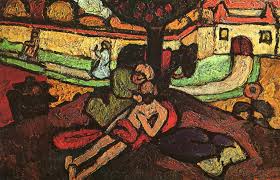
The Transfiguration and the Veiling of the Divine Glory

Deacon Douglas McManaman

The readings for the Second Sunday of Lent are about hope. In the first reading, the Lord gives Abram (Abraham) hope that his descendents will be as numerous as the stars of the sky, and that he will be the father of a great nation. In the Second Reading, Paul reminds us of the hope that the Lord will transform our bodies to be conformed to the body of his glory, by his power. And the gospel reading is an unveiling of Christ’s glory. Peter, James and John see Christ in all his splendor, his human nature permeated by the glory of the divine nature. It’s very hard to imagine what that experience was like for them, but they describe it as ‘kalon’, beautiful: “It is beautiful for us to be here”. 

This event is important because it is easy to lose hope, and if we lose hope, we have lost faith, and by faith we mean trust in Christ, in his promise of salvation, his promise of sharing in his everlasting glory. Peter, James, and John were given this experience to strengthen them for what is to come, namely the suffering and death of Christ. But if the glory of God the Son was unveiled at the transfiguration, it means that he was veiled beforehand. And this is what Paul says in Philippians: 

Though he was in the form of God, Jesus did not deem equality with God something to be grasped at. Rather, he emptied himself and took the form of a slave, being born in the likeness of men.

The key word here is “empty” (ekenosen). He emptied himself of the glory that he had as the only Son of God the Father. He took the form of a slave; the Greek word is doulou: servant, slave, from which the French word for sorrow or pain is derived: douleur. He became a man of suffering servitude. Paul continues:

He was known to be of human estate, and it was thus that he humbled himself, obediently accepting even death, death on a cross!

So his glory was hidden. He was unknown, unrecognized, as we read in the gospel of John: 

He was in the world, and the world came to be through him, but the world did not know him. He came to what was his own, but his own people did not accept him.

The glory of his divinity was hidden under the veil of his humanity. Hence, he was rejected. And this is what it means to live our life in Christ. He invites us to become like him, to share in his hidden life, to be hidden as well. 

The glory that is in you is the glory of his love (the Holy Spirit). The more that charity burns in you, the less you will be understood in this life. The reason is that we only really understand what has a likeness to ourselves, and most people are not like this God, who is Love and chooses servitude. So if you are a person of great charity, the very heart of your personhood will be veiled and you will suffer the pain of not being understood by most people, and there can be a certain loneliness in that. And because your love is great, your suffering will be that much greater as you behold the suffering around you, which increases your sorrow (douleur). Injustice bothers you more than it does others. Your lot (kleros) is to share in that hiddenness of Christ and the pain that goes with it. There is tremendous glory in that, but it is hidden, like his. 

But Christ says in Luke that there is nothing concealed that will not be disclosed, or hidden that will not be made known (12, 2). Given that the glory of his love is in you and growing, slowly transforming you into his image, that glory will one day be revealed. You will be transfigured. But today, very few people will truly know and understand you. This hiddenness is something that we have to learn to love. St. Silouan the Athonite writes: “When the soul sees the Lord, how meek and humble He is, then she [the soul] is thoroughly humbled, and desires nothing so much as the humility of Christ. And however long the soul may live on earth, she will always desire and seek this humility which passes all understanding.” 

Now the converse is also true. There are people in this world who seek their own glory, people whose predominant desire is to be known, admired, or barring that, feared. They love power and the glory of authority and having others fawn all over them; such people have an aversion to servitude. And so wherever there are positions of authority, such people will aspire after them, or aspire to be associated with those who have them. This is not to suggest that everyone in a position of power grasped after that authority; some are gifted leaders who would rather not have authority. One of the greatest popes in the history of the Church was Gregory the Great, a brilliant administrator and at the same time a great contemplative and pastoral genius–a rare and unusual combination. He was a monk, the first pope to have come from a monastic background. In the late 6th century, he wrote The Book of Pastoral Rule, a work that should be read by all who hold Church office. It is remarkable how well he understood human psychology, in particular the psychology of those who aspire after positions of authority and who abuse power, either by excess or neglect. As an example, consider the following:  

It is common that a ruler, from the very fact of his being set over others, is puffed up with elation, and while all things serve his need, while his commands are quickly executed according to his desire, while all his subjects extol with praises what he has done well, but have no authority to speak against what he has done poorly, and while they commonly praise what they should have reproved, his mind, seduced by what is offered in abundance from his subordinates, is lifted above itself; and, while outwardly surrounded by unbounded favour, he loses his inward sense of truth, and, forgetful of himself, he scatters himself on the voices of others, and believes himself to be as they say he is, rather than such as he ought inwardly to have judged himself to be. He looks down on those who are under him, nor does he acknowledge them as his equals; … he esteems himself wiser than all whom he excels in power. He establishes himself, in his own mind, on a lofty eminence, and, though bound together in the same condition of nature with others, he disdains to regard others from the same level.

What is interesting here is that the emptiness and small heartedness of such authority figures is veiled by the trappings of power and pomp, the complete inverse of the genuine follower of Christ, whose interior is rich with the glory of the divine love, but hidden behind the veil of the ordinary. And that’s why we are so often wrong in our judgments of others; we judge on the basis of appearances and forget that not everything is as it appears. As Pope Francis once said, we put clerics on pedestals, but they are only human beings, and if they relish the pedestal and in time fall off, we become terribly disillusioned, which can lead us to turn our backs on the Church indefinitely. But Peter, the first pope, did not lose sight of his own humanness and radical equality with others, for when he entered the house of Cornelius, he fell at Peter’s feet and paid him homage. Peter, however, raised him up, saying, “Get up. I myself am also a human being.” Unfortunately, history is filled with examples of human beings doing quite the opposite of what we see in the kenosis of God the Son. Instead of emptying themselves of the desire for glory and settling for a difficult life of hidden servitude, they relish elevation and cover themselves with trappings of glory and expect to be addressed by lofty titles. Our task, however, is to decrease so that Christ may increase, that is, increase within us, that his image may expand within us, that the love of God and neighbour may increasingly take possession of us, all under the appearance of the ordinary, like the Eucharist, which is the risen Christ under the appearance of an ordinary and unexciting piece of bread. 

Some Thoughts on Scripture and Ineffective Kerygma

Deacon Douglas McManaman

The Church of course has the task of proclaiming the gospel, the good news of deliverance, that is, the good news of Christ’s resurrection, the Christ who conquered death. The kingdom of God has been established in the Person of Christ, who is the Way, the Truth, and the Life (Jn 14, 6). The Truth that we are called to proclaim, however, is not so much a set of theses bearing upon a limited number of issues of personal morality, mostly of a sexual nature, but a Person, a risen Person whose mind we are called to make our own (Phil 2, 5).

Recently I read and commented on an article written by a US prelate, an article that to me came across as an attempt to provide a bird’s eye view of the relationship between the modern world–described as lost, confused and depraved–and the Church–or perhaps a conservative and faithful remnant within the Church that possesses and guards the “Truth” in its purity and fullness. The first few paragraphs of this article were devoted to sin, and the first specific example of what the bishop had in mind when talking about sin was the sexual revolution. This was soon followed by a reminder that the society in which we live denies moral absolutes and natural law, which in turn was followed by more examples that included abortion, the meaning and purpose of sexuality, the definition of marriage, and gender issues. These apparently constitute a sufficient moral characterization of the secular world we are living in. The focus of the article was clearly a moral one, but perhaps, I thought to myself, a wider and more complete description of contemporary society was forthcoming, but the examples were limited to “acceptance of contraception, homosexual activity, transgenderism, puberty blockers and surgery for minors and euthanasia”, which the author claimed are now being advocated for by some theologians, priests and bishops within the Church. 

I could not help but detect a radical change in temperature when I compared this article, rooted as it is in a very specific, limited, and legalistic/moralistic paradigm, and the actual gospels themselves. When we take a cursory glance at the gospels, for example, Luke and Matthew, we notice a very different hue, that is, an entirely different emphasis. Christ eats with tax collectors and sinners (thereby challenging the culture and social structure of prestige), he picks corn on the sabbath (violating religious law, which is made for man, not vice versa); he cures the man with a withered hand, delivers a dire warning to those who have plenty to eat now (“woe to you”), who laugh now, and blesses the poor, the hungry, those who are weeping now. Jesus speaks of the importance of compassion, he speaks of the true disciple, proclaims the coming of God’s kingdom and demonstrates that coming by raising the dead to life and working miracles, for example his power over nature. He speaks of following him along the way of the cross, and he gives power to heal, provides the criterion for greatness, which is humility and childlikeness; he commands us to forgive those who have trespassed against us, exhorts us to give alms and to sell our possessions, to trust in providence, and he derides the hypocrisy of the religious leaders.

He tells the parable of the good Samaritan which shines the light on the problem of putting ritual or liturgical purity over attending to the needs of our neighbour, and he teaches about the Lord’s incomprehensible mercy in three different parables. We encounter a single verse only on divorce (Lk 16, 18), followed immediately by eleven verses of a parable: the rich man and Lazarus, and more verses on the need for persistence in prayer, the power of faith, a note on humble service. We read about the presumption of the Pharisee and the humility of the tax collector, more on the dangers of riches, the healing of the blind man, the expulsion of the dealers from the Temple, the widow’s mite, and much more.

In Matthew’s Beatitudes we have poverty of spirit as a necessary condition for belonging to his kingdom, meekness, hungering and thirsting for what is right, mercy, the importance of peacemaking, undivided love of God, endurance in persecution, another single verse on divorce, followed by a multitude of verses on nursing anger, looking upon another with contempt and damaging a person’s reputation. We encounter more exhortation to remember the poor, to trust in providence, not to judge the hearts of others, to pray with faith, we see more cures, the scandal of eating with sinners and tax collectors, more parables of the kingdom of God, Christ’s compassion for the hungry and the subsequent miracle of the loaves and fishes, a single mention of fornication and adultery (15, 20), soon followed by another miracle of the loaves, more deriding of the religious leaders, a parable of the lost sheep which details not so much that they are lost as a result of their rejection of moral absolutes and natural law, but the fact that the Shepherd is concerned about and goes looking for the lost, and will not stop until he finds them. And of course there is the parable of the last judgment, which mentions nothing about sex, gender, divorce, homosexuality, or liturgy, but teaches us the meaning of attending to the hungry, thirsty, lonely, the sick, the imprisoned, with whom the Lord identifies so much that to serve or ignore them is to serve or ignore him.  

After reading this and other similar articles, I am inclined to offer some advice to the culture warrior who insists on a moralizing kerygma–as opposed to one well rooted in the gospel–, an approach that seems to have left things unchanged these past 50 years at the very least. When you are at war and you see that you’ve been losing the war for decades now and yet you continue to employ the same strategy, it is fair to suggest that you are a lousy general. You need to be replaced by one with fresh ideas and a more effective military strategy, one that actually works. Moralistic assertions of truths long rejected are not going to cut it. Furthermore, dividing the world neatly into “us” (the faithful ones who possess the “Truth”) and “them” (those on the outside, the confused, lost, and immoral) is not quite true to the facts. You have to be able to understand those who have left the Church–or have never been in the Church in the first place–and see that they indeed embrace many absolute moral principles and are in many ways good willed, but often carry emotional wounds that spawn inconsistencies in their thinking, like many in the Church who are on the “left” and the “right”. You have to be the kind of person who is able to enter into their lives, as Christ entered into the lives of those rejected, the outcasts, the downtrodden, the poor, those who were considered to be “forsaken” by God, and you have to be able to move them to love the Lord, but you can only do that the same way a mother awakens a smile in her baby, that is, by smiling at her baby. You have to be able to see the goodness in others and help them to see themselves from God’s point of view. Moralizing per se is ineffective. We should not confuse Christianity with Churchianity (Metropolitan Anthony Bloom)—such an approach has failed and continues to fail. We need a strategy that is more focused on relationships with real concrete people who are struggling to survive in this world, and less on relatively abstract moral arguments written for politically slanted Catholic journals that few people have time to read let alone know how to find. We need a strategy more focused on the Person of Christ and his message, which is a message of mercy, of the love and providence of God, that we are loved by God beyond our ability to conceive, that he loves us so much that he seeks us out and won’t stop till he finds us. In short, “relationship” is more fundamental than moral problem solving. 

Issues of personal morality are important and have their place, especially the direct killing of the mentally and terminally ill, but putting the cart before the horse keeps the horse from moving forward. I know of a man who overcame his addiction to pornography only after he fell in love with a woman. It was his experience of real love of a person that allowed him to see through the false love to which he was enslaved, the love of self. All the pontificating in the world would not have moved him off his addiction. Similarly, it is faith, which is a genuine confidence in a Person, namely Christ who loved us while we were sinners (Rom 5, 8), that is going to make all the difference in our lives. Martin Luther, one of the most misunderstood personages in the history of the Church, drew the following analogy that underscores the primacy of faith as trust: “When a man and a woman love each other and truly believe in their love, who teaches them how to behave, what to do, what to avoid, what to say or not say, and what to think? Their confidence alone teaches them all this and more. They don’t differentiate between actions: they do big, long, and many tasks as gladly as small, short, and few ones, and vice versa; all with joyful, peaceful, and confident hearts, each being a free companion to the other. But where there is doubt, people search for what is best; then they imagine different actions to win favor, yet they do it with a heavy heart and great reluctance. It’s as if they are trapped, more than half in despair, and often end up making a fool of themselves” (Luther, Martin. Treatise on Good Works: Modern, Updated Translation (p. 11). (Function). Kindle Edition. See also The Joint Declaration on the Doctrine of Justification, 1997, by the Lutheran World Federation and the Catholic Church. Dicastery for Promoting Christian Unity). 

Faith in the Person of Christ is prior to everything else. Repentance is not so much what an individual does in order to merit forgiveness; rather, it is what a person does precisely because he has been forgiven. Zacchaeus is an example of this pattern; for his repentance and good works came only after Jesus’ decision to approach him, almost impose himself, or invite himself to his house: “…come down quickly, for today I must stay at your house”. We tend to think of repentance and good works as a precondition for salvation: “If you repent, then Christ will enter your life”. No, Christ draws close to us, he enters our lives, and his “intrusion” is an unmerited gift, and only then are we able to respond accordingly: “Behold, half of my possessions I shall give to the poor, and if I have extorted anything from anyone, I shall repay it four times” (Lk 19, 8). Jesus did not go looking for Zacchaeus as though he knew Zacchaeus as a very generous soul concerned about the poor, a person of unimpeachable integrity; that’s not who Zacchaeus was–he was a hated tax collector who was indifferent to the poor and most certainly extorted others. Rather, Zacchaeus turns towards the poor and becomes a person of integrity precisely because Jesus found him first. 

We are all like Zacchaeus, especially St. Paul who viciously persecuted the Church prior to Christ’s approach that changed him forever. That is why the words of St. Isaac the Syrian are fitting: “Do not call God just anymore, for his justice is not manifest in the things concerning you” (The Ascetical Homilies of Saint Isaac the Syrian. 1.51.250.). What is manifest in the things concerning us is God’s absolute mercy. And, St. Silouan the Athonite prays: “How could I do other than seek You, for You first sought me and found me and gave me the ability to delight in Your Holy Spirit, and my soul fell to loving You” (A Year in the Holy Spirit with Saint Silouan the Athonite: A Calendar of Daily Quotes. Compiled by Elizabeth P. Fitzgerald. Kindle Edition, 2020. s.v., Feb. 14th. p. 17).

Creative and Destructive Conflict

Deacon Douglas McManaman
Also published at https://www.lifeissues.net/writers/mcm/mcm_422creativedestructiveconflict.html

A kiln is a furnace that dries out the potter’s clay and actually transforms it into a beautiful ceramic piece. We can’t use a clay bowl or cup that has not been in the kiln; it would fall apart, for it would be too soft. And of course, we are the clay, as we read in Isaiah, “Yet, Lord, you are our father; we are the clay and you our potter: we are all the work of your hand” (Is 64, 8). And so it follows that trials, sufferings, difficulties, are part and parcel of the spiritual life.

I have found over the years that the vast majority of people mistakenly believe that religious life, life in the Church, life in Christ, the devout life, is supposed to be a life of peace and tranquility, like the quiet of a cemetery, where everything works out smoothly and without a glitch. And so when things go awry, we tend to see this as an anomaly, that something is wrong, that if we are right with God, life should proceed without a struggle. But this is a serious misconception. Life is essentially conflict, because it is movement, and all motion is at some level a struggle. Anyone who has studied evolutionary biology knows this. There is no such thing as life without conflict and struggle.

There are, however, two kinds of conflict: destructive conflict and creative conflict. Sports (play) is essentially conflict and struggle, but it is an enjoyable one because it is essentially creative. Art is a matter of creative conflict, a battle between the sculptor and the resistance of the marble that he is about to carve into a beautiful figure. A life without creative conflict becomes intolerably dull and meaningless. In fact, heaven will be an eternity of creative conflict. Hadewijch of Antwerp writes:

God will grace you to love God with that limitless Love God loves himself with, the Love through which God satisfies himself eternally and forever. With this Love, the heavenly spirits strive to satisfy God: this is their task that can never be accomplished and the lack of this fruition is their supreme fruition” (Love is Everything: A Year with Hadewijch of Antwerp, trans. Andrew Harvey, May 1st). 

“Peace” and “rest” are not opposites of conflict, that is, heaven is not a life without obstacles and things to achieve. 

It is destructive conflict that is the problem. However, God joined a human nature, he joined himself to our humanity, and in doing so he entered into the destructive conflict that human sin has brought about in the world. The victory of that destructive conflict is death, which without Christ has the final word over our lives. But Christ came to die, to enter into our death, to inject it with his divine life, to destroy the power of death, to rise from the dead. He was victorious over death, and so he overcame the struggle of human existence, the battle against destructive conflict. 

Christ transformed the destructive conflict of death and sin in all its various instances into a matter of creative conflict, a matter of play, as it were: “When he set for the sea its limit, so that the waters should not transgress his command; When he fixed the foundations of earth, then was I beside him as artisan; I was his delight day by day, playing before him all the while, playing over the whole of his earth, having my delight with human beings” (Prov 8, 29-31). We can now share in his victory over both sin and death. He offers us his own humanity so that we might overcome our own life struggles with his strength: “I can do all things in him who strengthens me” (Phil 4, 13). The kiln that dries out all our moisture (disordered love of self) and in time transforms us into something beautiful is the particular difficulties and struggles that we have to contend with in our lives. And some people have greater struggles than others; the heat of the kiln is much hotter in their lives, and perhaps they have been in it for much longer than the rest of us. But the result is a more beautiful product from the hand of the potter. It is not the case that God wills that certain people suffer illness or tragedy; rather, God the Son joined himself to a human nature in order to draw very close to us in our suffering and trials, to give us his divine life that we might overcome the world and its conflicts with him and through him, that we might share in the joy of his victory. The greater the struggle, the greater the victory, and the greater will be the joy in that victory.

This, I believe, is the key to unlocking today’s gospel: “Can a blind person guide a blind person?…Why do you see the speck in your neighbour’s eye, but do not notice the log in your own eye?…first take the log out of your own eye, and then you will see clearly to take the speck out of your neighbour’s eye”. The spiritual life is a long and difficult road, a slow process of gradual enlightenment. I don’t know about you, but I do not like looking back at my life and being reminded of what I was back then, because I see my blindness. And of course, the blind cannot lead the blind. But the blind are leading the blind all the time. Even great saints had their blind spots. Study the history of the Church without triumphalist blinders: stupidity, arrogance, sin, oppression, envy, violence, lust for power, control, avarice, etc, is everywhere in our history. We have had great popes who did great things as well as some outrageous things; made great decisions as well as terrible decisions that were very destructive and whose repercussions are still with us today in many ways. It is a real mixture. But that’s life in the Church, as well as the life of the individual person in a state of grace. The spiritual life is conflict, a struggle, a struggle against our own blindness and propensity to sin and self seeking as well as the blindness of others and its repercussions. 

But before we can take it upon ourselves to correct others, we have to spend years in the kiln, in the furnace, allowing the fire of the divine love to change us so that we may remove the plank from our eye. Recently I asked my Confirmation class about the graces they are going to receive from God upon their Confirmation, specifically the grace of mission. 

“You are going to be sent on a mission; but to do what?” I asked them. 

One good candidate put up his hand and said: 

“To proclaim the gospel”. And of course, that’s a great answer. 

“But how are you going to do that?” 

“Preach”, he said. 

Well, the problem is you’ll lose friends quickly. If you want to be friendless, start preaching to them. If parents want to drive their kids from the church, start preaching. The way to proclaim the gospel is by the very life you lead. The gospel is the good news of Christ’s victory over death, his resurrection. We don’t need to use words. We just need to be a person who lives in the joy of Easter, a person who has the hope of eternal life, a person who is not overcome by life’s tragedies, because we believe that Christ has overcome the world and conquered death. Others will see that in us, by how we react to life’s difficulties and struggles, even life’s tragedies–that we have risen above them in the joy of the risen Christ. 

Catholic Tribalism

Deacon Doug McManaman

Today’s gospel reading (Wednesday of the 7th Week in Ordinary Time) is taken from Mark, chapter 9, verses 38-40. John says to Jesus that they saw someone casting out demons in Jesus’ name and that they tried to stop him, “because he was not following us”–as if it is about “following them”, and not Christ, or acting in the name of the Person of Christ. Jesus tells them straight out: “Do not stop him; for no one who does a deed of power in my name will be able soon afterward to speak evil of me. Whoever is not against us is for us”. 

It continues to puzzle me that this reading continues to fly over the heads of so many Christians today, including Catholic prelates, clergy, and very traditional Catholics who are thoroughly sectarian or tribal in their thinking. If there is one section of the gospel that rails against Catholic tribalism, it seems to me that this is the one. Had the hierarchy taken the path laid out by Pope Gregory the Great, a pastoral and administrative genius, rather than the authoritarian approach of Pope Leo the Great–not to mention Innocent III—, the history of Christianity would have looked very different than what it is now.  

When I study such great theologians as Jurgen Moltmann, or G. Studdert Kennedy, Sergius Bulgakov, or Vladimir Solovyov, Christoph Blumhardt or Gerhard O. Forde, Robin A. Parry or F. D. Maurice, etc., I lose all awareness that these people belong to another “tribe”, a different denomination, that is, that they are “Protestant”. All I sense is that we are of the same family; we are “of the same mind”, which is the mind of Christ Jesus (Phil 2, 5). 

The first reading from Sirach (4, 11-19) is also very revealing: “Wisdom teaches her children and gives help to those who seek her. Whoever loves her loves life, …Whoever holds her fast inherits glory, and the Lord blesses the place she enters. Those who serve her minister to the Holy One; the Lord loves those who love her.” My last 20 years of teaching were at a school in which close to 50% of my students were non-Catholic; many were Muslims, Hindus, Sikhs, and Buddhists, and many of these were genuine seekers of wisdom, lovers of wisdom, and they recognized wisdom whenever they encountered her. The Lord loves those who love her, and one cannot love her without divine grace, which is a sharing in the divine life. So much for Catholic triumphalism, Muslim tribalism, or any tribalism for that matter. 

I would not say that these people were “anonymous Christians”, a term made popular by Karl Rahner in the early post-Vatican II period. The best criticism of this apparently inclusive way of regarding those who are not explicitly Christian comes from Hans Kung, who writes: 

Karl Rahner’s theory of the “anonymous Christian” is in the final analysis still dependent on a (Christian) standpoint of superiority that sets up one’s own religion as the a priori true one. For, according to Rahner’s theory, which attempts to solve the dilemma of the “Outside the Church” dogma, all the Jews, Hindus, Muslims, Hindus, and Buddhists are saved not because they are Jews, Muslims, Hindus, and Buddhists, but because in the final analysis they are Christians, “anonymous Christians,” to be precise. The embrace here is no less subtle than in Hinduism. The will of those who are after all not Christians and do not want to be Christians, is not respected but interpreted in accordance with the Christian theologian’s interests. But around the world one will never find a serious Jew or Muslim, Hindu or Buddhist, who does not feel the arrogance of the claim that he or she is “anonymous” and, what is more, an “anonymous Christian.” Quite apart from the utterly perverse use of the word “anonymous”—as if all these people did not know what they themselves were—this sort of speculative pocketing of one’s conversation partner brings dialogue to an end before it has even gotten under way. We must not forget that followers of other religions are to be respected as such, and not to be subsumed in a Christian theology (Theology for the Third Millennium: An Ecumenical View. trans. Peter Heinegg. New York: Doubleday, 1988. P. 313). 

My students may not be “anonymous Christians”, but if they seek wisdom, love wisdom, and in serving her serve the Holy One who loves those who love her, then they are moved by grace, which is the indwelling of the Trinity. To be in such a state does not depend upon adopting a certain terminology or conceptual frame of mind, but on the love of her (Sophia). All things came to be through the Logos (Jn 1, 1ff), and all were created for him. Just as I can learn so much more about the Person of Christ, the Logos, by contemplating the cosmos that came to be through him and for him, so too I can learn so much more about the Person of Christ by contemplating the ancient wisdom of those who seek, love and live for the wisdom spoken about in the book of Sirach, the Sophia through whom and for whom all things came to be. 

The Feast of the Presentation

D. McManaman

The gospel reading on the Presentation is really about humility. The word humility comes from the Latin ‘humous’, which means dirt or soil. The humble are down to earth; they don’t walk high and mighty. But another English word that is derived from ‘humous’ is humour. Now what’s interesting about humour is that it hinges upon irony. You’ll notice this in the nicknames that kids give to one another. They are full of irony, which is why they are funny. The short kid is nicknamed stretch, the tall kid is given the nickname shorty, the skinny kid is nicknamed Hercules, and when I was a kid, they called me slim. 

What’s interesting about the gospel is that it is full of irony, and so it is full of humour–divine humour. St. Gregory of Nyssa calls attention to this divine irony in his sermon on the Beatitudes when he says that the judge of all creatures is subject to the judgment of mere humans, the author and sustainer of life tastes death, the all powerful is hungry for bread and dies on a cross, and so on. 

This gospel reading is also packed with irony. Jesus is presented in the temple, because the Torah says that “every male that opens the womb shall be consecrated to the Lord”. Now to consecrate means to ‘make holy’. But Jesus is the fount of all holiness; he is Lord, God the Son. This is irony. So too, Mary undergoes forty days of purification, but she is purity itself, for she is the Immaculate Conception, she is ‘full of grace’, as the angel addressed her at the Annunciation. Not only that, but Mary is, according to the author of the gospel of Luke, the New Ark of the Covenant. The Ark of the Covenant in the Old Testament was the holiest object in Israel, and it contained the tablets of the commandments, manna from the desert, and the staff of Aaron the Levite priest. Mary, the New Ark of the Covenant, contains in her womb Christ the New Law, who is the Bread of Life, and who is the eschatological priest who came to offer himself for the salvation of the world. She is the holiest of God’s creatures, and Joseph is the greatest saint next to her. Nonetheless, both of them submit to the requirements of the old law. That is perfect humility.

But there is more. Simeon is described as righteous and devout, awaiting the Messiah. It was revealed to him that he would not see death before laying eyes on Messiah. He recognized, through the Holy Spirit, that this child was the Messiah, and that he would be a sign of contradiction, and he turns to Mary and tells her that a sword will pierce your soul also. And Mary and Joseph both marvelled at what was being said by Simeon. Furthermore, Simeon blesses both Mary and Joseph. And so Mary, the greatest saint, full of grace, and Joseph, the greatest saint next to her, are amazed, impressed, they marvel at what was said about the child, and both are willing to receive Simeon’s blessing. Moreover, Anna, a prophetess, married and widowed, a woman of prayer and fasting, came forward too and spoke about the child. And one other irony: Mary and Joseph, the richest creatures ever created by God, are poor; for they offer the offering of the poor, two turtle doves instead of a lamb, and yet they hold in their arms the lamb of God who takes away the sins of the world. And Luke, throughout his gospel, depicts Mary as one who “ponders these things in her heart”. In other words, it’s not as if she knows everything. She learns, and marvels at what she learns through others like Simeon and Anna, the prophetess, and ponders what she hears.  

It is obvious that Mary and Joseph have no idea of their status before God, no idea of their holiness. Both of them allow themselves to be taught, and to be amazed; although the old law is fulfilled in her womb, Mary does not see herself as superior to the old law, nor as superior to Simeon or Anna, even though she is even higher than the angels.

This says a great deal about what true holiness is. Those who are genuinely holy do not know they are extraordinary; for they don’t compare themselves to others. The truly holy allow themselves to learn from everyone, and they are able to be impressed with others. The proud and envious, on the contrary, are rarely impressed with anyone or anything, unless it is related to them and glorifies them in some way. 

And rarely do they speak well of others. Although the true saint is hidden and unknown, because they don’t stand out, pseudo-saints find many subtle ways to make themselves stand out from others around them. Great saints don’t know they are saints, they don’t pontificate, they are not quick to correct others or give advice; pseudo-saints pontificate, are quick to offer correction, are quick to advise. True saints affirm others who go away from them always feeling better about themselves; but pseudo-saints do not allow others to leave them feeling better about themselves, but confused and doubtful about their worth. Genuine saints are very generous, pseudo-saints are stingy, not only with money, but with everything–they rarely praise or compliment others, unless the object of their praise somehow reflects back on them. And as genuine saints are not the least bit aware of their holiness, pseudo-saints are not the least bit aware of their pretension and hypocrisy, but see themselves as superior. 

Let me finish by saying that Pope Francis, early in his papacy, derided the notion of a self-referential Church, focused on itself. Many in the Church were distressed by the suggestion, but he continues to call the Church to turn outward, towards the world, to become a more listening Church. This is why he has put so much effort into Synodality; listening to the lay faithful, recognizing their gifts, talents, and expertise. In other words, he envisions a more Marian Church, a Church that, like Mary, listens and marvels at the extraordinary gifts, talents, insights and abilities of unknown men and women who are genuinely influenced by the Holy Spirit, like Simeon and Anna in this gospel. 

Suicide, Depression, and Salvation

https://www.lifeissues.net/writers/mcm/mcm_420suicide.depression.salvation.html

Deacon Douglas McManaman

Soon after ordination in 2008 I began to minister to those who suffer from mental illness (mental sufferers), and over the years I have known a few who have taken their own lives, including a former student and parent of that student, as well as patients that I came to know in ministry. On a couple of occasions I found myself situated between a rock and a hard place when asked by a patient suffering from depression whether she would automatically go straight to hell if she were to take her own life. The problem, I tell them, is that if I were to say ‘yes’, I’d be telling you something that I simply do not for an instant believe and feel that I’d be lying; if I were to say ‘no’, that it is not necessarily the case that you are going to hell for taking your own life, you might receive that as permission, and I cannot grant you that permission. Interestingly enough, the few that have asked me this understood, and as far as I know, none of those took their own lives.

But I have dealt with a number of patients before in the face of whose sufferings I have honestly said to myself, with tremendous fear and trepidation: “If I had to suffer the depression they are experiencing at this moment, I sincerely don’t think I could endure it. I’m afraid I’d “do myself in”.” I perceived very clearly my own inability to go on, on my own strength. 

One of the most significant moments in my life as a deacon was Christmas, 2011. Two days before Christmas, on the last day of school before the holidays in front of a classroom of senior high school students, I began to sweat and shake. I had to leave school quickly and went straight home to bed. Soon my head and shoulders were wracked with pain and my body was shaking with chills. The pain soon made its way down to my arms and wrists, and then my back and legs. Christmas dinner for me that year was a can of tuna; on Boxing Day I had to go to the Emergency. The emergency physician thought I could have polymyalgia rheumatica, a condition that typically strikes those who are 50+ and there is no known cure. I was given prednisone and oxycodone and sent home–the oxycodone was so powerful that I was too frightened to take any more after the first day. 

I honestly believed that I would not be returning to the classroom again, that my teaching career had come to an end, for I could not imagine teaching while in such pain. More importantly, I was battling deep despair—for no medical expert had an answer, none could tell me whether a light would eventually appear at the end of this tunnel. I was on the phone with my spiritual director every night, and I remember saying to him at one point: “I think I’m beginning to appreciate what my patients, who suffer from clinical depression, have to go through every day.” The thought that I had to endure this darkness for another week, let alone for years to come, was terrifying, and so I began to train myself to think not one week at a time, or one day at a time, but one moment at a time.

Things began to change when my spiritual director casually advised me to say the following prayer: “Into your hands, Lord, I commend my spirit; into your hands, Lord, I commend my spirit”. Of course, I knew that prayer, for it is part of the Night Prayer of the Breviary that we are required to pray daily. But when one has been saying a certain prayer for years on end, after a time it can become just words, without a great deal of thought behind them. So I decided that I would say this prayer, think of the words, and mean it. If I was no longer able to continue to teach and had to spend the rest of my life in a wheelchair, then your will be done, Lord; into your hands I commend my spirit.

That night I had the best sleep I’d had in years. I woke up feeling as though a cool breeze had passed through my body. I was still in a lot of pain, but the despair and darkness were gone, and eventually I was slowly weaned off of the prednisone. It turned out that my illness was not polymyalgia rheumatica, but the medical experts to this day have no idea what it was. Nevertheless, the experience was very important for me. 

Not that I ever had the inclination to do so, but I would not pronounce judgment on anyone in the throes of clinical depression who decided to take his/her own life, and I continue to be unpleasantly surprised that a good number of the faithful are under the false impression that anyone who does so is automatically consigned to a state of eternal damnation–and worse, that there are still a number of “pastorally challenged” clergy—few in number—who believe and teach this, and refuse to conduct a funeral mass for such a person.

Traditionally, there are three conditions required for one to be in a state of sin: knowledge, free deliberation, and serious matter. Clearly, taking one’s life constitutes “serious matter”, but free deliberation is the condition in which there is a serious mitigating factor, namely clinical depression. Dr. J. Raymond DePaulo Jr., writes: 

All too many people today still hold the belief that suicide somehow represents a rash but rational act committed by otherwise healthy persons. When someone takes his or her own life, the usual reactions are of shock and bewilderment. How could she do such a thing? She never gave any sign that anything was wrong. Or, Why didn’t he call me? I knew he lost his job … he and Janet split … but why this? But suicide is not an act committed by an otherwise healthy and rational person. On the contrary, more often than not, the person who commits suicide is in the throes of a severe depression when taking his or her life. And in most cases the act is preceded by severe depression with increasing signs and symptoms of hopelessness and despair. About two-thirds of the people who take their own lives suffer from major depression or bipolar disorder. Almost everyone else who commits suicide has depression, alcohol or substance abuse, or a delusional illness like schizophrenia.1

On 9/11, a number of people jumped off of the World Trade Center to their deaths. Did they freely choose to take their own lives? They certainly did not; and those who take their own lives to escape the utter darkness, the feeling of utter hopelessness, the depression they’ve had to endure for decades, are very much like those who jump from a burning building to avoid the flames. 

There is a distinction between small ‘d’ depression and major depressive disorder, which typically features a dramatic change in mood (sadness, anxiety, apathy, numbness, either separate or in combination), a loss of vitality, energy, concentration, as well as muddled thinking, a loss of self-esteem, a sense of uselessness, profound pessimism, and suicidal impulses. In some cases, anxiety and panic disorder occur as manifestations of the depression.2 What I experienced in 2011 was not major depressive disorder (clinical depression), but something much less severe; however, it provided me with some appreciation for what those who do suffer from this debilitating illness have to endure.

The Vocation of Mental Illness

On Holy Thursday night in Gethsemane, Jesus experienced the worst mental anguish, and he called Peter, James, and John to accompany him for one hour. But they could not do so; they slept. Mental sufferers, on the other hand, do not sleep; rather, they keep Christ company in his mental distress–and he keeps them company in theirs. Friendships are typically founded upon common qualities and interests. The special gift that mental sufferers are given by Christ is precisely this common experience, which makes them special friends of Christ. Thus, it is easy for me to believe that, instead of eternal despair, they will encounter the Lord’s gratitude for keeping him company in his mental anguish throughout all those years they had to endure it. Caryll Houselander writes: 

Mental patients often live out their lives in Gethsemane, and without alleviation for the fear and conflict that they suffer–and here it is that we discover the very core of the vocation of those who serve them. …Their great need is that which Christ pleaded for in Gethsemane–compassion. He did not ask them to try to do away with his anguish or to alleviate his passion, but simply to be with him, to enter into his suffering through compassion. But this even Peter, who would so gladly have swept the passion away, could not do! ‘Then he went back to his disciples to find them asleep; and he said to Peter, had you no strength then to watch with me even for an hour?’

It is the same today. In the mental sufferer Christ asks first of all and most of all for compassion, for those who will simply be with him, who will see through the sweat of his agony to the secret of his love.3

In terms of the proclamation of hope and the good news of divine mercy, I think I can safely argue that the traditional kerygma has been rather deficient over the centuries, and so many of the faithful today have had to carry the wounds of that deficiency for decades. We speak of the unfathomable mercy of God and his unconditional love on the one hand, and on the other hand we undermine and belie the claim as we project our own limits onto God, preaching what he is able to forgive and not able to forgive, turning the justice of God, revealed in Christ as absolute mercy, into an absurdity so much beneath the worst examples of human “justice”. No doctrine can be true which makes Jesus less than God, or which makes God less than Jesus.4 Priest and poet G. Studdert Kennedy writes:

A thousand mysteries begin to clear away, if we cling persistently to that great Name of God which is given by St. John: “God is Love” –the Love that was revealed in Jesus. That is not one of His attributes; that is His very Self. Cling to that Name, and use it, in all these great passages:

            “All we like sheep have gone astray; we have turned every one to his own way; and Love hath laid on Him the iniquity of us all.”

            “Love, for our sakes, in His own Body bare our sins upon the tree.” “Him that never knew sin, Love made to be sin for us.”

            Doesn’t a light begin to break through?

            I remember being called upon to visit a man who was in prison for forgery and embezzlement. He was the queerest, crookedest, hardest-hearted specimen of humanity that it has ever been my luck to strike, and I could not move him an inch nearer repentance. The only sign of softening that he showed at all, was when he asked me to go and see his mother. I went. She came down, looking worn and sleepless, and that I expected. But there was something about her which I, being young, could not understand. She was bitterly ashamed, and in my pity for her I wondered, What has she to be ashamed of? And then there came the light, and I murmured to myself: Surely she hath borne his griefs and carried his sorrows; the chastisement of his peace is upon her, and with her stripes he shall be healed, if there be any power that can heal him. He has gone astray and turned to his own way, and Love hath laid on her the iniquity of her son. The mother-heart which knew but little sin, Love hath made to feel exceeding sinful for his sake. I understood and, in a measure, the eternal mystery cleared. That love which a woman can pour out upon her son, and which makes her so entirely one with him, that his sin is her sin, his disgrace is her disgrace, his shame is her shame, is the nearest that we can get upon earth to the love of God; to what God is.

            It was that love, extended to infinity, which beat within the human heart of Christ, God Incarnate, and made Him feel to every man, every woman, and every child in all the world, as that mother felt for her son; so that our sins became His sins; our disgrace His disgrace; our shame His shame; and in His own Body He bare our sins upon the tree.5

A close priest friend of mine once preached that God can control his anger, but he cannot control his mercy. This is the God who has been revealed in the Person of Christ, the Good Shepherd who seeks the lost. He does not wait for us to seek Him out, rather, He goes in search of us and will not stop until He finds what He is looking for. This is what is so important about the parable of the lost coin. We miss the radical nature of the divine mercy when we focus solely on the parables of the Prodigal Son and the Lost Sheep, and overlook this very short parable in the fifteenth chapter of the gospel of Luke. At least the prodigal son freely chose to return home to beg for mercy; the lost sheep is alive enough to bleat in the wilderness, enabling the Shepherd to follow the sound in order to find it and bring it home. Both are alive. But a coin is a lump of inert matter; it is dead. It cannot rise up and make its way home nor cry out for mercy. It is entirely lost, hidden in the dust of a first century Palestinian floor. But God’s love is comparable to the love of a woman who lights a lamp and sweeps the house, searching carefully until she finds it. This is what God is like. St. Paul says, “While we were sinners, Christ died for us”. In other words, before we turned to him and repented, He loved us. “In this is love: not that we have loved God, but that he loved us and sent his Son as expiation for our sins” (1 Jn 4, 10). This is the heart of the mystery of grace that so few have been able to grasp, more than likely as a result of the tendency to look at sin through a juridical lens. As Studdert Kennedy points out: “Sin did estrange man from God; but it never has, and it never could, estrange God from man. God never waits for us to come to Him, God is for ever coming to us–He is the coming God.”6 Further, he writes: “We get much nearer to the significance of the forgiveness of sins, when we think of it in terms of life, than when we think of it in terms of law. Forgiveness is always regeneration, new birth; sin is always a process of decay, rather than an act of disobedience.”7

If I am saved, I am saved personally, but not individually. It is the person, not the individual, who has been created in the image and likeness of God, who is a Trinity of Persons, Father, Son, and Holy Spirit, a plurality in unity. I am saved as a plurality, a member of Christ’s Mystical Body, a member of a Brotherhood, a community in which salvation is made possible. And if I am not saved individually, it is because I am not redeemed individually, and by extension I am not condemned or lost individually. Many others share in responsibility for my state of being lost. This, I believe, is the point made by the Elder Zosima in Dostoevsky’s The Brothers Karamazov:

My friends, ask God for gaiety. Be gay as children, as the birds of the sky. And let not human sin confound you in your deeds, do not be afraid that it will frustrate your task and not allow it to be accomplished, do not say: ‘Strong is sin, strong is impiety, strong is the vicious world in which men live, and we are alone and helpless, that vicious world will frustrate us and not allow us to accomplish our good deeds.’ Avoid, O children, this melancholy! There is but one salvation from it: take yourself and make yourself a respondent for all human sin. Friend, this is indeed truly so, for no sooner do you sincerely make yourself the respondent of all creatures and all things than you will immediately see that it is in reality thus and that it is you who are guilty for all creatures and all things.8  

Sin is not a private affair between me and God, or you and God, but is a public affair. My sins have repercussions that extend beyond the circle of my own private relationship with God; they adversely affect others in ways that I am currently unaware of. If one person is in hell, we are all in hell, for the “one” who is in hell is my brother, my sister to whom I am attached—to whom I am a respondent. There is nothing I can do to detach myself from him so that he suffers by himself and I am left unaffected: “… if you bring your gift to the altar, and there recall that your brother has anything against you, leave your gift there at the altar, go first and be reconciled with your brother, and then come and offer your gift” (Mt 5, 24). I will never be saved completely as long as my brother, my sister, is in hell and has something against me (See 1 Co 15, 20-28). The love of Christ was universal in the fullest sense of the word, and we are called to love in the same way: “As I have loved you, so you also should love one another” (Jn 13, 34). The mother has made herself responsible (a respondent) for the sins of her son, for she looked worn and sleepless, an image of God, whose worn out and sleepless face is Christ crowned with thorns. She bore his griefs and carried his sorrows, and the chastisement of his peace is upon her, and with her stripes he shall be healed. If I choose to love as I have been loved by Christ crowned with thorns, then I will carry the sorrows of the condemned, the chastised (kolasis), and the heavenly liturgy will wait for us, in the Person of Christ, to destroy hell’s brass gates, who destroyed those gates on Holy Saturday.9 We cannot endure the suffering of our damned son or daughter, for if we belong to Christ, we are joined to their suffering (1 Co 12, 26). Mental sufferers too do not allow us to suffer alone because they do not allow Christ to suffer alone; for Christ purchased their suffering, making them co-redeemers, that is, sin-bearers. Caryll Houselander writes: 

This is a vocation in which everyone, not only the specialist, has some part because it depends on an attitude of mind and heart, which for the majority of people must mean a change of mind and heart toward the mental sufferer, who is of all suffering people the least understood. This change of heart, and with it power to help the mental sufferer, means learning to recognise Christ in the patient and to recognize the patient’s own vocation, his part in Christ’s passion and his gift to the world. For he, by his unique suffering, is taking part in the world’s redemption. 

This must never be forgotten. The mental sufferer must never be regarded as one whose life is without purpose or meaning, as a burden to his family, or as one who gives nothing to those who care for him, because he is in fact giving the redeeming suffering of Christ, on which the salvation of the world and each one of us depends.10

Some Final Thoughts

Of course, the clinically depressed are also sinners, like everyone else, but their depression is not an indication or the result of a moral failure—at least not a genuine mental illness consistent with holiness11—, and much less is it a punishment for sin— another offshoot of a juridical paradigm, which formed the background of centuries of bad preaching. Their suffering is a vocation, as is ours, which always involves sin-bearing to one degree or another, whatever that vocation is. God the Son entered into human suffering in order to redeem it and make us sharers in his redemption. Those who suffer from mental illness share in this to a somewhat greater extent than the rest of us. 

To be called to minister to them either professionally (I.e., the psychiatrist and psychiatric nurse) or non professionally is to be called to a highly noble task. It is a ministry of compassion in the true sense of that word: “to suffer with…” It is a mission of accompaniment, a call to taste their darkness, and this we do to the degree that we love them. Our task is to join the light of our hope and the joy of the risen Christ to their darkness. To the degree that we taste their darkness, they taste our joy and the hope of new life. Although we may not have the privilege of being Christ’s special friends, those called to minister to them may have the next best thing, namely the vocation to serve them who in turn accompany Christ in his mental anguish. The evolution of that branch of medical science that seeks to understand and treat clinical depression and other mental disorders is a sacred history because it is ordered to the good of man, whose existence is ordered to Christ: “For all were created through him and for him” (Col 1, 16). Those current achievements are the fruit of creative conflict, a battle rooted in the love of humanity, ordered to the overcoming of an illness that cripples so many human persons.12

Notes

1. Dr. J. Raymond DePaulo Jr., Understanding Depression: What We Know and What You Can Do About It. New Jersey: Wiley & Sons, Inc. 2002, pp. 133-134.

2. Ibid., p. 23. See also p. 51ff. 

3. Caryll Houselander. “The Care of the Mentally Ill” in The Mother of Christ. London: Sheed and Ward, 1978, p. 104.

4. G. A. Studdert Kennedy. The Wicket Gate or Plain Bread. London: Hodder and Stoughton. 1935, p. 197.

5. Ibid., pp. 197-199.

6. Ibid., p. 178.

7. Ibid., p. 178-179. About twenty years later, Nicholas Berdyaev writes: “There is something servile in the interpretation of sin as crime which infringes the will of God and calls for legal proceedings on the part of God. To overcome the servile conception means movement within, movement in depth. Sin is dividedness, a state of deficiency, incompleteness, dissociation, enslavement, hatred, but it is not disobedience and not formal violation of the will of God. It is impossible and inadmissible to construct an ontology of evil. The idea of an eternal hell is, therefore, absurd and evil. Evil is but a pathway, a testing, a disruption; to fall into sin is above all else a testing of freedom. Man moves towards the light through the darkness. Dostoyevsky revealed this more profoundly than anyone.” The Divine and the Human, trans. R. M. French. London: Geoffrey Bles, 1949. p. 89. 

8. Bk 6, ch. 3 (g). translated by David McDuff. New York: Penguin Books, 2003, p. 414.

9. “Death, unwilling to be defeated, is defeated; corruption is transformed; unconquerable passion is destroyed. While hell, diseased with excessive insatiability and never satisfied with the dead, is taught, even if against its will, that which it could not learn previously. For it not only ceases to claim those who are still to fall [in the future], but also sets free those already captured, being subjected to splendid devastation by the power of our Saviour.… Having preached to the spirits in hell, once disobedient, he came out as conqueror by resurrecting his temple like a beginning of our hope, and by showing to [our] nature the manner of the raising from the dead, and giving us along with it other blessings as well.” Cyril of Alexandria, Fifth Festive Letter, 29–40 (SC 372, 284). Quoted in Metropolitan Hilarion Alfeyev, Christ the Conqueror of Hell, New York: St. Vladimir’s Seminary Press. p. 78. Commenting on this text, Metropolitan Hilarion writes: “Clearly, Cyril perceives the victory of Christ over hell and death as complete and definitive. For him, hell loses authority both over those who are in its power and those who are to become its prey in the future. Thus the descent into Hades, a single and unique action, is perceived as a timeless event. The raised body of Christ becomes the guarantee of universal salvation, the beginning of the way leading human nature to ultimate deification.” Ibid. Consider, as well, Fulton Sheen’s vision of the man on a cross. Upon attempting to take the nails out of his feet, the man said: “Let them be; for I cannot be taken down until every man, woman, and child come together to take me down”.

10. Op.cit., p. 96-97.

11. In this article, I have limited myself to discussing mental illness consistent with sanctity; there is, however, mental illness that is inconsistent with sanctity. See Thomas Verner Moore. Heroic Sanctity and Insanity: An Introduction to the Spiritual Life and Mental Hygiene. New York: Grune & Stratton, 1959. 

12. “It was not only of his historical passion that he spoke when he said, ‘Lay up in your hearts these words; for it shall come to pass, that the son of man shall be delivered into the hands of men’. For as long as this world lasts, and men live and love and suffer and die in it, the passion of Christ will go on, and he will suffer it in the lives of men. Because this is so, all vocations, however varied outwardly, have fundamentally the same object, the comforting of Christ, and there is none of which this more true than that of caring for the mentally ill.” Caryll Houselander, Op.cit., p. 96. 

Joining Humanity and Divinity

https://www.lifeissues.net/writers/mcm/mcm_419homily12.29.2024epiphany.html

Homily for the Epiphany of the Lord
Deacon Douglas McManaman

It is fitting that we exchange gifts at Christmas, because our life in Christ is a gift exchange. He came among us precisely to exchange gifts. Jesus is God the Son, the Second Person of the Trinity, who joined his divinity to a human nature. In joining a human nature, he joined divinity to humanity. Vatican II pointed out that in joining a human nature, God the Son is intimately present to every man (joined himself to every man, as it were). But he does not force himself upon anyone. His Incarnation is an offer of exchange, and the exchange is: If you give me your humanity, I will give you my divinity.  

Jesus is both human and divine, and he offers us the opportunity to become both human and divine; for it was St. Athanasius who said: “God became man so that man might become god”.

Parents who have their children baptized carry out this exchange; parents offer their children on their behalf. They give to Christ the humanity of their child, and in return, Christ gives that child his divinity. The result is that the child leaves the Church a different creature than when he or she arrived. That child has been deified, divinized, filled with divine grace (theosis). That child is human, but at the same time more than human. That child shares in the divine nature, and so he or she is more than human without ceasing to be human, and as a result that child has capacities that he or she would not have without divine grace, such as the power to believe what Christ has revealed about himself (faith), the capacity to hope for eternal life, and the power to love God intimately, as an intimate friend between whom secrets are shared. None of this is possible without divine grace. And of course, the child receives the 7 personal gifts of the Holy Spirit, as seeds that will unfold as the child continues to grow in faith. And there’s no doubt in my mind that parents for the most part have no idea the good they are doing for their children and for the world in offering their children for baptism. They have a sense that this is a good thing, because they arrange for baptism, even when they are not fully practicing the faith themselves. But they don’t fully realize how much good they are doing for their children and for the world in doing so.

That is the exchange that Christ offers us. I will give you my divinity if you give me your humanity, and it is a giving that we have to renew for the rest of our lives, because we tend to drift away from him over the course of the years. We tend to get caught up in things that ultimately don’t matter; we get distracted by fear and the lures of pleasure, power, and money, and sin blinds the mind to a certain degree, which allows us to veer away even further. And if we are reflective enough, we become aware of an increasing emptiness–these things don’t fulfill us, and the reason is that we became a “son of God”, deified, divinized, sharers in the divine nature. That’s our deepest identity. In 1920, army chaplain and poet G. Studdert Kennedy wrote: 

If I am the son of God, nothing but God will satisfy my soul; no amount of comfort, no amount of ease, no amount of pleasure, will give me peace or rest. If I had the full cup of all the world’s joys held up to me, and could drain it to the dregs, I should still remain thirsty if I had not God. If the feast of all the good things of life, pleasures and powers that have been and that are, could be laid out before me and I could eat it all at one meal, I should still be hungry if I had not God. Nor would it satisfy my soul, if I could be assured of an infinite extension of this present life at its best, apart from God. If the feast of this life’s goods could last forever, yet would I start up from the table satiated but still unsatisfied, because I had not God. There is not enough in ten material worlds to satisfy a fully-developed human soul–I must have communion with God. Whatever tends to break that communion is an enemy of mine, however much it may pretend to be a friend. However stubbornly I may stick to the delusion that I can live without Him, however closely I may cling to the idol that I put up in His place, sooner or later, in this world or in the next, the idols and delusions will have to go.

There is another side to this exchange. In joining his divinity to our humanity, Christ joined the divine joy to the suffering of our humanity, and this is something we can experience as well. If I am a son of God, if Christ’s divinity is joined to my own humanity as a result of my own willing acceptance of that divinity, and if I have made some progress in the spiritual life, then I can sense the joy of that divinity in the midst of suffering, especially physical suffering. Although the suffering is horrible, whether it is a kidney stone, a painful illness, or the pain of dying of old age, at the very core of one’s being, there is joy. Not exhilaration, not exuberance, but a tiny and subtle flame of joy suffering cannot touch or extinguish, only illuminate. In my experience with dying patients, it is always those with real faith who, although they are experiencing some agony, have not lost charity, but are still full of gratitude, still thoughtful, still good natured. This is rarely the case with people who are dying. There is a clear difference between dying patients who have lived a life of faith, hope, and charity throughout their lives, and those who seemed to have refused the divine exchange.

And so there is really nothing to fear when it comes to pain and suffering, if we have given our humanity to him. At the deepest center of our nature, we will detect the divine light, which illuminates and brings a degree of warmth in the midst of that suffering, so that the suffering does not overwhelm us with fear and despair. 

Complicity

Deacon Douglas McManaman

Recently I encountered a woman who said to me that many people have left the Church as a direct result of the news of the unmarked graves on the property of the old Kamloops Residential School in British Columbia–her husband being one of them. Of course, there is no denying that the Residential school system, at its origin, constituted a fundamental violation of the basic human rights of the Indigenous peoples of Canada. In 1883, John A. MacDonald wrote: 

When the school is on the reserve the child lives with its parents, who are savages; he is surrounded by savages, and though he may learn to read and write his habits, and training and mode of thought are Indian. He is simply a savage who can read and write. It has been strongly pressed on myself, as the head of the Department, that the Indian children should be withdrawn as much as possible from the parental influence, and the only way to do that would be to put them in central training industrial schools where they will acquire the habits and modes of thought of white men.

Despite the fact that a number of First people had positive and memorable experiences in their Residential schools, the entire system originated in and existed under the umbrella of this utterly racist conceptual frame of mind and culturally genocidal purpose. It goes without saying that the Church should never have cooperated with the Canadian government in this. But they, along with the rest of the country, did cooperate with it.

In this light, why would I want to belong to such an organization as the Roman Catholic Church? I guess it is the same reason that I choose to belong to this country, Canada, which obviously has a very sordid history–it is not on account of this country’s sins that I wish to belong to it, but on account of the tremendous goods that this country has managed to achieve throughout its long history. In belonging to the Church, I certainly belong to an institution that has a very sordid past, but is there a nation or institution in this world that does not? Is it even possible for an individual person, a saint even, not to have a relatively sordid history? Don’t we all look back at our lives and shake our heads? 

The process of coming to belong to the Church is not in any way the same as the process of coming to belong to any other institution, such as a corporation like Pepsi or Bell Canada, or a hospital or educational institution, etc. The reason is that the object of faith is not the Church as such, but Christ. For a person to believe in Christ and to enter into his death through baptism is to become, by virtue of that baptismal immersion, a part of his Mystical Body, and that person’s eyes are still on Christ, not on his Church; for he has become that Church, a member thereof, and he is taught to say every day: “Forgive us our trespasses as we forgive those who have trespassed against us”. The reason for this is that he remains a sinner, but one who has been “deified”, filled with divine grace, not by virtue of anything he has done, but simply by virtue of the unutterable mercy of God. His life is now a battle to overcome the effects of his wounded nature, namely, death, concupiscence, and the dulling of the mind. His life will therefore be one of continual reform, which is why the Church as a whole is in continual reform, for the Church is made up of sinful and flawed human beings whose minds are to a degree blinded by sin. There is no getting around this. And that is why the study of the history of the Church is a rather painful experience for the Catholic who has an idealized image of the Church, as a child has an idealized image of his own mother and father–the child chooses not to see what he simply does not want to see.

Those who choose to leave the Church because highly scandalous behaviour on the part of clergy or religious has been reported in the news, such as the operation of Residential schools and the abusive behaviour that took place in those institutions, or the clerical sex abuse scandals, etc., seem to believe that they have no complicity in the sins of the nation and the sins of the Church. But we were all complicit at the time–practically everyone operated within the arrogance of a Eurocentric worldview that looked down upon Indigenous culture, a worldview that kept us from appreciating its beauty and value, and we are all complicit today in the perpetuation of the injustices that First people continue to endure, such as lack of clean drinking water on the reserves among other things. And we are complicit in the injustices that Canadian young people and young families are forced to endure (i.e., housing prices and the cost of living) as a result of political and economic decisions made by an unjust and incompetent government that we put into power and kept in power. This notion of universal complicity is not a new concept, by any means. In 1923, G. Studdert Kennedy wrote:

Not long ago, a man was sentenced to ten years penal servitude for holding up a post office and shooting at a policeman. He was one of the army of unemployed in London. He had a wife and two children; he paid 8s. 3d [8 shillings, 3 pence] a week for two rooms in Whitechapel, which were so dark that the gas had to be kept burning all the time; he had fought in the army and been wounded, and he had done 10 weeks work in 18 months. He was not a good character, being weak and easily led; but in any decent community rightly ordered, he would in all probability have led quite a decent life. But in “justice“ he is to serve ten years. I am not disposed to rail at the courts – I think the sentence was inevitable for the protection of society, but purely for that reason, and not because it is just. He is suffering as much for the sin of the world, for your sin and mine, as for his own (The Wicket Gate, p. 73).

A person who leaves the Church or refuses to have anything to do with the Church because of her past sins has, at the very least, committed the fallacy of judging the past by the standards of today; to do so is to misunderstand the nature of human progress. I am what I am today because of the imperfections and mistakes of my past, and what I know today was the result of a decision to continually reflect upon my life as it was unfolding and as it unfolded. In other words, it was a result of a continued reflection upon my experiences, which are now past. All of us are expected to grow from experience, but how can a person be changed for the better unless he was in some ways worse than he is today? This means that if we are changing for the better, as we have a responsibility to do, then we can reasonably expect to experience disappointments when looking back on our lives. Individually, we cannot help but judge our own past by the standards we currently live by, but it seems we have no choice but to forgive ourselves, because the standards we hold up for ourselves today are the result of that experience and our own decision to reflect upon it, in light of moral principles we have discovered along the way–not to mention the resolution to improve. But for some reason we judge others’ histories with much less patience than we do our own; we overlook that the growing process is the same for everyone, every nation, and every institution. And of course, that does not necessarily cancel our responsibility for certain past decisions–one may still have to make reparation for a decision made long ago, perhaps a criminal decision or simply an immoral decision that left another or others profoundly hurt. But why would I walk away from the Church that Christ established— the Church that abandoned him on Holy Thursday night—, for being exactly the kind of developing organism that I have always been and cannot otherwise be?