Thoughts on the Trastevere

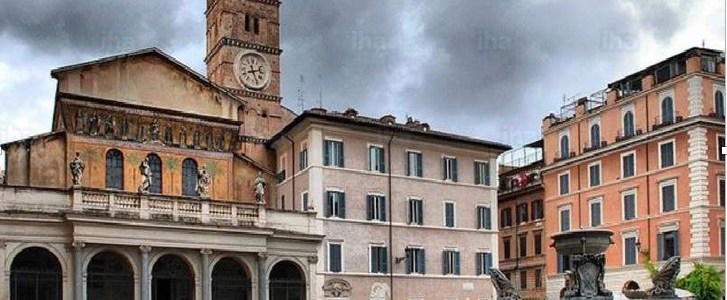
I have a picture of the piazza di Santa Maria, which is in the heart of the Trastevere (Rome), on my computer. I am familiar with this piazza, I’ve been there a number of times. In fact, if one were to drop me off anywhere in Rome, I would be able to find my way there. I’ve been inside the Basilica di Santa Maria, in Trastevere, which is one of the most beautiful Churches in Rome. So when I gaze at this picture, I think back to the time I spent there. 

Each time I gaze at the picture, however, I notice a detail or two that I did not notice while there. There is so much about this small area that I was not explicitly aware of. I often gaze at the apartments surrounding the piazza; I was not aware of the number of apartments there are–in fact, I still don’t really know, I haven’t counted–, nor do I know who owns those apartments, whether they are rented out or not. I do not know the apartments from within, I’ve never been inside them, and I don’t know the occupants, what they do, where they came from, I don’t know the two restaurants on the street level, I’ve never eaten there, nor have I worked there, so I don’t know the employees or the owner, what it is like to work there every night, etc., I don’t know what kind of plants are in the pots, nor do I know anything about the architecture of those buildings, how they were designed, nor the kind of drywall used for the interior, I do not know the kinds of materials used on the outside of the apartments, I do not know about the wiring (the quality of wire used, nor how the building was and is now wired, whether or not it has changed, etc.), nor do I know anything about the plumbing (the kind of metal pipe used, the plans for the plumbing), etc. I have been inside the Church, but there is so much to know about the interior, such as the ceiling and when it was built, the art, who produced it and when, the floor of the Church, who designed it and when and under what circumstances; I do not know about the geological features below the ground on that small piazza. In short, there is so much about the history of that piazza that I am unaware of and will always be unaware of; there is a veritable cognitive inexhaustibility about that little place that I am, nevertheless, familiar with. I could spend more time there and if I did so, my understanding of it would gradually increase, especially if I had access to a historian, a geologist, an architect, and a carpenter perhaps. After a time, I would very likely not look at that piazza the same way again, just as we do not look at anything we come to know more fully the same way as we did initially. 

The world is like that; science is like that. In the 1950s, we had no idea that there was so much more to the cell than what we thought at the time, i.e., a membrane, a nucleus, protoplasm, etc. We now appreciate that the complexity of a cell far exceeds that of a computer. How much more is there to the physics of a simple water molecule than what most of us currently know about water? How much more is this true of human nature? Consider what cognitive psychology has discovered about the epistemic conditions that are behind the day to day judgments we make, almost entirely unaware of the influences that have shaped those judgments? I know what I know, but I tend not to be aware of how much I do not know and how much more there is to know about the very things I know. I can make myself aware of it to some degree as I have done here, but the details will always escape me, for if I understood the extent and the details, I would not be ignorant of them. I can only know my ignorance generally. 

The same is true of people. How much about these students before me do I not know? How much more is there to know about them? 

Now all these new pieces of information that are gradually acquired as my experience is enlarged are data, as it were, that become part of the limited set of data we already have, on the basis of which we draw our conclusions about the real. I come to a conclusion about the student in front of me (or any person, for that matter) or the city I’ve been to twice, etc., on the basis of the evidence I have up to this point, that is, the data, the theses that constitute the set I now possess. I draw a conclusion about this person, or about Italy, the Trastevere, the food, etc., on the basis of the data I have acquired. New data might corroborate a judgment, it might enrich it, but new data may also render my current set of data internally inconsistent, which in turn affects the plausibility of the data I have. In other words, some theses will have to be dropped, for their plausibility has been drastically reduced. I have to adjust, that is, accommodate the new data, throw out certain theses, etc. For example, I may learn that this student before me is actually abusive to her parent, or I may become aware that he has autism spectrum disorder, etc. Or, thinking back to the piazza di Santa Maria, I may say to myself: I’d love to live here in one of these apartments. But with further data, I may change my mind. I look at those apartments now and certain feelings of nostalgia arise, but after years of acquiring new data (perhaps as a result of living there), that may change. I may become completely indifferent to this place; I may never want to see it again. Sometimes ignorance is bliss; for if I am ignorant, I can imagine anything I want about this place, i.e., a life that is exhilarating, but in the end the product of my imagination is unreal. 

Think of growing up in a white, American, Catholic/Protestant world. The Sikh, the Hindu, the Muslim, etc., all come across as foreign. I don’t know what they believe, how they think, but they do dress differently, their symbols are different, they don’t eat the same kinds of foods. Initially at least, they appear as strange; they are an enigma. The usual course of action is to react defensively: I remind myself what it is we believe, that we see the world as it really is, that our way is right, it is the norm, and they are not part of that norm; I tend to think they should assimilate to our way of life, or way of dress and way of thinking, eating, etc. The unknown can give rise to fear. But as we come to know them, as we begin to live with them day in and day out, we begin to understand one another. Fear begins to subside, and they are not so foreign anymore; we realize that they are in many ways just like us. And they too looked at us as foreign, and they have or had the same defensive reaction. The world as they see it makes sense to them, it is right not just to them, but absolutely, and in their minds perhaps, we are the ones who have to assimilate. In other words, they can be just as dogmatic as we are. But this new encounter enriches us both with new information, and so it can enlarge our cognitive frame of mind. It is a real personal encounter that provides this new data, which may corroborate or render inconsistent the set of data we already possess and through which we see and interpret the real. 

This epistemic process involved in plausible reasoning takes place within the realm of theological science as well–how could it not? There is so much about my Sikh brother that I don’t know about, and there is so much about me he does not know about, and as Socrates pointed out, there is so much about me that I don’t know about, and as the Old Testament makes clear there is so much about God that I don’t know about; as a Christian, there is so much about Christ that I don’t know about. Indeed, I can say with St. Paul that Christ lives in me and I live in him, but how much more is there to know about him? The knowledge I refer to here is connaitre, the French verb for connatural knowledge, the kind we possess for those close to us. The more I love someone, the more I enter into a kind of union with that person, and the result is the more I know him. Do I really believe my love for Christ is adequate? And so isn’t the same epistemic process at work in my knowledge of Christ? Isn’t the same process at work in a Muslim’s knowledge of Allah or a Jew’s knowledge of G_d? And, could further data upset the applecart of my own set of data, my own limited cognitive framework? Of course it can and it will, in due time. My conclusions are tentative because they are not strictly deductive; they are a matter of coherence. They are maximally plausible on the basis of the theses I have at my disposal. But the plausibility of these theses may change with further data. We see this type of growth and development–sometimes revolutionary–throughout the history of the Church. If the 10th or 14th century Church were to look into a crystal ball and see the Church in the 21st century, with its expanded understanding of human rights, the right to freedom of speech, our post-Vatican II ecumenism or pastoral approach to human beings, our understanding of the separation of Church and state, perhaps the way people dress, etc., would she be scandalized?

There are none so blind

Reflection for the 4th Sunday of Lent

@Where Peter Is

Deacon Douglas McManaman

Many years ago people would often ask me whether I thought this person or that person in the seminary was going to make a good priest, and I would readily offer my opinion. I’ve since refused to answer such questions only because I’ve been wrong far too often. This person, who I thought would make a great priest, turned out not to be, and that person who I thought would not last very long turned out to be a fine and committed priest. The fact of the matter is we simply don’t have all the information required to make a secure and accurate judgment, whether we are talking about the quality of future priests or just people in general. We are always information deficient, but we tend not to realize it. We are inclined to believe that “what you see is all there is” (availability heuristic), which is a very pervasive cognitive bias.

I used to teach the Theory of Knowledge to International Baccalaureate students, and when teaching young adults, one has to provide lots of examples, so I began to pay attention to the mistaken inferences that I would make on a daily basis and would use these as examples to illustrate the precarious nature of inductive inference. It is remarkable how many mistaken inferences we typically make every single day, but without realizing it, and that is another common bias of ours–we tend to quickly forget the times we were wrong, but the instances when we were right stand out in our memory like neon lights. Take a simple matter like forming a judgment on why a student has been late to class five days in a row: “Well, because he doesn’t really care about his education”, or “He doesn’t like my class, he’s bored”, etc., and then a short time later we discover that his mother is dying of cancer and he has to take his younger sister to school every morning, so he just can’t manage to get to school on time, let alone concentrate. These things happen all the time with us. 

The first reading is a good illustration of this. David is regarded as having the lowest social standing in his family; his father and brothers thought he was the least likely to be chosen king, so they left him in the fields to do the menial work of a shepherd; he was not even included in the lineup for the prophet Samuel. Of course, this is the person whom God chose to be king of Israel. The Lord said to Samuel with regard to Eliab: “Do not judge from his appearance or from his lofty stature, because I have rejected him. Not as man sees does God see, because man sees the appearance but the Lord looks into the heart.”

One serious problem with human beings is that we don’t like the feeling of not knowing; we insist on the feeling of possessing certain knowledge, which inclines us to settle upon unwarranted conclusions, only to vigorously defend them even when evidence is eventually brought forth that strongly suggests our judgment is mistaken. And so, it is very important to cultivate a healthy skepticism in the face of our own truth claims and remain ready to alter them if evidence demands it. Openness or open-mindedness (docility) is a very important virtue, one not easy to cultivate, especially for religious people, ironically enough.

Consider the judgment that the disciples pronounced on the man born blind, in today’s gospel reading: “As Jesus passed by he saw a man blind from birth. His disciples asked him, ‘Rabbi, who sinned, this man or his parents, that he was born blind?’” This is a good example of the need to have an answer to a difficult question. Suffering is a great mystery, but it makes things so much easier if we can convince ourselves that this person is suffering misfortune because of his sins or the sins of his ancestors. Suddenly I don’t feel guilty for not making the effort to help this person, after all, his condition is a kind of punishment from God. This is a primitive mode of thinking that has not entirely disappeared. I remember quite clearly a number of people who insisted that the Covid 19 pandemic was a divine chastisement on the world for its sins. But how would one know this? How do we distinguish between the daily misfortunes that befall us personally and those that affect others or the world at large? Is a flat tire a punishment from God? Is a death in the family a punishment from God? Thankfully, Jesus corrected the disciples: “Neither he nor his parents sinned; it is so that the works of God might be made visible through him.”

There’s an old proverb: “There are none so blind as those who will not see”. So much of our mistaken beliefs are rooted in a desire for them to be true, and so we attribute great weight to evidence that confirms them. We see this in the conversation between the man born blind and the Pharisees. They asked him how he was able to see. He told them. They asked him what he thought of the man who opened his eyes. “He is a prophet”, was his reply. 

But they didn’t quite like what they were hearing. In fact, they began to doubt that was born blind, so they called his parents in and asked them. They, however, were astute and knew that if they said something the Pharisees did not want to hear, they would be made to pay in some way. They acknowledged that this was their son and that he was born blind, but to the question: “How does he now see?” they said: “Ask him, he can speak for himself”.  So, the Pharisees called him back again and said: “We know that this man (Jesus) is a sinner.” The man replied: “If he is a sinner, I do not know”. He readily acknowledges his ignorance, but not the Pharisees; in their own eyes, they know. The man continued: “All I know is that I was blind and now I see”. So they asked him again: “How did he open your eyes?” At this point, it is becoming comical. The man said: “I told you already and you did not listen. Why do you want to hear it again? Do you want to become his disciples, too?”

The man born blind has a sense of humor, and what he says to the Pharisees at this point is rather brilliant: “This is what is so amazing, that you do not know where he is from, yet he opened my eyes. We know that God does not listen to sinners, but if one is devout and does his will, he listens to him. It is unheard of that anyone ever opened the eyes of a person born blind. If this man were not from God, he would not be able to do anything” (Jn 9, 30-33).

Of course, this is not what the Pharisees wanted to hear, so before throwing him out they managed to assure him of his place: “You were born totally in sin, and are you trying to teach us?” Note the irony. Who is really blind here? Those who will not see. 

St. Paul says that God chooses the weak of this world to shame the strong. To the Corinthians he writes:

Consider your own calling, brothers. Not many of you were wise by human standards, not many were powerful, not many were of noble birth. Rather, God chose the foolish of the world to shame the wise, and God chose the weak of the world to shame the strong, and God chose the lowly and despised of the world, those who count for nothing, to reduce to nothing those who are something, so that no human being might boast before God (1 Cor 1, 26-29).

And of course, the prime example of this is our Blessed Mother, who was nothing in her own eyes: “The Lord has looked upon the nothingness (tapeinōsis) of his handmaiden” (Lk 1, 48). That is why Mary was able to listen to Simeon and the prophet Anna at the Presentation in the temple. She was impressed by what they were saying to her; she could listen to them, because she was not elevated in her own eyes. 

It’s a very dangerous place to be in to see ourselves as something. Like water, God seeks the lowest place–that’s why basements flood, not the upper levels. God is always found in the lowest places. And Mary has the highest place, she is the Queen of Angels, only because she held the lowest place in her own eyes.

Religion and Relationship

Reflection for the 3rd Sunday of Lent

Deacon Douglas McManaman

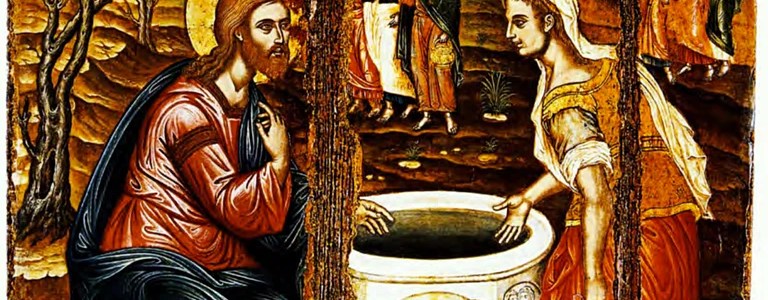
That Jesus is speaking to a Samaritan woman is quite radical; for Jews had no dealings with Samaritans. Pious Jews were known to take long detours rather than walk through Samaria. It was unheard of for a Jewish man to speak with a woman in public, especially a Samaritan woman, and the disciples marveled (ethaumasan) that Jesus was speaking to her. Moreover, that Jesus was asking her for a drink was also quite radical–he was willing to use her vessel from which to drink, which would have rendered him ritually unclean. Also, he did not condemn her, knowing that she was married five times and was currently living with a man who was not her husband, but he chose to relate to her anyways, to communicate and actually drink from her container. As we can see, Jesus was not very orthodox by Jewish standards. Relationship is more important than law–i.e., the Sabbath was made for man, not man for the Sabbath (Mk 2, 27). 

But what’s particularly interesting about this conversation with the Samaritan woman is the change that took place in her during the course of it. She goes from calling Jesus “Sir”, to calling him a prophet, to becoming a witness to the Samaritan villagers that he is the Messiah, and finally, the townspeople go from believing in him on the basis of her testimony to believing in him through their own personal experience of Jesus, professing him as Saviour of the world (Sir, prophet, Messiah, Saviour of the World). And this was all due to Jesus’ decision to enter into relationship with this woman, to do something contrary to religious custom, to actually communicate with her as a human being with inherent dignity. And this was typical of Jesus—after all, he entrusted the good news of the resurrection to Mary Magdalene, chose her to be the first person sent to deliver the good news of the resurrection to the rest of the disciples. His was a very unique and revolutionary way of seeing women. Incidentally, the woman at the well is venerated as Saint Photina. She was martyred under Nero, and her name means enlightened one or “shining”, which calls attention to her missionary work, bringing the light of the Gospel to those in Smyrna and Carthage. In the Eastern rite, she is venerated with the rare title “Equal to the Apostles” (Isapostolos). 

But most importantly, this gospel shows clearly that true religion is not primarily about law; it is about relationship first and foremost. Both words (religion and relationship) are from the Latin religare, which means “to bind fast”. Jesus desires to enter into relationship with this woman, to give her the living water of his own divinity, but he asks that she give him the water of her humanity. That is the exchange he offers each one of us: “I will give you my divinity if you give me your humanity”, to be divinized, deified (theosis), filled with the life of grace, sharers in the divine life. 

For every desire we have in our lives is ultimately a desire for God. Nothing in this world can satisfy the human heart, which is restless and is always in search of rest. The problem is that the human heart’s thirst is infinite, and nothing in this contingent universe can bring it rest, nothing except God alone. St. Augustine said it on the first page of his Confessions: “O Lord, you made us for yourself, and our hearts are restless until they rest in You”. God became flesh so that we could make our way back to God in the Person of Christ. He is the living water that alone brings rest to the human heart. For most people, it takes a lifetime to finally learn this. 

I mentioned in a previous reflection that a patient I was visiting in the hospital told me about a certain person who owns a 165-million-dollar estate; this patient was utterly dismayed that someone would spend so much on himself. Later in the day I decided to do a “fact check”, and indeed he does own a 165-million-dollar estate, but that’s not all; he has three other estates in Florida, all three totaling 230 million, another property in Hawaii at 78 million, another in Washington for 23 million, and some apartments in New York City totaling 80 million. It is a strange phenomenon that the more wealth we acquire, the greater our desire for more. One would think that greater wealth would be accompanied by a corresponding decrease in desire, that one is gradually reaching the point at which one no longer feels the need for more, but it seems the opposite happens; the more wealth we acquire, the desire for more continues to increase, as if we are becoming poorer. It’s as if the heart rebels against us by desiring more, as if to tell us that we’re on the wrong track. 

St. Augustine says later on in the Confessions: “O You Omnipotent Good, You care for every one of us as if you care for him only, and so for all as if they were but one!” (3.11.19). This life is about coming to know that love intimately, not just in our heads, but knowing it by experience.

There’s a wonderful story of a San Francisco physician who had a friend do some house sitting for him while he was away on vacation. When he returned, he found his friend sitting on the stairs, staring out into space. As he approached him to see if he was ok, his friend stood up, screaming, and he began hitting the doctor with a tennis racquet. The doctor lost consciousness, but when he came to, his friend had a dagger; he tried to fight him off, but he was overpowered. He then saw a hallway filled with light, and he said the love coming from this light was utterly overwhelming. He said it was so overwhelming that “this life must have something to do with learning to love like that”. But then he corrected himself: “Rather, this life must have something to do with learning to be loved like that, to allow yourself to be loved by this light”. He then adds that if anyone you know died in horrible circumstances like this, “if my experience is any indication, they did not die alone; they died in a sea of love around them”. 

Sin takes on a whole new meaning for us when we have personally experienced the love that God has for us. At that point, religion is no longer a matter of observing rules, and sin is no longer the violation of a law; rather, it is the rupture of a relationship. I remember the first change that took place in me when I returned to my faith as a teenager, after having had a very personal experience of God’s intervention in my life, was that I could no longer take the Lord’s name in vain, which was habitual for me at the time. I became aware that I had God’s undivided attention at every instant of the day; I was in relationship with a Person and my actions affected this Person. 

To get to that point, we have to pay attention to what God is doing in our lives, individually, in my life, your life, the particular ways that God is showing you that He loves you, that he is paying attention to you, giving you his undivided attention, to become more aware of the blessings he pours out upon us at every moment, that is, allow ourselves to be loved by him and allow that love to awaken us and bring us to life. Then we begin to taste a tiny portion of the joy of heaven, for that experience is very much like finding a great treasure in a field, and we will be ready and willing to give up everything in order to purchase that field so as to never lose that treasure.