Creative and Destructive Conflict

Deacon Douglas McManaman
Also published at https://www.lifeissues.net/writers/mcm/mcm_422creativedestructiveconflict.html

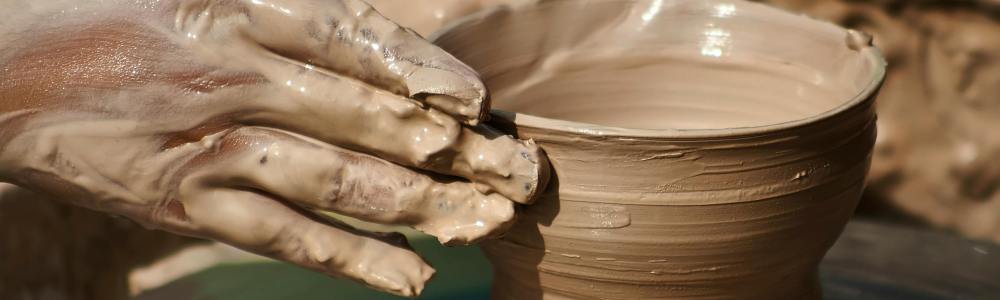
A kiln is a furnace that dries out the potter’s clay and actually transforms it into a beautiful ceramic piece. We can’t use a clay bowl or cup that has not been in the kiln; it would fall apart, for it would be too soft. And of course, we are the clay, as we read in Isaiah, “Yet, Lord, you are our father; we are the clay and you our potter: we are all the work of your hand” (Is 64, 8). And so it follows that trials, sufferings, difficulties, are part and parcel of the spiritual life.

I have found over the years that the vast majority of people mistakenly believe that religious life, life in the Church, life in Christ, the devout life, is supposed to be a life of peace and tranquility, like the quiet of a cemetery, where everything works out smoothly and without a glitch. And so when things go awry, we tend to see this as an anomaly, that something is wrong, that if we are right with God, life should proceed without a struggle. But this is a serious misconception. Life is essentially conflict, because it is movement, and all motion is at some level a struggle. Anyone who has studied evolutionary biology knows this. There is no such thing as life without conflict and struggle.

There are, however, two kinds of conflict: destructive conflict and creative conflict. Sports (play) is essentially conflict and struggle, but it is an enjoyable one because it is essentially creative. Art is a matter of creative conflict, a battle between the sculptor and the resistance of the marble that he is about to carve into a beautiful figure. A life without creative conflict becomes intolerably dull and meaningless. In fact, heaven will be an eternity of creative conflict. Hadewijch of Antwerp writes:

God will grace you to love God with that limitless Love God loves himself with, the Love through which God satisfies himself eternally and forever. With this Love, the heavenly spirits strive to satisfy God: this is their task that can never be accomplished and the lack of this fruition is their supreme fruition” (Love is Everything: A Year with Hadewijch of Antwerp, trans. Andrew Harvey, May 1st). 

“Peace” and “rest” are not opposites of conflict, that is, heaven is not a life without obstacles and things to achieve. 

It is destructive conflict that is the problem. However, God joined a human nature, he joined himself to our humanity, and in doing so he entered into the destructive conflict that human sin has brought about in the world. The victory of that destructive conflict is death, which without Christ has the final word over our lives. But Christ came to die, to enter into our death, to inject it with his divine life, to destroy the power of death, to rise from the dead. He was victorious over death, and so he overcame the struggle of human existence, the battle against destructive conflict. 

Christ transformed the destructive conflict of death and sin in all its various instances into a matter of creative conflict, a matter of play, as it were: “When he set for the sea its limit, so that the waters should not transgress his command; When he fixed the foundations of earth, then was I beside him as artisan; I was his delight day by day, playing before him all the while, playing over the whole of his earth, having my delight with human beings” (Prov 8, 29-31). We can now share in his victory over both sin and death. He offers us his own humanity so that we might overcome our own life struggles with his strength: “I can do all things in him who strengthens me” (Phil 4, 13). The kiln that dries out all our moisture (disordered love of self) and in time transforms us into something beautiful is the particular difficulties and struggles that we have to contend with in our lives. And some people have greater struggles than others; the heat of the kiln is much hotter in their lives, and perhaps they have been in it for much longer than the rest of us. But the result is a more beautiful product from the hand of the potter. It is not the case that God wills that certain people suffer illness or tragedy; rather, God the Son joined himself to a human nature in order to draw very close to us in our suffering and trials, to give us his divine life that we might overcome the world and its conflicts with him and through him, that we might share in the joy of his victory. The greater the struggle, the greater the victory, and the greater will be the joy in that victory.

This, I believe, is the key to unlocking today’s gospel: “Can a blind person guide a blind person?…Why do you see the speck in your neighbour’s eye, but do not notice the log in your own eye?…first take the log out of your own eye, and then you will see clearly to take the speck out of your neighbour’s eye”. The spiritual life is a long and difficult road, a slow process of gradual enlightenment. I don’t know about you, but I do not like looking back at my life and being reminded of what I was back then, because I see my blindness. And of course, the blind cannot lead the blind. But the blind are leading the blind all the time. Even great saints had their blind spots. Study the history of the Church without triumphalist blinders: stupidity, arrogance, sin, oppression, envy, violence, lust for power, control, avarice, etc, is everywhere in our history. We have had great popes who did great things as well as some outrageous things; made great decisions as well as terrible decisions that were very destructive and whose repercussions are still with us today in many ways. It is a real mixture. But that’s life in the Church, as well as the life of the individual person in a state of grace. The spiritual life is conflict, a struggle, a struggle against our own blindness and propensity to sin and self seeking as well as the blindness of others and its repercussions. 

But before we can take it upon ourselves to correct others, we have to spend years in the kiln, in the furnace, allowing the fire of the divine love to change us so that we may remove the plank from our eye. Recently I asked my Confirmation class about the graces they are going to receive from God upon their Confirmation, specifically the grace of mission. 

“You are going to be sent on a mission; but to do what?” I asked them. 

One good candidate put up his hand and said: 

“To proclaim the gospel”. And of course, that’s a great answer. 

“But how are you going to do that?” 

“Preach”, he said. 

Well, the problem is you’ll lose friends quickly. If you want to be friendless, start preaching to them. If parents want to drive their kids from the church, start preaching. The way to proclaim the gospel is by the very life you lead. The gospel is the good news of Christ’s victory over death, his resurrection. We don’t need to use words. We just need to be a person who lives in the joy of Easter, a person who has the hope of eternal life, a person who is not overcome by life’s tragedies, because we believe that Christ has overcome the world and conquered death. Others will see that in us, by how we react to life’s difficulties and struggles, even life’s tragedies–that we have risen above them in the joy of the risen Christ. 
Catholic Tribalism

Deacon Doug McManaman

Today’s gospel reading (Wednesday of the 7th Week in Ordinary Time) is taken from Mark, chapter 9, verses 38-40. John says to Jesus that they saw someone casting out demons in Jesus’ name and that they tried to stop him, “because he was not following us”–as if it is about “following them”, and not Christ, or acting in the name of the Person of Christ. Jesus tells them straight out: “Do not stop him; for no one who does a deed of power in my name will be able soon afterward to speak evil of me. Whoever is not against us is for us”. 

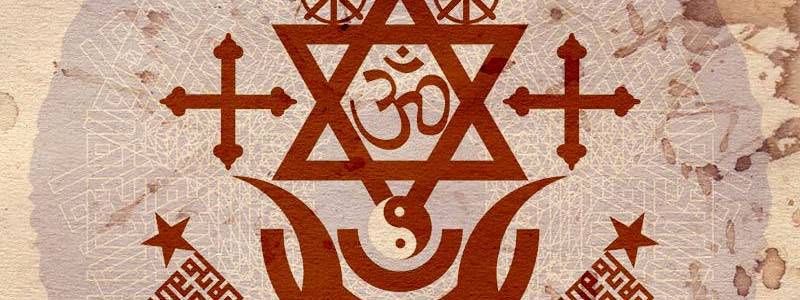
It continues to puzzle me that this reading continues to fly over the heads of so many Christians today, including Catholic prelates, clergy, and very traditional Catholics who are thoroughly sectarian or tribal in their thinking. If there is one section of the gospel that rails against Catholic tribalism, it seems to me that this is the one. Had the hierarchy taken the path laid out by Pope Gregory the Great, a pastoral and administrative genius, rather than the authoritarian approach of Pope Leo the Great–not to mention Innocent III—, the history of Christianity would have looked very different than what it is now.  

When I study such great theologians as Jurgen Moltmann, or G. Studdert Kennedy, Sergius Bulgakov, or Vladimir Solovyov, Christoph Blumhardt or Gerhard O. Forde, Robin A. Parry or F. D. Maurice, etc., I lose all awareness that these people belong to another “tribe”, a different denomination, that is, that they are “Protestant”. All I sense is that we are of the same family; we are “of the same mind”, which is the mind of Christ Jesus (Phil 2, 5). 

The first reading from Sirach (4, 11-19) is also very revealing: “Wisdom teaches her children and gives help to those who seek her. Whoever loves her loves life, …Whoever holds her fast inherits glory, and the Lord blesses the place she enters. Those who serve her minister to the Holy One; the Lord loves those who love her.” My last 20 years of teaching were at a school in which close to 50% of my students were non-Catholic; many were Muslims, Hindus, Sikhs, and Buddhists, and many of these were genuine seekers of wisdom, lovers of wisdom, and they recognized wisdom whenever they encountered her. The Lord loves those who love her, and one cannot love her without divine grace, which is a sharing in the divine life. So much for Catholic triumphalism, Muslim tribalism, or any tribalism for that matter. 

I would not say that these people were “anonymous Christians”, a term made popular by Karl Rahner in the early post-Vatican II period. The best criticism of this apparently inclusive way of regarding those who are not explicitly Christian comes from Hans Kung, who writes: 

Karl Rahner’s theory of the “anonymous Christian” is in the final analysis still dependent on a (Christian) standpoint of superiority that sets up one’s own religion as the a priori true one. For, according to Rahner’s theory, which attempts to solve the dilemma of the “Outside the Church” dogma, all the Jews, Hindus, Muslims, Hindus, and Buddhists are saved not because they are Jews, Muslims, Hindus, and Buddhists, but because in the final analysis they are Christians, “anonymous Christians,” to be precise. The embrace here is no less subtle than in Hinduism. The will of those who are after all not Christians and do not want to be Christians, is not respected but interpreted in accordance with the Christian theologian’s interests. But around the world one will never find a serious Jew or Muslim, Hindu or Buddhist, who does not feel the arrogance of the claim that he or she is “anonymous” and, what is more, an “anonymous Christian.” Quite apart from the utterly perverse use of the word “anonymous”—as if all these people did not know what they themselves were—this sort of speculative pocketing of one’s conversation partner brings dialogue to an end before it has even gotten under way. We must not forget that followers of other religions are to be respected as such, and not to be subsumed in a Christian theology (Theology for the Third Millennium: An Ecumenical View. trans. Peter Heinegg. New York: Doubleday, 1988. P. 313). 

My students may not be “anonymous Christians”, but if they seek wisdom, love wisdom, and in serving her serve the Holy One who loves those who love her, then they are moved by grace, which is the indwelling of the Trinity. To be in such a state does not depend upon adopting a certain terminology or conceptual frame of mind, but on the love of her (Sophia). All things came to be through the Logos (Jn 1, 1ff), and all were created for him. Just as I can learn so much more about the Person of Christ, the Logos, by contemplating the cosmos that came to be through him and for him, so too I can learn so much more about the Person of Christ by contemplating the ancient wisdom of those who seek, love and live for the wisdom spoken about in the book of Sirach, the Sophia through whom and for whom all things came to be. 

The Feast of the Presentation

D. McManaman

The gospel reading on the Presentation is really about humility. The word humility comes from the Latin ‘humous’, which means dirt or soil. The humble are down to earth; they don’t walk high and mighty. But another English word that is derived from ‘humous’ is humour. Now what’s interesting about humour is that it hinges upon irony. You’ll notice this in the nicknames that kids give to one another. They are full of irony, which is why they are funny. The short kid is nicknamed stretch, the tall kid is given the nickname shorty, the skinny kid is nicknamed Hercules, and when I was a kid, they called me slim. 

What’s interesting about the gospel is that it is full of irony, and so it is full of humour–divine humour. St. Gregory of Nyssa calls attention to this divine irony in his sermon on the Beatitudes when he says that the judge of all creatures is subject to the judgment of mere humans, the author and sustainer of life tastes death, the all powerful is hungry for bread and dies on a cross, and so on. 

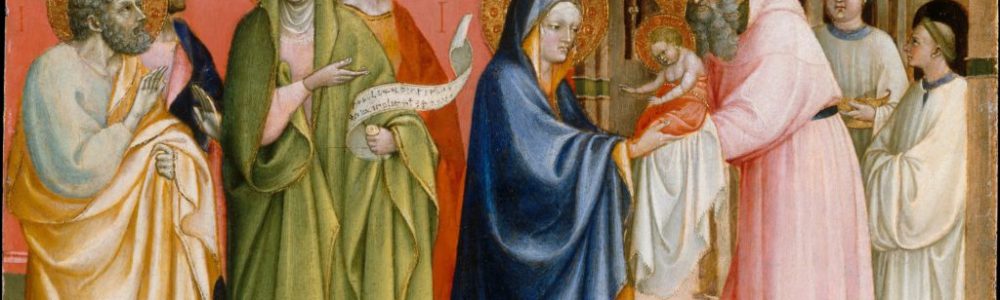
This gospel reading is also packed with irony. Jesus is presented in the temple, because the Torah says that “every male that opens the womb shall be consecrated to the Lord”. Now to consecrate means to ‘make holy’. But Jesus is the fount of all holiness; he is Lord, God the Son. This is irony. So too, Mary undergoes forty days of purification, but she is purity itself, for she is the Immaculate Conception, she is ‘full of grace’, as the angel addressed her at the Annunciation. Not only that, but Mary is, according to the author of the gospel of Luke, the New Ark of the Covenant. The Ark of the Covenant in the Old Testament was the holiest object in Israel, and it contained the tablets of the commandments, manna from the desert, and the staff of Aaron the Levite priest. Mary, the New Ark of the Covenant, contains in her womb Christ the New Law, who is the Bread of Life, and who is the eschatological priest who came to offer himself for the salvation of the world. She is the holiest of God’s creatures, and Joseph is the greatest saint next to her. Nonetheless, both of them submit to the requirements of the old law. That is perfect humility.

But there is more. Simeon is described as righteous and devout, awaiting the Messiah. It was revealed to him that he would not see death before laying eyes on Messiah. He recognized, through the Holy Spirit, that this child was the Messiah, and that he would be a sign of contradiction, and he turns to Mary and tells her that a sword will pierce your soul also. And Mary and Joseph both marvelled at what was being said by Simeon. Furthermore, Simeon blesses both Mary and Joseph. And so Mary, the greatest saint, full of grace, and Joseph, the greatest saint next to her, are amazed, impressed, they marvel at what was said about the child, and both are willing to receive Simeon’s blessing. Moreover, Anna, a prophetess, married and widowed, a woman of prayer and fasting, came forward too and spoke about the child. And one other irony: Mary and Joseph, the richest creatures ever created by God, are poor; for they offer the offering of the poor, two turtle doves instead of a lamb, and yet they hold in their arms the lamb of God who takes away the sins of the world. And Luke, throughout his gospel, depicts Mary as one who “ponders these things in her heart”. In other words, it’s not as if she knows everything. She learns, and marvels at what she learns through others like Simeon and Anna, the prophetess, and ponders what she hears.  

It is obvious that Mary and Joseph have no idea of their status before God, no idea of their holiness. Both of them allow themselves to be taught, and to be amazed; although the old law is fulfilled in her womb, Mary does not see herself as superior to the old law, nor as superior to Simeon or Anna, even though she is even higher than the angels.

This says a great deal about what true holiness is. Those who are genuinely holy do not know they are extraordinary; for they don’t compare themselves to others. The truly holy allow themselves to learn from everyone, and they are able to be impressed with others. The proud and envious, on the contrary, are rarely impressed with anyone or anything, unless it is related to them and glorifies them in some way. 

And rarely do they speak well of others. Although the true saint is hidden and unknown, because they don’t stand out, pseudo-saints find many subtle ways to make themselves stand out from others around them. Great saints don’t know they are saints, they don’t pontificate, they are not quick to correct others or give advice; pseudo-saints pontificate, are quick to offer correction, are quick to advise. True saints affirm others who go away from them always feeling better about themselves; but pseudo-saints do not allow others to leave them feeling better about themselves, but confused and doubtful about their worth. Genuine saints are very generous, pseudo-saints are stingy, not only with money, but with everything–they rarely praise or compliment others, unless the object of their praise somehow reflects back on them. And as genuine saints are not the least bit aware of their holiness, pseudo-saints are not the least bit aware of their pretension and hypocrisy, but see themselves as superior. 

Let me finish by saying that Pope Francis, early in his papacy, derided the notion of a self-referential Church, focused on itself. Many in the Church were distressed by the suggestion, but he continues to call the Church to turn outward, towards the world, to become a more listening Church. This is why he has put so much effort into Synodality; listening to the lay faithful, recognizing their gifts, talents, and expertise. In other words, he envisions a more Marian Church, a Church that, like Mary, listens and marvels at the extraordinary gifts, talents, insights and abilities of unknown men and women who are genuinely influenced by the Holy Spirit, like Simeon and Anna in this gospel.