The Normality of Struggle

Deacon Douglas McManaman

Struggle is a normal and necessary part of human existence, with or without the Fall of Man. After the Fall of Man (Gn 3), the struggles involved in everyday human life did not suddenly arise; rather, they simply became difficult, frustrating, and unenjoyable. The reason is that after the Fall, man, wounded by concupiscence, seeks rest without struggle. Prior to the Fall, daily struggles that are part and parcel of human existence would have been as enjoyable and exhilarating as a well played game or sport. In this light, rest and struggle are not opposites.

Creation itself, the bringing into being of all things, involves a kind of tension or a battle of sorts: 

In the beginning God created the heavens and the earth. The earth was without form and void, and darkness was upon the face of the deep; and the Spirit of God was moving over the face of the waters.

Water is a symbol for chaos, for it is powerful, destructive and without form, and thus creation is depicted as a bringing order out of chaos, or form and content out of what is formless and empty, or light from darkness, as a sculptor stands before a heavy slab of marble that will resist his efforts to bring form and order out of its formless posture. Like an artist who contemplates his finished work, God contemplates all He has made and “behold, it was very good”. Rest comes after the struggle, and there is no rest without it. Beauty is its fruit.

Work is holy, but work is fundamentally a struggle, a kind of emulation of God who creates: “And the Lord God took the man and put him in the garden of Eden to till it and keep it.” It was only as a result of the Fall that work–or what is humanly good to do–became burdensome to man: “…in toil you shall eat of it all the days of your life,…In the sweat of your face you shall eat bread”. 

The spiritual life is a battle, specifically a battle of love. It is only a battle against the self because it is a “battle of love”, and inordinate self-love destroys love and is the resistance that makes the spiritual life a genuine struggle. Without a spiritual life, human life is empty, for it is the spirit that brings direction (meaning) to the matter of the universe, and so human life as a whole is a battle, specifically a struggle to achieve love, which is unitive and creative, and thus it is a battle for universal fraternity (the kingdom of God). Inserting struggle into our lives is God’s way of dealing with us: “We should be grateful to the Lord our God, for putting us to the test, as he did our forefathers. Recall how he dealt with Abraham, and how he tried Isaac, and all that happened to Jacob in Syrian Mesopotamia while he was tending the flocks of Laban, his mother’s brother. Not for vengeance did the Lord put them in the crucible to try their hearts, nor has he done so with us. It is by way of admonition that he chastises those who are close to him” (Jud 8, 25-27). To chastise is to prune, which a gardener does for the good of the plant being pruned, that it may bear more fruit. And so a life without the struggle and dialectic of opposites, that is, a life of rest without arduous struggle bears very little fruit and leaves a person without a great deal of depth and light.

G. Studdert Kennedy writes: 

“Love endures all things.” The word of “endure” is translated patience, and so is long-suffering, but “endures” is the patience that works and plods at things. Love is a fighter, a reformer, not content with things as they are. “Endures” means “conquers through patience,” it is that which overcomes the world. Patience that fights and wears things down until they become expressive of order and love. It stands on the rock and is patience born of faith and hope in presence of love’s very self. It has the sense of going on along a road or climbing a hill and never giving up but going steadily at it. There is the description of what love does, it ends as this life, which consists in walking on steadily, will do. There’s this much joy in it, that the road gets easier the more faithfully we keep on. The first hills of childhood seem terribly hard and so the troubles of the young are harder than those of the old because the young do not realise that the flat part will come later, it won’t be all hills. But patience is its own reward and there is never a moment when we don’t need it. The troubles of a child seem quite heart-breaking, e.g. when it tells its first lie and is ostracized by its parents who hear it crying in the next room and cannot go to it. At last we must get our feet firmly set and know that if sorrow comes we will go through it. If we keep close to Love we shall win in the end. …The world is made for love and demands it. We are toiling and working out the problem of the perfection of love and we must learn to live in unity in the human race, bearing each other’s burdens and fighting the battle of love.” The Best of Studdert Kennedy, p. 190-193.
Thoughts on Trinity and Personhood

Deacon Douglas McManaman

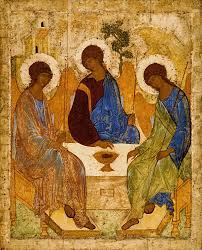
In the first book of Maccabees, we read: “In those days Mattathias, son of John, son of Simeon, a priest of the family of Joarib, left Jerusalem and settled in Modein” (2, 1). This kind of description is typical in the bible. The reason is that a person is fundamentally a plurality. That’s why the doctrine of the Trinity is so important, more important than a pure and rational monotheism. God is three Persons in One divine nature, not one in three. “Three” must always precede the One, and the One must be seen in relation to the three, and not within the conceptual framework of a metaphysical oneness. God is a plurality of three equal Persons: God the Father, God the Son, and God the Holy Spirit. The Oneness of God is the Oneness of the three equal Persons: “I pray not only for them, but also for those who will believe in me through their word, so that they may all be one, as you, Father, are in me and I in you, that they also may be in us, that the world may believe that you sent me. And I have given them the glory you gave me, so that they may be one, as we are one, I in them and you in me, that they may be brought to perfection as one, that the world may know that you sent me, and that you loved them even as you loved me” (Jn 17, 20-23).

The human person is created in the image and likeness of God; but God is a Trinity of Persons. It follows that although you and I are individual persons, one being, we are first and foremost a kind of plurality. For example, my own human existence has a place within history, and it is a historically relational existence. I am related to the past; I cannot be understood apart from the past. The human person is born from a mother, and that child has just spent his/her first nine months of life deep within her womb, nurtured and sustained by that mother, placed in her arms immediately after delivery. That child is completely and utterly dependent upon the care of the parents for many years to come, who in turn are dependent upon innumerable others. And so my existence is related to the past in that others before me have made my life possible–I inherited their matter, their proclivities, talents, I’ve been positively influenced by people in my own family and by certain people outside of my family, such as my teachers, many of whom I have forgotten, not because they were insignificant, but by virtue of the limits of memory, which in turn allows me to further depend on others; and my existence influences others who will live after I am gone, who will have been influenced by my life and my sacrifices in some way. And so “my life” is not purely mine. It is not an isolated existence, but a thoroughly relational one. It is the product of the love and labor of countless others.

Our fundamental purpose is to struggle to bring about a universal fraternity, a plurality in unity, a brotherhood that sin destroys. Vatican II points out: “Christians should cooperate, willingly and wholeheartedly, in building an international order based on genuine respect for legitimate freedom and on a brotherhood of universal friendship” (GS 88). Christ came to gather, but sin always divides. 

Some Thoughts on the Cross and the Lynching Tree

The Cross and the Lynching Tree, by James Cone

Deacon Doug McManaman

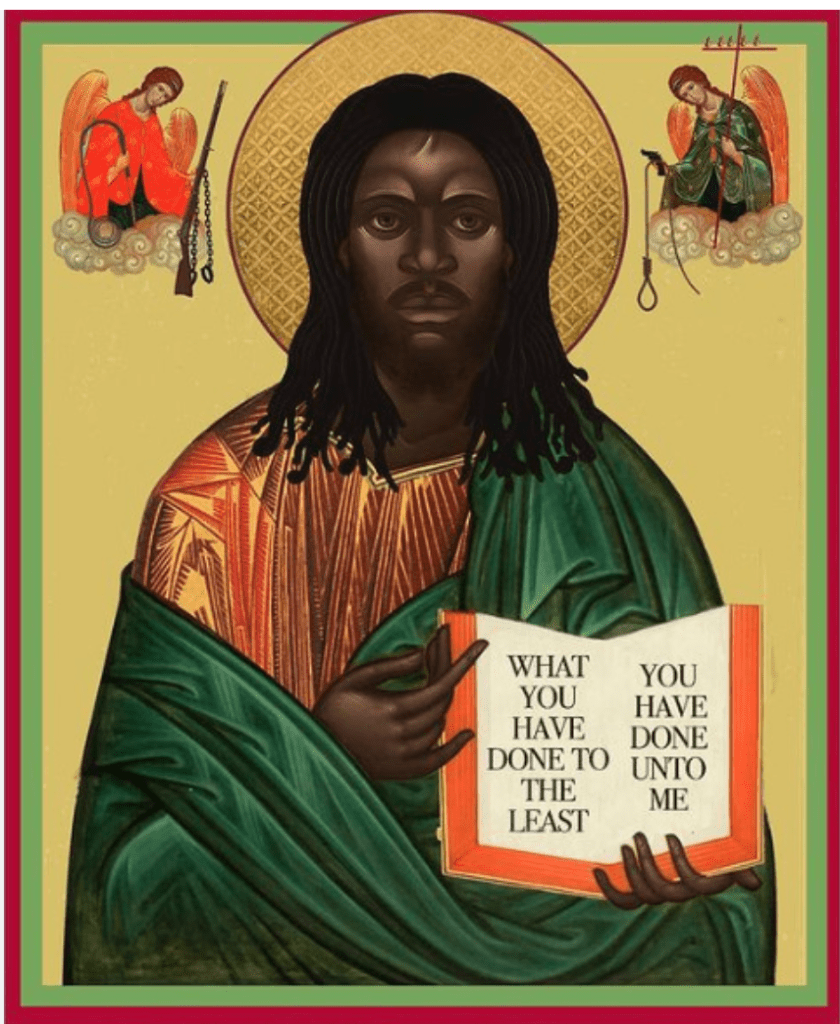
When I read about this terrible suffering and injustice, this complete indifference to the rights of black Americans during the lynching era, the utter brutality and mind boggling hypocrisy, all I can say is that indeed they are the Christ among white Americans. Christ is them, and they are Christ, and their suffering is the deepest possible sharing in the redemptive work of Christ himself. They are suffering for their persecutors, for white Christians who don’t know Christ, who are crucifying the Christ they allegedly worship. These laugh now (at the time), but will weep later, as we read in Luke. Those who are suffering in the Person of Christ achieve the greatest honor and they have the greatest joy in the kingdom, thanks to this identification between their lives and the crucified. Their persecutors, these cruel murderers and all those who cooperate with them, are forever connected to their victims, and this is their torment. They are immersed in the specter of their utter cruelty, the ugliness of their sin, and it is an intolerable sight. But in the midst of their crucified victims, these murderers see the crucified that they think they’ve worshiped. He is there among the lynched, tortured, and burned. He is their only hope. But if he is their only hope, it means that they, their victims, are their only hope, because the identity between Christ and their victims is perfect. They forgive their persecutors, because they are victorious in the crucified one who is among them, and they have received the forgiveness of their own sins in him, so how can they deny forgiveness to those who have murdered them. In fact, their greatest desire is to share in Christ’s victory over sin and death, which they do by their sufferings and the heart of mercy, which each one possesses. They can say with Christ: “…forgive them, for they know not what they do”, and indeed, they know not what they have done. But they will, because they are forever connected to their victims, and so they will forever behold what they have done until they cannot stand the sight of their own ugliness any longer. Their victims along with Christ, who is in their midst, are waiting to be invited by these murderers to defeat their evil with the victory of Christ’s charity and forgiveness. That will be their greatest joy, because it will be their greatest victory, their unique sharing in the victory of Christ. And they wait, and wait, but they won’t wait forever, because St. Paul tells us that “every knee shall bend, of those in heaven and on earth and under the earth, and every tongue confess that Jesus Christ is Lord, to the glory of God the Father”. Finally, it is interesting to compare two perspectives. Today, so many have called for reparations; for they see black Americans as terribly disadvantaged by the allegedly superior whites. But in the light of a theology of the cross, in particular the theology of the cross that came out of this era, in their poetry, their music, their literature, it seems rather obvious that they have a nobility and power that is their glory. They entered into the struggle against sin and death, and they conquered, and many graces were bestowed upon America as a result of that struggle. What we are today is, in large part, the result of that victorious struggle. Black Americans stand higher, not lower. We look up to them, not them to us.

Harmful Dualisms

Deacon Doug McManaman

A great irony today is that Catholics, generally speaking, no longer think historically, that is, within a historical paradigm. However, all things were created through him (Christ) and for him (Christ). As Tertullian points out, the very clay in which Adam was formed was created in view of Christ; man was created in view of Christ. And so history is directed towards Christ, that is, towards “Christification”. This movement of history does not stop at the Ascension of Christ; it is not as if now, since the Ascension, history is cyclical and we are just waiting for the number of the elect to be complete, which will then be followed by the Second Coming of Christ. No, history is still linear and moving towards Christ. Everyone who has gone before us has in some way contributed to the evolution of humanity towards Christ. History is sacred. There are not two histories, one sacred and the other profane. All history is sacred history, because it is under the providence of God, directed towards the Second Coming of Christ, that is, towards the Christification of creation (Teilhard de Chardin). My own individual and personal existence has a place within this history; it is a historically relational existence. It is related to the past in that others have made my life possible–I’ve inherited proclivities, talents, I’ve been positively influenced by certain people, many of whom I have forgotten not because they were insignificant, but by virtue of the limits of memory; and my existence influences others who will live after I am gone, who will have been influenced by my life in some way. But “my life” is not purely mine; it is the product of the labor of innumerable others.

The genuinely creative work of others is holy. The evolution of medical technology and medical advancements, for example, is holy (set apart from what was ‘before’); advancements in the design of automobiles and other means of transportation is holy; the creation of computers is holy; the invention of new techniques in construction and its latest products are holy, etc., for they are all the result of creative conflict that is ordered to the betterment of humanity, and man was created in view of Christ. 

It is not as if the world is unholy (the realm of the profane) while within this world is a tiny community of believers, the baptized (the Church), who alone are holy. Not at all. It is sin that profanes, but creation is holy from the start, and man was created to be a priest of creation and to have that priesthood perfected and elevated by Christ. Creation comes from God, and it is sustained by God, and the Old Testament reveals the God of Israel as the God of history. The Church is much larger and wider than the Roman Catholic Church. A Roman Catholic Mass certainly does involve the changing of the substances of bread and wine into the single substance of Christ’s body and blood, that is, the Person of Christ, but that is the very image of history in its completion, for the matter of creation is destined to become Christ (Christification). The Mass is a sneak preview so to speak, a microcosmic instance of history’s destiny. The Mass is ordered towards the fulfillment of history. 

Images of Christ abound throughout creation: each of the four seasons, fertility, death and growth, the sun, the stars that praise God, creatures of every sort, etc. To enjoy a sunset is a holy act; for the beauty of a sunset speaks of the beauty of God who hides himself and illuminates our lives, only to hide himself again. The light of faith, which is like the rays of that sun just before dawn, allows us to believe in the Incarnation of the Son of God; that light allows us to see creation on a much deeper level, a level that was hidden up to this point. The habit of mind that regards the natural as essentially profane is a false paradigm, a distorted and non-biblical worldview. In revealing Himself, God intends to reveal the deepest meaning of creation, not a new meaning. It is new to the person who does not have faith and suddenly acquires it, but with faith, one sees Christ everywhere in it, which is why Christ could speak in parables. Grace, although distinct, is not separated from nature. Grace is part of the divine plan, just as my life includes friendships that were gratuitously given. Grace is a part of human existence, because man was created in view of Christ. Grace is supra-nature, but God’s supernatural and Trinitarian existence is to be opened up to humanity. The natural is not the supernatural, but it is ordered to the supernatural, for it is ordered to Christ, from the very beginning. The Church’s task is to reveal the true nature of things.

In the Incarnation, Christ conquered death and sin, giving all of us the capacity to rise above the struggles that belong to human existence and to conquer in him. One does not have to be explicitly aware of this in order for Christ’s Incarnation to be effective in one’s life and in the life of the world. All the progress in this world is the fruit of the Incarnation; for Christ has joined himself to every man when he joined himself to matter. 

When Pius X was made the archbishop of Venice, his mother and father both looked at his ring and said: “You would not have that ring if it wasn’t for this ring”, indicating their wedding ring. It was as if to say: “We were instrumental in this. Without marriage, you wouldn’t be here, buddy.” They were the ones who provided his education that led to this. Hierarchy, sacred order, arises out of the faithful, not above the faithful. It is the fruit of marriage. The word “laity” is from laos, which is ‘of the people’. A cleric remains a part of the people, a servant of the people, never outside and above. The movement from non-cleric to cleric is not from above to the Cathedral; rather, it is from parents to the Cathedral, parents whose marriage is holy, a sharing in the paschal mystery.