Joining Humanity and Divinity

https://www.lifeissues.net/writers/mcm/mcm_419homily12.29.2024epiphany.html

Homily for the Epiphany of the Lord
Deacon Douglas McManaman

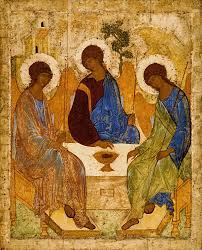
It is fitting that we exchange gifts at Christmas, because our life in Christ is a gift exchange. He came among us precisely to exchange gifts. Jesus is God the Son, the Second Person of the Trinity, who joined his divinity to a human nature. In joining a human nature, he joined divinity to humanity. Vatican II pointed out that in joining a human nature, God the Son is intimately present to every man (joined himself to every man, as it were). But he does not force himself upon anyone. His Incarnation is an offer of exchange, and the exchange is: If you give me your humanity, I will give you my divinity.  

Jesus is both human and divine, and he offers us the opportunity to become both human and divine; for it was St. Athanasius who said: “God became man so that man might become god”.

Parents who have their children baptized carry out this exchange; parents offer their children on their behalf. They give to Christ the humanity of their child, and in return, Christ gives that child his divinity. The result is that the child leaves the Church a different creature than when he or she arrived. That child has been deified, divinized, filled with divine grace (theosis). That child is human, but at the same time more than human. That child shares in the divine nature, and so he or she is more than human without ceasing to be human, and as a result that child has capacities that he or she would not have without divine grace, such as the power to believe what Christ has revealed about himself (faith), the capacity to hope for eternal life, and the power to love God intimately, as an intimate friend between whom secrets are shared. None of this is possible without divine grace. And of course, the child receives the 7 personal gifts of the Holy Spirit, as seeds that will unfold as the child continues to grow in faith. And there’s no doubt in my mind that parents for the most part have no idea the good they are doing for their children and for the world in offering their children for baptism. They have a sense that this is a good thing, because they arrange for baptism, even when they are not fully practicing the faith themselves. But they don’t fully realize how much good they are doing for their children and for the world in doing so.

That is the exchange that Christ offers us. I will give you my divinity if you give me your humanity, and it is a giving that we have to renew for the rest of our lives, because we tend to drift away from him over the course of the years. We tend to get caught up in things that ultimately don’t matter; we get distracted by fear and the lures of pleasure, power, and money, and sin blinds the mind to a certain degree, which allows us to veer away even further. And if we are reflective enough, we become aware of an increasing emptiness–these things don’t fulfill us, and the reason is that we became a “son of God”, deified, divinized, sharers in the divine nature. That’s our deepest identity. In 1920, army chaplain and poet G. Studdert Kennedy wrote: 

If I am the son of God, nothing but God will satisfy my soul; no amount of comfort, no amount of ease, no amount of pleasure, will give me peace or rest. If I had the full cup of all the world’s joys held up to me, and could drain it to the dregs, I should still remain thirsty if I had not God. If the feast of all the good things of life, pleasures and powers that have been and that are, could be laid out before me and I could eat it all at one meal, I should still be hungry if I had not God. Nor would it satisfy my soul, if I could be assured of an infinite extension of this present life at its best, apart from God. If the feast of this life’s goods could last forever, yet would I start up from the table satiated but still unsatisfied, because I had not God. There is not enough in ten material worlds to satisfy a fully-developed human soul–I must have communion with God. Whatever tends to break that communion is an enemy of mine, however much it may pretend to be a friend. However stubbornly I may stick to the delusion that I can live without Him, however closely I may cling to the idol that I put up in His place, sooner or later, in this world or in the next, the idols and delusions will have to go.

There is another side to this exchange. In joining his divinity to our humanity, Christ joined the divine joy to the suffering of our humanity, and this is something we can experience as well. If I am a son of God, if Christ’s divinity is joined to my own humanity as a result of my own willing acceptance of that divinity, and if I have made some progress in the spiritual life, then I can sense the joy of that divinity in the midst of suffering, especially physical suffering. Although the suffering is horrible, whether it is a kidney stone, a painful illness, or the pain of dying of old age, at the very core of one’s being, there is joy. Not exhilaration, not exuberance, but a tiny and subtle flame of joy suffering cannot touch or extinguish, only illuminate. In my experience with dying patients, it is always those with real faith who, although they are experiencing some agony, have not lost charity, but are still full of gratitude, still thoughtful, still good natured. This is rarely the case with people who are dying. There is a clear difference between dying patients who have lived a life of faith, hope, and charity throughout their lives, and those who seemed to have refused the divine exchange.

And so there is really nothing to fear when it comes to pain and suffering, if we have given our humanity to him. At the deepest center of our nature, we will detect the divine light, which illuminates and brings a degree of warmth in the midst of that suffering, so that the suffering does not overwhelm us with fear and despair. 

Complicity

Deacon Douglas McManaman

Recently I encountered a woman who said to me that many people have left the Church as a direct result of the news of the unmarked graves on the property of the old Kamloops Residential School in British Columbia–her husband being one of them. Of course, there is no denying that the Residential school system, at its origin, constituted a fundamental violation of the basic human rights of the Indigenous peoples of Canada. In 1883, John A. MacDonald wrote: 

When the school is on the reserve the child lives with its parents, who are savages; he is surrounded by savages, and though he may learn to read and write his habits, and training and mode of thought are Indian. He is simply a savage who can read and write. It has been strongly pressed on myself, as the head of the Department, that the Indian children should be withdrawn as much as possible from the parental influence, and the only way to do that would be to put them in central training industrial schools where they will acquire the habits and modes of thought of white men.

Despite the fact that a number of First people had positive and memorable experiences in their Residential schools, the entire system originated in and existed under the umbrella of this utterly racist conceptual frame of mind and culturally genocidal purpose. It goes without saying that the Church should never have cooperated with the Canadian government in this. But they, along with the rest of the country, did cooperate with it.

In this light, why would I want to belong to such an organization as the Roman Catholic Church? I guess it is the same reason that I choose to belong to this country, Canada, which obviously has a very sordid history–it is not on account of this country’s sins that I wish to belong to it, but on account of the tremendous goods that this country has managed to achieve throughout its long history. In belonging to the Church, I certainly belong to an institution that has a very sordid past, but is there a nation or institution in this world that does not? Is it even possible for an individual person, a saint even, not to have a relatively sordid history? Don’t we all look back at our lives and shake our heads? 

The process of coming to belong to the Church is not in any way the same as the process of coming to belong to any other institution, such as a corporation like Pepsi or Bell Canada, or a hospital or educational institution, etc. The reason is that the object of faith is not the Church as such, but Christ. For a person to believe in Christ and to enter into his death through baptism is to become, by virtue of that baptismal immersion, a part of his Mystical Body, and that person’s eyes are still on Christ, not on his Church; for he has become that Church, a member thereof, and he is taught to say every day: “Forgive us our trespasses as we forgive those who have trespassed against us”. The reason for this is that he remains a sinner, but one who has been “deified”, filled with divine grace, not by virtue of anything he has done, but simply by virtue of the unutterable mercy of God. His life is now a battle to overcome the effects of his wounded nature, namely, death, concupiscence, and the dulling of the mind. His life will therefore be one of continual reform, which is why the Church as a whole is in continual reform, for the Church is made up of sinful and flawed human beings whose minds are to a degree blinded by sin. There is no getting around this. And that is why the study of the history of the Church is a rather painful experience for the Catholic who has an idealized image of the Church, as a child has an idealized image of his own mother and father–the child chooses not to see what he simply does not want to see.

Those who choose to leave the Church because highly scandalous behaviour on the part of clergy or religious has been reported in the news, such as the operation of Residential schools and the abusive behaviour that took place in those institutions, or the clerical sex abuse scandals, etc., seem to believe that they have no complicity in the sins of the nation and the sins of the Church. But we were all complicit at the time–practically everyone operated within the arrogance of a Eurocentric worldview that looked down upon Indigenous culture, a worldview that kept us from appreciating its beauty and value, and we are all complicit today in the perpetuation of the injustices that First people continue to endure, such as lack of clean drinking water on the reserves among other things. And we are complicit in the injustices that Canadian young people and young families are forced to endure (i.e., housing prices and the cost of living) as a result of political and economic decisions made by an unjust and incompetent government that we put into power and kept in power. This notion of universal complicity is not a new concept, by any means. In 1923, G. Studdert Kennedy wrote:

Not long ago, a man was sentenced to ten years penal servitude for holding up a post office and shooting at a policeman. He was one of the army of unemployed in London. He had a wife and two children; he paid 8s. 3d [8 shillings, 3 pence] a week for two rooms in Whitechapel, which were so dark that the gas had to be kept burning all the time; he had fought in the army and been wounded, and he had done 10 weeks work in 18 months. He was not a good character, being weak and easily led; but in any decent community rightly ordered, he would in all probability have led quite a decent life. But in “justice“ he is to serve ten years. I am not disposed to rail at the courts – I think the sentence was inevitable for the protection of society, but purely for that reason, and not because it is just. He is suffering as much for the sin of the world, for your sin and mine, as for his own (The Wicket Gate, p. 73).

A person who leaves the Church or refuses to have anything to do with the Church because of her past sins has, at the very least, committed the fallacy of judging the past by the standards of today; to do so is to misunderstand the nature of human progress. I am what I am today because of the imperfections and mistakes of my past, and what I know today was the result of a decision to continually reflect upon my life as it was unfolding and as it unfolded. In other words, it was a result of a continued reflection upon my experiences, which are now past. All of us are expected to grow from experience, but how can a person be changed for the better unless he was in some ways worse than he is today? This means that if we are changing for the better, as we have a responsibility to do, then we can reasonably expect to experience disappointments when looking back on our lives. Individually, we cannot help but judge our own past by the standards we currently live by, but it seems we have no choice but to forgive ourselves, because the standards we hold up for ourselves today are the result of that experience and our own decision to reflect upon it, in light of moral principles we have discovered along the way–not to mention the resolution to improve. But for some reason we judge others’ histories with much less patience than we do our own; we overlook that the growing process is the same for everyone, every nation, and every institution. And of course, that does not necessarily cancel our responsibility for certain past decisions–one may still have to make reparation for a decision made long ago, perhaps a criminal decision or simply an immoral decision that left another or others profoundly hurt. But why would I walk away from the Church that Christ established— the Church that abandoned him on Holy Thursday night—, for being exactly the kind of developing organism that I have always been and cannot otherwise be?

Our Deeds Go Before Us

Deacon Douglas McManaman

Last month I was out with a few fellas from our parish men’s prayer group, and the reading our leader gave out for us to reflect upon (“The Great Project of Our Life”, Msgr. Fred Dolan ) contained a Jewish tale that, after reading it, I knew I would use at some point. A rabbi in Toronto told this story at a funeral; he said that in a kingdom long, long ago, there was a woman who had three friends. One of them she adored; they were in touch every day. As for the second friend, the two of them would get together once a month for a coffee. As for the third friend, they were rarely ever in touch. One day, however, this woman was summoned to the castle by the King. When she received that summons, she was terrified. And so she called her first friend, the one whom she adored and asked: “Can you please go with me to the castle? I’m really frightened.” The friend said, “No. Forget it, I will not go with you.” Terribly disillusioned, she turned to the second friend, filled with hope. The second friend, however, said: “I will go with you as far as the doors of the castle, but I will not take one step beyond that point.” On the verge of despair, she turned to her third friend, without expecting a great deal. To her great surprise, the third friend said: “I would be delighted to go with you. Not only will I accompany you, I will go ahead of you to prepare the way to make sure that everything is ready for you to see the King.” 

What does this mean? The first friend, the one who was adored, represents all our money. When we die, our money does us no good whatsoever; it will not even go with us to the castle. We’ve all heard the old adage that we’ll never see a hearse pulling a U-Haul trailer–we can’t take anything with us. But what about the second friend, the one who would go all the way to the gates of the castle but no further? This friend represents our family, who will be there at our side when we are on our deathbed, but they cannot go any further than that. Who, then, is this mysterious third friend, the one who will accompany us and even go ahead of us to prepare the way? That third friend is our mitzvot, which is the plural of mitzvah, which is Hebrew for our good deeds. Our deeds accompany us and even go ahead of us to prepare the way for us to meet the King of kings. 

This is a wonderful tale that illustrates what ultimately matters in this life, which is “the day to day leaving behind us a trail of mitzvot”, that is, good deeds. 

There is a real unity between love of God and love of others. The more a person loves God, the more that person loves all who belong to God, and human beings belong to God. That’s what holiness is–love of God and neighbor. Holiness is not the same as piety or devotional practices. These are certainly good, but a person can easily be pious and fervently religious without being holy, that is, without the love of God and neighbor, as Jesus implies in Matthew: Although you prophesied in my name, cast out demons in my name, worked miracles in my name, I never knew you (Mt 7, 21-23). And so, appearances can be deceiving.

Mother Teresa said very often: “Not all of us can do great things, but we can do small things with great love”. Doing small things with great love moves this world forward in ways that are beyond our purview. We cannot see the effects of those small acts of great love, but God is not subject to the passing of time, so all our deeds in time are present to God all at once, eternally. Our good deeds are the sacrifices that rise to him like the sweet smoke of incense–the incense at a liturgy is just a symbolic representation of these small acts of great love, which include our prayers. Your day to day labors, if they are carried out with great love for God and neighbor, are that pleasing incense; they are genuine acts of worship, no matter what that work is. I met a former student of mine recently while taking out the garbage–he was the garbage man who grabbed and dumped my trash can. He kept trying to justify his job, as if he was embarrassed by it. But there is nothing to be embarrassed about. That work has great dignity, and it is utterly important work, and if it is done with great love for the common good, it is holy and has eternal value. Our good deeds are like the materials that we lay at the feet of Christ, who takes those materials and builds a mansion with them, one that will be our eternal dwelling place, as Christ says in the gospel of John: “In my Father’s house, there are many mansions” (Jn 14, 2). 

English poet William Wordsworth said: The best portion of a good man’s life is his little, nameless, unremembered acts of kindness and love (From ‘Lines Written a Few Miles above Tintern Abbey, on Revisiting the Banks of the Wye during a Tour, July 13, 1798.’). And that’s the point of sacrificial offerings to God, especially the Old Testament sacrifices, to offer Him the best portion of what we have, the first fruits of the harvest or the first born of the flock. The best portion of our life is our little, nameless, and unremembered acts of kindness and love.

Thoughts on Free-Choice, Damnation, and Grace

Deacon Douglas McManaman

Human beings certainly have free-choice, for without it, we would have no sense of responsibility. But that sense of responsibility–for we do hold others responsible for their decisions–is a clear indication that we are free. However, contrary to Jean Paul Sartre, I don’t believe we are absolutely free. I’m quite convinced that our freedom is limited by a multitude of factors: ignorance, passion, unhealed memories and emotional wounds that distort our perception and understanding of things and people and that keep us from an accurate assessment of things, etc. These factors in the lives of others are for the most part invisible to us–even to ourselves. Only God, who is omniscient, knows the human heart, and so we are rightly commanded not to judge the hearts or guilt of others (Mt 7, 1-5). 

Years ago, when I held an almost absolutist notion of freedom, I had a tendency to judge, because in my mind at least, I was able to. That absolutist notion of freedom allowed me to leave out any consideration of the myriad of factors that limit human freedom and responsibility–if no such factors exist, then the sinner is completely and entirely responsible for his choices, and I am free to pronounce judgement. But those factors do exist. All we have to do is look back at our own lives to when we were younger and made very bad decisions, even sinful decisions. The point I wish to make is the following: free-choice involves options, and each option contains finite goods, some of which are not contained in the other options, which is the reason we deliberate. The object of the will is the “good”, and so the will is drawn to the finite goods contained in each of these options. If any option contained all the goods that are found in the others, there would be no choice to make–I would not deliberate but would necessarily choose that option. But I continue to deliberate because no option contains all the finite goods that are found in the others. Decision is the “cutting off” (Latin: decidere: to cut off) of the deliberation process.

Now, let’s say I know that option #3 is contrary to God’s will–it may be an act of adultery, or theft, or lying under oath, etc. What draws me to this option is not the evil as such, but the good or goods that the option contains, such as, in the case of adultery, the alleviation of loneliness, the comfort of companionship, the feeling of being loved or the feeling of being important, etc.,–let’s say this woman is saying all the right things at the right time. I know, on the other hand, that this is seriously wrong, but I just don’t believe I have the strength of will to deny my passions–probably because I haven’t had a whole lot of practice, for let’s assume I was not raised by religious parents who stressed the importance of self-denial, who never observed Lent, much less encouraged me to fast and pray, and of course I was raised in a postmodern society that encourages young people to follow our dreams and passions, etc. I would argue that in this imaginary scenario, my choice to be unfaithful was really not a choice to be unfaithful as such, it was fundamentally a choice for the finite goods contained in that option. It was a deficient option to be sure, thus an evil option, and I was aware of that, which is why the experience of guilt results from the decision. I am all too aware that it was a selfish decision, and I am responsible for it, but it was the limited goods in that option that were the motivating principles of that choice. I accepted the evil (as opposed to ‘intend’), that is, the deficiency of that option–which I was obligated not to–, but what I intended primarily in choosing that option (an option I willed) were the goods contained therein. I am indeed responsible for choosing that option, the deficiency of which I understood and in principle could have rejected–otherwise I am completely without responsibility. But how much responsibility do I have? God knows the degree of my freedom, limited as it is by a myriad of factors partially hidden from me, because God is omniscient. Although my choice was a sinful choice, was it essentially a rejection of the Supreme Good Itself (God)? I don’t think so; rather, it was a choice “for” certain goods that are congruent with my nature. That is not all, of course. I knew it was wrong in the larger scheme of things and that there were better options, but accompanied by fear, loneliness, anxiety, weakness of will, etc., I freely chose the sinful option. Did that choice amount to a decision for eternal alienation from God? Did I really look God in the face and spit? I would say not at all, even were I to feel no remorse and to have no use for religion. God knows all the many factors that contributed to my decision to leave religion behind. But it is not as if one option was simply God in all his unlimited goodness and love which I rejected–that’s impossible anyways, for the Supreme Good contains all the good contained in the entire ensemble of all possible alternatives. But it was a deficient option (evil option) that contained finite goods that I was drawn to, and the ultimate motivating principle for my being drawn to these goods is my being drawn to God, who is the Good as such, without limits. 

To continue with this phenomenology of sin, I know that I should discipline myself so that I can avoid those choices and choose in accordance with God’s will, but in this case I did not. Before I get to Confession, I am shot as a result of a robbery. Did I freely and totally reject God and choose hell? As was said above, I did freely reject the option I knew would please God, so I made a choice inconsistent with His friendship, and thus wounded my friendship with him, but did I totally and intentionally reject God in all his goodness and beauty? I don’t think so. Do I deserve the pain of purgatory? Yes I do. I need to experience the hurt that I’ve caused others (i.e., my wife, children, relatives, etc.). But do I deserve a never ending torment? I cannot for the life of me see it. Is it possible for me to refuse to repent of that sin? I would have to say yes. But did my choice amount to choosing darkness for all eternity? I don’t think so. I don’t want darkness, for there is nothing to love about darkness; for it is empty. Indeed, I am my own worst enemy when I sin, because I don’t want darkness and emptiness, but I choose a course of action that leads to darkness and emptiness. I was deluded in believing that the pleasure of adultery, or the pleasure of stolen goods, etc., was going to last forever and bring me perpetual joy, which I ultimately seek–because I pre-consciously seek God in every one of my choices. It did not last forever; rather, it left me empty. Again, there’s my ignorance. So what would motivate a person after death to persist in rebellion against God? After all, it is not as if the state after death leaves a person frozen and completely immobile; just consider the parable of the Rich Man and Lazarus: “…he cried out, ‘Father Abraham, have pity on me. Send Lazarus to dip the tip of his finger in water and cool my tongue, for I am suffering torment in these flames.’” At the very least, the rich man is no longer completely indifferent to Lazarus. When that didn’t work, he said: “‘Then I beg you, father, send him to my father’s house, for I have five brothers, so that he may warn them, lest they too come to this place of torment’” (Lk 16, 24; 27-28). After I am dead, what competing finite good exists that I choose instead of life and light? I have no idea. The illusion of pride perhaps? The fact that I have become my own god? Could anyone choose that perpetually, over the Supreme Good? No one has been able to explain that to me. Some do insist ‘there is no competing good’, one simply has to live eternally within the state of mind one is in, which is a state of darkness and emptiness, for ever and ever and ever and ever, ad infinitum. But what could a person do to deserve a retributive punishment that is unending? A fling with another woman during a difficult period of his/her life? Perhaps it was not a difficult period of a person’s life, perhaps this person is just self-centered and irreligious. Indeed, God does not owe anyone eternal life or mercy. Such a person dies his/her own worst enemy, and there is nothing anyone can do to escape the hell they put themselves in as a result of a life of sin. But what can we on the outside expect from God, according to what He has revealed about himself? We can expect mercy, because his justice was revealed as unfathomable mercy. 

There is real irony in those who, on the one hand, insist that the divine mercy is unfathomable, but on the other hand reveal themselves to be the most brutal of infernalists; for the doctrine of never ending hell makes God’s mercy quite fathomable, limited, and understandable according to our own limits. Some descriptions of hell do much worse than render the divine mercy fathomable; they render the divine justice patently absurd, i.e., Portrait of the Artist as a Young Man and others like it found in the writings of some saints. We are the ones who say “I’ll never forgive that person as long as I live”, not God. He instructs us to forgive 70 x 7 (490 is the numerical value of the biblical Hebrew word “tamim” which means to “complete,” “perfect,” or “finished”; God’s forgiveness is perfect). Would God command us to forgive 70 x 7, a symbolic number that corresponds to his divine nature, which is without limit, while He Himself refuses to forgive once the blanket of death covers our eyes? I can only doubt it. A man’s sin is in his unjustified acceptance of the deficiency of his choice, and so that choice deserves kolasis (chastisement), even aionios kolasis (Mt 25, 46), a chastisement that lasts “ages of ages”. But unending? 

A number of people have raised the following objection or something similar: “There is a danger in trying to understand God’s mercy and justice through human experience; we apply limited human logic to mysteries that transcend our comprehension. God is always more.”

This is an interesting objection. Of course, it depends on what we mean by “trying to understand God’s mercy and justice through human experience”. If one means that we impose limits on God, i.e., anthropomorphism, then there is a sense in which this is true. But God became flesh, joined a human nature, precisely in order to reveal Himself, that we might understand him through our natural mode of knowing, that is, through our own human experience. Christ reveals God through his human words, through his own human experience, which he shares in common with us. He speaks a human language and reacts emotionally as well. That is precisely how we understand him, in the same way we understand anything else–you step on a thumb tack and yell out in pain; I understand you are in pain through my own past experience of pain. 

When Jesus says: “Father, forgive them, they know not what they do”, I understand his words through my own experience of ignorance, which lessens responsibility, which I too have experienced—I’ve done things that I didn’t realize were worse than what I thought, but I just didn’t realize it at the time, for I lacked experience. But that is how we understand Christ, through our own experience. God revealed Himself through a human nature, that of Christ, and when it comes to the mercy and justice of God, he too speaks in a way that we can understand, because it corresponds to our own experience. We know through experience that sacrifice is the language of love. Christ sacrifices his life for us. We understand what that means through our own experience of making sacrifices. When we realize, through faith, that Jesus is God, and that God the Father gave up His only begotten Son for us, we understand this analogically, through our own experience of our love for our children. We also know, through the experience of the limits of our own love, that His love exceeds what we are capable of. Moreover, when we read about the divine justice, again, we understand this through our own experience of justice. However, when we are expected to believe that God’s justice is completely incongruent with our own in the sense that we would not impose an infinite sentence of unending suffering on another, but God would, we experience a cognitive dissonance, one that flies in the face of all we understand about justice. Such a teaching cannot be understood analogically. To insist that “God is a mystery that is beyond us” does not resolve the dissonance, but merely buries it. Justice implies that the punishment fits the crime, and a good judge must, to the best of his ability, take into consideration the intention of the person as well as what he knew and did not know or understand. A 66 year old man from Norwalk, Connecticut received a 675 year prison sentence for sexually abusing an 11 year old relative. Obviously, he cannot serve that. But let’s do a thought experiment. He can now live for 1000 years. After 675 years, he has paid his debt and ought to be released, otherwise it is an inadequate prison sentence. We seem to intuitively understand that justice demands a limit to the punishment, for there is a limit to the crime, for the criminal is limited in every way. Now, if one maintains that God imposes a punishment not of 675 years, but infinity, for a person who was let’s say not a Christian, not baptised, or who lived a very selfish and irreligious life, there is simply nothing in our experience by which we can grasp or make sense out of that, unlike every other aspect of divine revelation; for it is the only thing in divine revelation that is entirely incongruent with our own mode of knowing. Unimaginable suffering that does not end is unintelligible as a mode of justice. From our point of view, it is absurd. But the infernalist claims that from God’s point of view, it is love. Faith is assent to what is beyond reason but consistent with reason, not what is below reason and absurd. Nicholas Berdyaev writes: 

There is something servile in the interpretation of sin as crime which infringes the will of God and calls for legal proceedings on the part of God. To overcome the servile conception means movement within, movement in depth. Sin is dividedness, a state of deficiency, incompleteness, dissociation, enslavement, hatred, but it is not disobedience and not formal violation of the will of God. It is impossible and inadmissible to construct an ontology of evil. The idea of an eternal hell is, therefore, absurd and evil. Evil is but a pathway, a testing, a disruption; to fall into sin is above all else a testing of freedom. Man moves towards the light through the darkness. Dostoyevsky revealed this more profoundly than anyone (The Divine and the Human, p. 89). 

There is a real sense in which I am what I am today because of the imperfections and mistakes of my past. What I know today was the result of a decision, to be sure, a decision to continually reflect upon my life as it was unfolding and unfolded, and so it was a result of a continued reflection upon my experiences, which are now past. I and everyone else are expected to grow from experience, but how can a person change for the better unless he was in some ways worse than he is today? That is why judging the past using the standards of today is irrational, because the standards of today were the result of reflection upon what is now past; for we are here today, precisely where we are morally, as a result of that past and our decision, as a society, to reflect upon our past decisions and their repercussions. That’s how a culture changes and truly progresses. That does not necessarily cancel our responsibility for certain past decisions–one may still have to make reparation for a decision made long ago, perhaps a criminal decision or simply an immoral decision that left another or others profoundly hurt.

Finally, consider the following objection: “If we can freely choose love and goodness, then it’s also possible to freely reject them. And if someone were to persistently reject God, even in the face of His mercy, then the separation they choose may well be eternal”.

Perhaps this is correct. If someone were to persistently reject God, then God must allow that person to do so, if God is Love, for love does not compel. But this becomes very mysterious when we consider the fact that God did not allow you and me to reject Him, for while we were sinners, Christ died for us (Rom 5, 8). Consider the gospel of John: “You did not choose me, but I chose you” (15, 16). My freedom was restored by grace. Moreover, it is my experience that most Catholics hold a semi-Pelagian position in that they naturally believe that grace came to us precisely because prior to the infusion of grace, we made a free choice to open ourselves to God, and so God responded. But no, this is a heretical position. “While we were sinners” means while we were slaves, and slaves are not entirely free. We were unable to merit any grace; for we were unable to do anything pleasing to God that would merit a sharing in the divine nature. Otherwise, we are not saved by grace, but by our own initial choice to say ‘yes’ to God. Grace is utterly gratuitous. You and I were saved by grace, and so our cooperation with grace was itself a grace. 

Freedom is a task to be achieved. It is not a homogeneous state that endures unchanging throughout the many changes in our lives. I was not as “free” in the past as I am today–and here I do not refer to political freedom, but moral freedom, which implies love, knowledge, and responsibility. Moreover, we often look upon the relationship between free-will and one’s ability to reject a course of action (such as the decision to form a friendship, or to marry and remain faithful to another, etc) as enjoying a positive correlation. But this may not be the case. Consider a faithfully married couple, married for 40 years. At the start of their relationship, they were more free to choose another option, for example, to pursue other relationships. And yet, they did not love one another then as they love one another now, after 40 years–their love now has been tested; it is stronger and purer. Are they more able to say to one another: “Well, there are other options for us, so let’s pursue those and open our marriage or just call it quits”? No, they are not; rather, that is far less likely to happen. And yet, their freedom is much greater than it was at the beginning. The greater the love, the greater the freedom, which in this case also means the less likely they are to freely choose to dissolve it; the less love there is, the greater the likelihood that they will dissolve it. Similarly, it is far less likely for a saintly person to reject God than it is for a not so saintly person, but the saintly person has a much greater freedom, a much deeper knowledge and certainly a greater responsibility than the not so saintly person. The paradox is that grace increases our freedom, but it also makes us less likely to reject it. Hence, St. Edith Stein writes:

All merciful love can descend upon anyone. We believe that it does. And now, should there
be souls who exclude themselves from it permanently? In principle, the possibility is not
excluded. In fact, it can become infinitely unlikely, precisely through what prevenient Grace is able
to accomplish in the soul. This Grace can only knock, and there are souls that open themselves
at even this quiet call. Others let it go unheeded. But then this Grace can worm its way into these
souls, and more and more expand itself in them. The greater the space that it occupies in such an
illegitimate way, the more unlikely it will be that the soul closes itself off. It already sees the
world now in the light of Grace…The more ground that Grace wins from that which occupied it
before, the more ground it deprives from the free acts directed against it. And, in principle, there
are no limits to this displacement. When all the impulses against the spirit of light are displaced
from the soul, then a free decision against it [the spirit of light] becomes infinitely unlikely. For
this reason, the belief in the boundlessness of God’s love and Grace, as well as the hope for universal salvation, are justified… 

This is an interesting and mysterious paradox: that grace slowly and gradually deprives a soul of the ground for the free acts directed against it, and yet such displacement in fact marks an increase in freedom, for “The Lord is the Spirit, and where the Spirit of the Lord is, there is freedom” (2 Co 3, 17). Those in darkness are slaves to sin, and they really do not understand the full implications of the choices they make. Indeed, Christ himself said: “Father, forgive them, for they know not what they do” (Lk 23, 34), and for the most part, we don’t know what we are doing–at least not entirely–, especially when our choices plunge us more and more deeply into darkness.


The Normality of Struggle

Deacon Douglas McManaman

Struggle is a normal and necessary part of human existence, with or without the Fall of Man. After the Fall of Man (Gn 3), the struggles involved in everyday human life did not suddenly arise; rather, they simply became difficult, frustrating, and unenjoyable. The reason is that after the Fall, man, wounded by concupiscence, seeks rest without struggle. Prior to the Fall, daily struggles that are part and parcel of human existence would have been as enjoyable and exhilarating as a well played game or sport. In this light, rest and struggle are not opposites.

Creation itself, the bringing into being of all things, involves a kind of tension or a battle of sorts: 

In the beginning God created the heavens and the earth. The earth was without form and void, and darkness was upon the face of the deep; and the Spirit of God was moving over the face of the waters.

Water is a symbol for chaos, for it is powerful, destructive and without form, and thus creation is depicted as a bringing order out of chaos, or form and content out of what is formless and empty, or light from darkness, as a sculptor stands before a heavy slab of marble that will resist his efforts to bring form and order out of its formless posture. Like an artist who contemplates his finished work, God contemplates all He has made and “behold, it was very good”. Rest comes after the struggle, and there is no rest without it. Beauty is its fruit.

Work is holy, but work is fundamentally a struggle, a kind of emulation of God who creates: “And the Lord God took the man and put him in the garden of Eden to till it and keep it.” It was only as a result of the Fall that work–or what is humanly good to do–became burdensome to man: “…in toil you shall eat of it all the days of your life,…In the sweat of your face you shall eat bread”. 

The spiritual life is a battle, specifically a battle of love. It is only a battle against the self because it is a “battle of love”, and inordinate self-love destroys love and is the resistance that makes the spiritual life a genuine struggle. Without a spiritual life, human life is empty, for it is the spirit that brings direction (meaning) to the matter of the universe, and so human life as a whole is a battle, specifically a struggle to achieve love, which is unitive and creative, and thus it is a battle for universal fraternity (the kingdom of God). Inserting struggle into our lives is God’s way of dealing with us: “We should be grateful to the Lord our God, for putting us to the test, as he did our forefathers. Recall how he dealt with Abraham, and how he tried Isaac, and all that happened to Jacob in Syrian Mesopotamia while he was tending the flocks of Laban, his mother’s brother. Not for vengeance did the Lord put them in the crucible to try their hearts, nor has he done so with us. It is by way of admonition that he chastises those who are close to him” (Jud 8, 25-27). To chastise is to prune, which a gardener does for the good of the plant being pruned, that it may bear more fruit. And so a life without the struggle and dialectic of opposites, that is, a life of rest without arduous struggle bears very little fruit and leaves a person without a great deal of depth and light.

G. Studdert Kennedy writes: 

“Love endures all things.” The word of “endure” is translated patience, and so is long-suffering, but “endures” is the patience that works and plods at things. Love is a fighter, a reformer, not content with things as they are. “Endures” means “conquers through patience,” it is that which overcomes the world. Patience that fights and wears things down until they become expressive of order and love. It stands on the rock and is patience born of faith and hope in presence of love’s very self. It has the sense of going on along a road or climbing a hill and never giving up but going steadily at it. There is the description of what love does, it ends as this life, which consists in walking on steadily, will do. There’s this much joy in it, that the road gets easier the more faithfully we keep on. The first hills of childhood seem terribly hard and so the troubles of the young are harder than those of the old because the young do not realise that the flat part will come later, it won’t be all hills. But patience is its own reward and there is never a moment when we don’t need it. The troubles of a child seem quite heart-breaking, e.g. when it tells its first lie and is ostracized by its parents who hear it crying in the next room and cannot go to it. At last we must get our feet firmly set and know that if sorrow comes we will go through it. If we keep close to Love we shall win in the end. …The world is made for love and demands it. We are toiling and working out the problem of the perfection of love and we must learn to live in unity in the human race, bearing each other’s burdens and fighting the battle of love.” The Best of Studdert Kennedy, p. 190-193.

Thoughts on Trinity and Personhood

Deacon Douglas McManaman

In the first book of Maccabees, we read: “In those days Mattathias, son of John, son of Simeon, a priest of the family of Joarib, left Jerusalem and settled in Modein” (2, 1). This kind of description is typical in the bible. The reason is that a person is fundamentally a plurality. That’s why the doctrine of the Trinity is so important, more important than a pure and rational monotheism. God is three Persons in One divine nature, not one in three. “Three” must always precede the One, and the One must be seen in relation to the three, and not within the conceptual framework of a metaphysical oneness. God is a plurality of three equal Persons: God the Father, God the Son, and God the Holy Spirit. The Oneness of God is the Oneness of the three equal Persons: “I pray not only for them, but also for those who will believe in me through their word, so that they may all be one, as you, Father, are in me and I in you, that they also may be in us, that the world may believe that you sent me. And I have given them the glory you gave me, so that they may be one, as we are one, I in them and you in me, that they may be brought to perfection as one, that the world may know that you sent me, and that you loved them even as you loved me” (Jn 17, 20-23).

The human person is created in the image and likeness of God; but God is a Trinity of Persons. It follows that although you and I are individual persons, one being, we are first and foremost a kind of plurality. For example, my own human existence has a place within history, and it is a historically relational existence. I am related to the past; I cannot be understood apart from the past. The human person is born from a mother, and that child has just spent his/her first nine months of life deep within her womb, nurtured and sustained by that mother, placed in her arms immediately after delivery. That child is completely and utterly dependent upon the care of the parents for many years to come, who in turn are dependent upon innumerable others. And so my existence is related to the past in that others before me have made my life possible–I inherited their matter, their proclivities, talents, I’ve been positively influenced by people in my own family and by certain people outside of my family, such as my teachers, many of whom I have forgotten, not because they were insignificant, but by virtue of the limits of memory, which in turn allows me to further depend on others; and my existence influences others who will live after I am gone, who will have been influenced by my life and my sacrifices in some way. And so “my life” is not purely mine. It is not an isolated existence, but a thoroughly relational one. It is the product of the love and labor of countless others.

Our fundamental purpose is to struggle to bring about a universal fraternity, a plurality in unity, a brotherhood that sin destroys. Vatican II points out: “Christians should cooperate, willingly and wholeheartedly, in building an international order based on genuine respect for legitimate freedom and on a brotherhood of universal friendship” (GS 88). Christ came to gather, but sin always divides. 

Some Thoughts on the Cross and the Lynching Tree

The Cross and the Lynching Tree, by James Cone

Deacon Doug McManaman

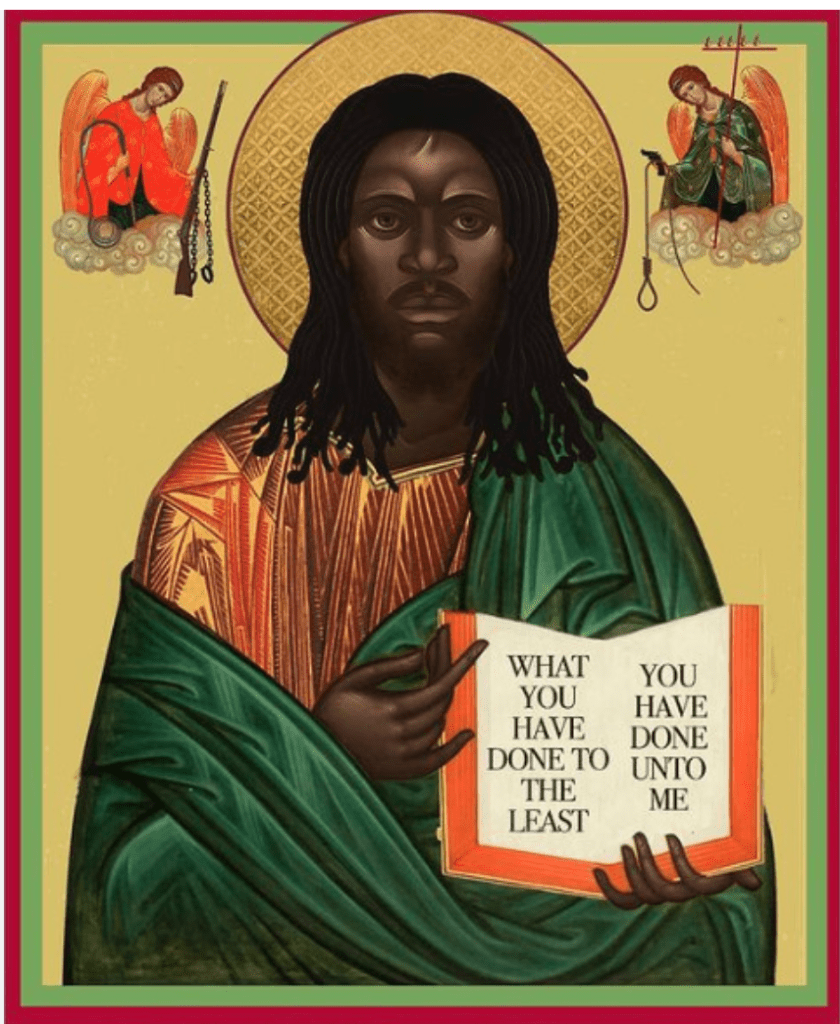
When I read about this terrible suffering and injustice, this complete indifference to the rights of black Americans during the lynching era, the utter brutality and mind boggling hypocrisy, all I can say is that indeed they are the Christ among white Americans. Christ is them, and they are Christ, and their suffering is the deepest possible sharing in the redemptive work of Christ himself. They are suffering for their persecutors, for white Christians who don’t know Christ, who are crucifying the Christ they allegedly worship. These laugh now (at the time), but will weep later, as we read in Luke. Those who are suffering in the Person of Christ achieve the greatest honor and they have the greatest joy in the kingdom, thanks to this identification between their lives and the crucified. Their persecutors, these cruel murderers and all those who cooperate with them, are forever connected to their victims, and this is their torment. They are immersed in the specter of their utter cruelty, the ugliness of their sin, and it is an intolerable sight. But in the midst of their crucified victims, these murderers see the crucified that they think they’ve worshiped. He is there among the lynched, tortured, and burned. He is their only hope. But if he is their only hope, it means that they, their victims, are their only hope, because the identity between Christ and their victims is perfect. They forgive their persecutors, because they are victorious in the crucified one who is among them, and they have received the forgiveness of their own sins in him, so how can they deny forgiveness to those who have murdered them. In fact, their greatest desire is to share in Christ’s victory over sin and death, which they do by their sufferings and the heart of mercy, which each one possesses. They can say with Christ: “…forgive them, for they know not what they do”, and indeed, they know not what they have done. But they will, because they are forever connected to their victims, and so they will forever behold what they have done until they cannot stand the sight of their own ugliness any longer. Their victims along with Christ, who is in their midst, are waiting to be invited by these murderers to defeat their evil with the victory of Christ’s charity and forgiveness. That will be their greatest joy, because it will be their greatest victory, their unique sharing in the victory of Christ. And they wait, and wait, but they won’t wait forever, because St. Paul tells us that “every knee shall bend, of those in heaven and on earth and under the earth, and every tongue confess that Jesus Christ is Lord, to the glory of God the Father”. Finally, it is interesting to compare two perspectives. Today, so many have called for reparations; for they see black Americans as terribly disadvantaged by the allegedly superior whites. But in the light of a theology of the cross, in particular the theology of the cross that came out of this era, in their poetry, their music, their literature, it seems rather obvious that they have a nobility and power that is their glory. They entered into the struggle against sin and death, and they conquered, and many graces were bestowed upon America as a result of that struggle. What we are today is, in large part, the result of that victorious struggle. Black Americans stand higher, not lower. We look up to them, not them to us.