The Unique Charism of the Chaplain
(Talk given to High School Chaplains, St. Bonaventure Church, Toronto, November 13, 2025)
Deacon Doug McManaman
It’s a real honor to be given this opportunity to speak to all of you this afternoon. And it’s been delightful to have spent these past few weeks thinking back over my 32 and a half years as a high school religion teacher and reflecting on the high school chaplains that have been a real support in my life. There is no doubt in my mind that the special charism of the high school chaplain is the ability to listen to people. And there is so much more to this charism than we tend to think. Most people think of listening as sitting back and not doing anything per se, something purely passive, but listening is really activity of the highest order, but most importantly, it is an activity that requires a host of conditions that only certain kinds of experience can put in place. Since we are given the charisms we need to live out the vocation that is ours, it is obvious to me that the Lord did not call me to chaplaincy in my years as a teacher, especially my early years; I didn’t have the gifts and the specific charism that are so essential for a chaplain. That charism developed slowly and came later as I was called to the diaconate, and this process of acquiring the necessary conditions in order to hear is still ongoing in my life, and will be until the very end.
My first teaching assignment was in the Jane and Finch area of Toronto, Regina Pacis Secondary School, which was founded by Father Gerald Fitzgerald CSSp. He envisioned a school in Jane and Finch that would serve those students who could not get accepted at the nearest Catholic high school, and I came on board in 1987. Father Fitz retired shortly thereafter, which was when they hired a Salesian priest as our school chaplain, Father Dave Sajdak SDB, and so it was at this time that I was introduced to the spirituality of St. John Bosco. When students would ask Father Dave what he actually does at the school, his answer was always: “I just hang out. That’s it. I walk around, and I talk to students, teachers, and administrators”. And of course he was a very significant presence in the school, and he was a very good listener, much better than I was at the time. When he left, Patty Ann Dennis, was hired to take his place, and she too was a great presence in the school, a very humble woman who easily recognized the students’ gifts and tapped into them, bringing out the best in them.
But there was one year early on after she left for another school board when I was asked to take on one period of chaplaincy. And so I did. During that year, with a period of chaplaincy, I recall spending a lot of time with a Vice Principal whose father had just died, and who was also having a very difficult time with a small group of staff who became rather bitter and cynical–because it was a very difficult school to teach in. In the heart of Jane and Finch, one needed a great deal more patience than one would need in almost any other school, and after a while, some teachers just got burned out and wanted to change that school into a school for the advanced level–but that’s not what the original mission of the school was, and so they became very cynical, cantankerous, and bitter. This Vice Principal, however, was a very good man, but with the death of his father and having to deal with a small group of cynics, he was becoming increasingly disillusioned, frustrated, and perhaps cynical himself, which is why I did spend a great deal of time in his office that year, just listening to him. But one day I said to him: “I’ve been coming down here all week, and I’ve seen this student sitting there for a couple of days now, and that student the other day. These are good kids. What’s going on?” I cannot recall the details, but let’s just say he made it clear to me that a good number of students were being sent down for the silliest reasons. And so I decided to challenge this Vice Principal, who I really liked. I said to him: “Why do you put up with this nonsense? Why don’t you challenge us at staff meetings? Why don’t you say something? You guys say nothing, you go on as if everything is okay, and you keep all this crap to yourselves”, or words to that effect. As a young and inexperienced teacher, I always wanted to challenge my administrators, and here I had the chance, because he was a friend of mine, and I could talk to him in a way that I wouldn’t talk to any other administrator–I knew there would be no repercussions. And, he could talk to me in a way that he would not speak to any other teacher, that is, he didn’t have to fear a grievance letter, of which he had plenty.
He told me in no uncertain terms that my neat and tidy solutions were the product of inexperience, they were not solutions at all, but imprudence rooted in a lack of data that would only result in a heap of difficulties. He helped me to see that there are many more levels for an administrator to consider, far more than a teacher has to consider: i.e., senior administration at the board level, the union, parents, police, the law, teachers, etc. When one becomes an administrator, one acquires a purview that is very different, far more complex and much larger than that of a teacher. I realized that the four walls of my classroom shielded me from appreciating the complexity of this work. I became a more grateful teacher, but it was an eye opener for me, and I became a better listener to those in administration than I had been previously and was able to offer much greater support to all my administrators in the following years.
I had an interesting dream that year as well. Over the years, I had dreams that were in many ways visions, as it were. Sometimes we are too busy to hear what the Lord is saying to us, but when we sleep, we just can’t interfere, so we are more disposed to listen to what God is trying to tell us. And I know when a dream is more than a dream, because I remember the details, I usually wake up in a spirit of joy, and it feels as if I just had a holiday and I have renewed strength to continue. But this was a very simple dream. I was in a huge barn, and I went to the barn door, the upper part of which was open, and I looked out onto this huge pasture, covered in manure, everywhere. I look to my left and see this beautiful stallion, and there’s a woman grabbing the hoof of this beautiful horse, like a farrier would, and cleaning the shit off of it, and she looks over at me and yells out my name and tells me to get out there and help her. So I did.
Now, I knew immediately upon waking that the stallion symbolizes my Vice Principal friend, and the woman, I knew, was Mary, the blessed mother. It’s a great image of Mary. She spoke to me with such familiarity, like an older sister, and she was shoveling shit with her hands. Very important. That’s how I knew my time with this Vice Principal was important. Just listen, help clean off the crap that is thrown at him every day, help him not to get discouraged.
The following year I was back in the classroom, which is where I wanted to be, but the experience of teacher cynicism, which was a very difficult ordeal for me, took me a bit further in terms of my ability to listen to a certain sector of the school, namely administration. And that’s why I never became an administrator. Many of my friends became administrators and so I knew what they had to go through, because they would tell me. I also knew I didn’t have those gifts, and administration is a charism that St. Paul lists among the various charisms he speaks about in 1 Corinthians and Romans.
Another painful but significant experience I had that helped me in terms of my ability to listen to and genuinely hear a certain group of people took place in 2011. I was ordained a deacon three years by then, and as a deacon my ministry was to those who suffer from mental illness. Every week I would visit CAMH, the old Queen Street Mental Health Center downtown. I was still a teacher, however, and we had been preparing to introduce the IB program in our school and I was set to teach the Theory of Knowledge course. Well, one day while visiting the philosophy classes at St. Theresa of Lisieux Secondary School in Richmond Hill, Friday, Dec 23rd, the last day before the Christmas holidays, I began to sweat, and I was getting the shivers. I stuck it out and left immediately at the end of the day, and just got into bed. The next day it was worse. I had terrible pain in my head and neck and shoulders, and the chills were bad, so I told my wife and daughter to go on ahead to Kitchener, Ontario, and I would drive up on Christmas day. Well, that wasn’t going to happen. The pain got worse, it moved from my head to my legs and arms, and I was taking Motrin, but you can only do that for so long before it burns a hole in your stomach. On Christmas day, all I had was a can of tuna. On Boxing Day, I went to the Emergency, and the doctor thought I might have Polymyalgia Rheumatica, for which there is no known cure. I was put on prednisone and given some oxycodone for the pain. The oxycodone was too powerful for me; it felt great, but it was playing tricks with my mind so I stopped it. But I was in a deep state of despair. I was on the phone with my spiritual director every night. I didn’t think I’d be able to return to the classroom ever again. I thought it was over. I could not imagine returning; for I was experiencing a general, all around flu like condition x 10 with lots of pain in my arms and legs, like nothing I’ve ever experienced before. But the worst part was the despair.
However, at one point in our conversation I said to him: “I think I understand now what my patients have to go through every day, the ones who battle depression.” I was genuinely frightened, because I didn’t know how I’d be able to manage this for the rest of my life–there is no known cure. I realized I had to stop thinking long term and think “one moment at a time”, not one week at a time nor even one day at a time. But I clearly remember saying to Father Kelly: “I think I have a glimpse, a much better appreciation, of what my patients have to go through every day”. And then Father Kelly said to me: “Just keep saying the following prayer: ‘Into your hands, Lord, I commend my spirit. Into your hands, Lord, I commend my spirit’.
Now, I knew that prayer, because it is part of the Night Prayer in the Breviary that we promised to pray on our day of ordination. The problem is when you say a prayer for years on end, it can become just words after a while. So I decided I would pray this prayer and mean it: “Into your hands, Lord I commend my spirit. If you do not want me to go back to teaching, your will be done”.
That night I had the best sleep. It felt as if a cool breeze had passed through my body. In the morning, the pain was still there, but the darkness was not. And eventually after a few days, the pain was beginning to subside, and I began to see a light at the end of the tunnel, and soon I was slowly weaned off the prednisone. But I had a much deeper appreciation for my patients who suffer from clinical depression. What I was experiencing was not clinical depression, they have it much worse, to be sure, but it was enough to give me a glimpse into what they have to battle every day for years on end. I was a much better chaplain to the mentally ill after that experience. “Blessed are the Poor in Spirit, the kingdom of heaven is theirs”, and it is mental sufferers who in my experience are the truly poor in spirit, who recognize their utter need for God.
But the Lord was not through with me yet. I’m reminded of Father Don MacLean saying to me in the sacristy one day when I was studying to be a Deacon; he said: “You never arrive. Remember that. You never arrive. Don’t ever think you’ve arrived”. As a Deacon for 17 years, I’ve seen things that I would probably not have seen without ordination, and not all of it was pretty; some of it was very ugly. I’ve known and worked with a number of very good priests over the years. When I first came back to the Church in my late teens, the priests who were the greatest influence were of course great priests, the most significant of which was Monsignor Tom Wells of the Archdiocese of Washington DC, who stopped the car and picked me up when I was hitchhiking to Nashville, TN, back in 1979. However, I have had my share of misogynistic priests, overly controlling micromanagers, insecure, arrogant, condescending, and envious priests; gossipy, petty, vindictive, male chauvinists who think women are good for little more than emptying the dishwasher, setting up tables and making coffee, setting down cookies and snacks, and other menial tasks, but not for giving talks for a parish mission or giving spiritual direction, much less preaching. Consistent with this clerical elitism–in some cases, a deep seated narcissism–, such priests, who are almost entirely indifferent to social outreach, will have a great love of liturgy and sanctuary decor, vestments, etc. These are the genuine poster boys for the clericalism that Pope Francis spoke out against so often during his papacy. I’ve had to taste that, experience that, and still do, it hasn’t disappeared, and that has been very difficult.
But I will say this: it has also been a great blessing in many ways; a painful blessing, but a blessing nonetheless. I say this because I didn’t always understand those who had been hurt by the Church. My mother was hurt by the Church; many of the patients I visit in hospital who haven’t seen the inside of a Church in decades have been hurt by the Church. I wasn’t able to identify with them completely; I didn’t really know what they were talking about. But now I do. I know exactly where they are coming from. And I am able to hear them in a way that was not possible earlier on. And so I am in some ways thankful for these condescending exemplars of clerical elitism who really believe the Church is about them and that the focal point of the life of the parish and the liturgy is them.
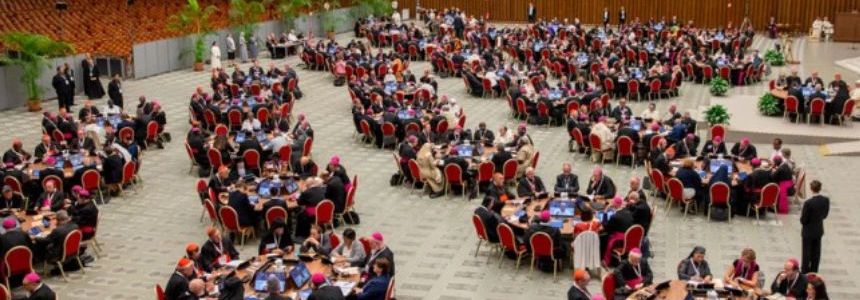
If we read the Document for the Continental Stage of the Synod on Synodality that Pope Francis initiated, we will see that this kind of clericalism is not a local problem, but a worldwide problem. Francis is one Pope that understood the importance of listening, but it is remarkable how few clergy see its importance and still regard the parish as their own little fiefdom, to change and mold as they please. At one time in our history, not too long ago, a large percentage of priests were like that. Hence, the number of people who will simply not set foot inside a Catholic Church, except for the occasional wedding or baptism.
In the gospel of Luke, Simeon is described as righteous and devout, awaiting the Messiah. It was revealed to him that he would not see death before laying eyes on the Messiah. He recognized, through the Holy Spirit, that the child Mary was holding was that Messiah and that he would be a sign of contradiction. He turns to Mary and tells her that a sword will pierce your soul also. Mary and Joseph both marvelled at what was being said by Simeon. Furthermore, Simeon blesses both Mary and Joseph. And so Mary, the greatest saint, full of grace, and Joseph, the greatest saint next to her, are amazed, impressed, they marvel at what was said about the child, and both are willing to receive Simeon’s blessing. Also, Anna, a prophetess, married and widowed, a woman of prayer and fasting, came forward too and spoke about the child. And one other irony: Mary and Joseph, the richest creatures ever created by God, are poor; for they offer the offering of the poor, two turtle doves instead of a lamb, and yet they hold in their arms the lamb of God who takes away the sins of the world. And Luke, throughout his gospel, depicts Mary as one who “ponders these things in her heart”. She listens. In other words, it’s not as if she knows everything. She learns, and marvels at what she learns through others like Simeon and Anna, the prophetess, and ponders what she hears. Mary and Joseph seem to have no idea of their status before God. Both of them allow themselves to be taught, and to be amazed; although the old law is fulfilled in her womb, Mary does not see herself as superior to the old law, nor as superior to Simeon or Anna, even though she is higher than the angels.
This says a great deal about what true holiness is. Holiness is listening, and listening is an activity, not a passivity, and it is rooted in charity. The truly holy allow themselves to learn from everyone, and they are able to be impressed with others. The proud and envious, on the contrary, are rarely impressed with anyone or anything, unless it is related to them and glorifies them in some way.
Pope Francis, early in his papacy, derided the notion of a self-referential Church, focused on itself. Many in the Church were distressed by the suggestion, but his successor, Pope Leo XIV, continues to call the Church to turn outward, towards the world, to become a more listening Church. In fact, two or three weeks ago, he said:
We must dream of and build a more humble Church; a Church that does not stand upright like the Pharisee, triumphant and inflated with pride, but bends down to wash the feet of humanity; a Church that does not judge as the Pharisee does the tax collector, but becomes a welcoming place for all; a Church that does not close in on itself, but remains attentive to God so that it can similarly listen to everyone. Let us commit ourselves to building a Church that is entirely synodal, ministerial and attracted to Christ and therefore committed to serving the world.
Listening is utterly central to the nature of the Church, which is a living organism that, in order to grow, must appropriate so much that is good from the environment that is outside the organism and integrate it. That is why synodal listening is so important, listening not just to clergy, but to the lay faithful, recognizing their gifts, talents, and expertise. However, not every diocese has been on board with this. There has been a great deal of indifference, in large part because very few clergy have been taught to listen and see themselves instead as the “anointed” with all the answers to life’s difficulties and peoples’ questions. But the world is vast and inconceivably complex, with a myriad of pockets of knowledge, each one a universe unto itself. The conceptual framework of one individual person and even a small bureaucracy made up of relatively like minded clerics unconvinced of the power of openness and listening to the lay faithful–not to mention those who have been hurt by the Church in many and varied ways–is far too limited to exercise any kind of effective and credible leadership today.
Francis thus envisions a more Marian Church, a Church that, like Mary, listens and marvels at the extraordinary gifts, talents, insights and abilities of unknown men and women who are unique and genuinely under the influence of the Holy Spirit, like Simeon and Anna in Luke.
Recently I asked Sue LaRosa, who was the longest serving director of the YCDSB, to do a video for my students at Niagara University. We are looking at magisterial pronouncements on the right to association, so I asked her to speak about her vision of the relationship between senior administration and the union. She says [emphasis mine]:
When I became Director of Education , I inherited a teacher’s strike followed by a provincial strike. Trust between the board and the union was shattered. I indicated to the Board of Trustees that “this is no way to live”. I committed to rebuilding trust and changing the culture. They didn’t discourage me, but they didn’t believe it could be done. I wasn’t totally convinced I could develop the trust level that would allow for a path to stop the “blame game”. So, I reflected on my beliefs. I believe we are all born with unique talents and a desire to contribute to the common good. No one thrives in conflict mode. The first step was one of reassurance and deep listening –not defensiveness if this broken relationship was going to be mended. The turning point was the introduction of interest-based bargaining. Many of you may never be involved in bargaining , but the concept of interest-based bargaining was the catalyst that restored trust. The name alone gives hope: interest based. The method is built on collaboration and mutual understanding . The board team and the teacher team trained together. The key word here is “together”. We moved cautiously , learning together . It wasn’t a rapid shift. In this approach, everyone had equal status—whether you were the Director or a teacher. That leveled the playing field. We were disciplined in following the proven strategies. It wasn’t always easy . Actually, there were moments I questioned the path. The result was evident; we successfully negotiated five collective agreements without ever hearing the word strike again. We went from forty annual grievances to three.
That was, of course, a small portion of her talk, but what struck me about this is that she understood the fundamental principles of synodality and ecumenical dialogue more than 13 years before the Papacy of Pope Francis.
There have been three priests in my life who I can characterize as having been widely beloved. A few years ago I began to reflect specifically upon why they are so loved by so many people. As I pondered this, I came to the conclusion that the reason they are so loved is that they are genuinely interested in ordinary people. They pay attention to people. They approach you and want to know your name, what you do, where you are from, what you love, the names of your children, etc. I was talking to one of these three priests the other day. He was out of town at a funeral reception a couple of weeks ago and he went around to everyone and shook their hands, asked about them, their names, the names of their children, what they do, and so on. But when he got up to leave, a number of them asked where he was stationed, that is, where he says Mass. He’s retired, so he is not stationed anywhere. But he was struck by their desire to maintain contact with him.
Now, I wasn’t surprised. That’s why he’s so widely loved. He’s genuinely interested in people, which is why he’s still very busy as a retired priest. My wife was reading Chesterton the other day and came across some lines that reminded her of my retired priest friend. He writes:
How much larger your life would be if yourself could become smaller in it; if you could really look at other men with common curiosity and pleasure; if you could see them walking as they are in their sunny selfishness and their virile indifference, you would begin to be interested in them, because they were not interested in you. You would break out of this tiny and tawdry theatre in which your own little plot is always being played and you would find yourself under a free sky in a street full of splendid strangers.
That’s why these three priest friends of mine are so interested in other people, because they are so small in their own eyes, and so they always walk under a free sky in streets full of splendid strangers.
I believe this is a small scale example of how ecumenical unity works. It’s not about having a great debate. These people were moved by the fact that this priest was interested in them as persons. They encountered Christ in him. ‘Someone loves me enough to pay attention to me’. In their minds, that has to be Christ. ‘Where do you live so we can make the effort to see you again’. That’s the key to ecumenical unity.
The more I was interested in my students’ religions, whether Islam or Sikhism, Hinduism, etc., the more they became interested in what I profess to believe. If they have Christ at some level, and if I love Christ, then I will have the eyes to discern Christ within their tradition, their literature, their great teachers. These students know from within that their religion is good, that God is among them (Emmanuel), and if they see that I am able to discern that, they know that I too must have something good that enables me to see this, and they want to know what that is, and they want to share in that. Ecumenical unity is not going to be the result of a series of Q & A sessions or a campaign of apologetics. It’s going to be a matter of mutual enrichment. ‘I see that you have something to offer me, that you can help me see the world in a way that I currently do not, that you can even help me to discover things about Christ that I would otherwise have overlooked, and vice versa.’ It’s not going to work if we insist that we have the “fullness of truth” while you others have only splinters and fragments here and there–so we don’t really need you, but you need us. No, at the heart of ecumenical dialogue is Christ. As St. Paul says: it is no longer I who live, but Christ who lives in me, and if he lives in me, then I have his eyes, and I will recognize him outside of my tribe. Hence, the importance of listening, hearing, seeing. Unfortunately, tribal Catholicism is on the rise, even among young Catholics who typically confuse evangelization with apologetics. Evangelization is the proclamation of the good news, and the good news is that Christ is risen, he has conquered death, that death no longer has the final word over my life and your life, and that in joining a human nature to himself, God the Son joined himself to every man, as it were.
Chaplains are called to be the good news. That’s how we proclaim it: “It is no longer I who live, but Christ who lives in me”. In our schools, there is great diversity. Almost 40% of my students in Markham were Muslim. We had Hindus, Sikhs, Buddhists and more. We are not called to proselytize, but to witness to the risen life of Christ, to the joy of Easter. If it is no longer you who live, but Christ who lives in you, then it follows that those Muslim, Hindu, and Sikh students who love you and love what they see in you in fact love Christ without them necessarily knowing it. The good news of the risen Christ is proclaimed to them in you. That’s what is most important at this point, not that they leave their religion and join the local Catholic parish.
Although none of you here are clergy, you are all priests, members of the Royal Priesthood of the Faithful. Each one of us, when baptized, were anointed, with sacred chrism, priest, prophet and king, Christ’s threefold identity, and as a high school chaplain, you are rightfully exercising that priesthood. Catholics of the Latin rite are not used to hearing this, again, due in large part to the clericalism of the past centuries that sees the Church as primarily clerics: deacons, priests, bishops, cardinals and pope, with the laity at the base of the pyramid. And many have forgotten the efforts made at the Second Vatican Council to define the Church primarily as the laos, from which is derived the word laity: the people, which includes clergy. The Church is the fellowship of believers, the people of God. The hierarchy is only a small part of that larger Church, but the whole Church is a priestly people. The ministerial priesthood exists to serve the common priesthood of the faithful. It was Pius X’s mother who commented on his papal ring that people were kissing and she said to him: “You wouldn’t be wearing that ring if it wasn’t for this ring here”, pointing to her wedding ring. Marriage is a genuine priesthood. A priest is one who offers sacrifice, and the life of a married couple is a genuine self-offering. It is difficult, it is sacrificial, and life in our schools today, whether you are a chaplain, teacher or administrator, is holy work. It is difficult work, but it is holy, sacred. When we walk into a classroom, we are walking on holy ground. And chaplains are called to minister to the entire school, not just the students, but administrators and support staff.
Finally, let me end with this. I was talking to a consecrated virgin in our parish recently; she is a wonderful woman and gives talks to seminarians at St. Peter’s in London–but not here, for a prophet is not welcome in her own town, especially if she’s a woman–, and she is on fire about synodality, and rather frustrated with the lack of it at the parish level. But I asked her what she thinks I should say to you. She said a host of things to me at that moment, but I asked her to write it down. She writes:
We don’t need to wait for some program about synodality to come into our parishes–like the Alpha program or a Bible study–for synodality to become a reality for us. We can start now in becoming synodal people, that is, people who intentionally encounter other parishioners, listen to them prayerfully in light of the Holy Spirit, come to appreciate their gifts, go out to the margins to encounter those who feel uncomfortable or excluded by church structures, etc. There is so much we can do now, as individuals or as informal groups of parishioners, to begin to live synodally, to be living signs of what synodality looks like. As Pope Francis said repeatedly, synodality is not just another program; it is a way of being church.
Yes, it will be great when initiatives taken by the Archdiocese begin to filter down to our parishes in structural reforms that will facilitate shared decision-making and accountability in our parish life. But we do not need to wait for those structural changes to come down from on high. We can begin now with grassroots, relational, attitudinal changes. What we can do now is about preparing the ground, so that when the structural changes do come, we will be ready to embrace them. Let us trust that the Holy Spirit will lead us in this, because it is so much a movement of the Spirit for our time – necessary and prophetic.
Of course, what she implies is that we should just start to do that in the school and not wait for the diocese, because you’ll probably be retired and in a long term care facility before we see anything like that. I was driving through Markham recently and saw, in big bold letters on the side of a barn, Be The Change. I laughed, because the line is such a cliche and very 70s, and yet it is true. Be that synodal Church. And that’s the unique gift brought by the chaplains that I’ve been blessed to have had in my life, the gift of synodal listening.
 A Catholic Philosophy and Theology Resource Page by Deacon Douglas McManaman