Padre, don’t forget
Deacon Douglas McManaman
My good friend, a retired priest from the Diocese of Hamilton, Ontario, took a group of kids to the Dominican Republic more than 30 years ago. One day he went out to the outlying regions in Consuelo, called the Bateyes, which are small rural settlements designed for plantation workers. They are very impoverished areas, lacking basic services such as clean drinking water. My friend remembers meeting a very poor woman who was blind and who had one arm severed; she was in her 50s, and of course she was living in great poverty. Through a translator, my friend said to her: “I’m sorry”. He was sorry for her condition, for her suffering. She read his sorrow on his face and simply said to him in reply: “Padre: don’t forget, there is going to be a resurrection”.
My friend felt tremendously uplifted by her words. In her suffering, and in her faith and hope in the resurrection, she lifted him up. This lady experienced something of the empty tomb; she was a witness that we can actually experience the reality of the resurrection without actually having been at the empty tomb. She is an example of those whom Christ referred to in the gospel of John: “Blessed are those who have not seen but believe”. Her Easter joy transcended all her misery.
The word ‘gospel’ means good news. Over the years, I would often ask my students: “What is the good news”? Many of them would be stuck for an answer. Only a few could tell me. And many Catholic adults today reduce the gospel to “a collection of rules and prohibitions… to the repetition of doctrinal principles, to bland or nervous moralizing” (Aparecida, 12). “You shall not kill”; is that good news? “Do not take the Lord’s name in vain… You shall not commit adultery… You shall not steal…”; is this the good news? Not at all: “…for through the law comes consciousness of sin” (Rom 3, 20).
Recently, I was part of a 90-day spiritual exercise at a local parish that includes rigorous disciplines, such as cold showers, fasting and abstinence on Wednesdays and Fridays, no social media, no sports on TV and alcohol, work out three times a week, and more. There are many good things about this exercise, in particular the weekly fraternity meetings, but it is very easy to fall into a discussion on the details of how we failed in this or that discipline during the week: “I was just too tired to work out this week”, or “I had a glass of wine”, or “I just couldn’t take cold showers this time around”, etc. This is not the good news, for we are talking about our failures. If anything, it was good news that the program ended on Easter Sunday.
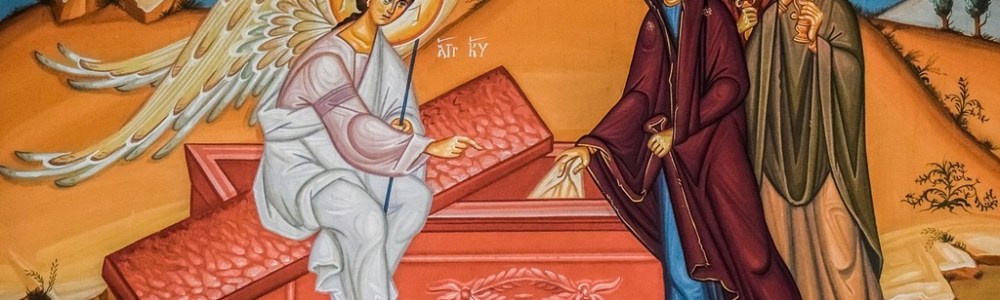
And this leads me to what the gospel really is, namely, Easter. The good news is the resurrection of Christ. Death has been defeated; for death had no power over him. So much of our sinful behavior throughout our lives is rooted in a deep but unconscious fear of death. The good news is that death no longer has the final word over your life and my life, and we know this because one Person has risen from the dead. His resurrection means that you too will rise to new and everlasting life. To live in him and to die in him is to live and die in the sure hope of resurrection. Furthermore, all those we loved in life and who have died, we will see and touch them again, for we will rise with a glorified body, not subject to sickness and death–and we won’t look like we do now, which is more good news to many of us.
I remember walking into my friend’s office and seeing a picture of a little girl, about 4 or 5 years of age. I asked my friend who that is. “That’s little Stephanie”, he said. One afternoon she choked on a sandwich and died. It was one of the saddest days of my friend’s priesthood, walking into the hospital and seeing her young mother and father standing there beside the hospital gurney with the lifeless body of their four-year-old girl lying on it. About 6 months later in the middle of a dark winter night, however, my friend had a powerful dream-vision of Stephanie, but not as a 4-year-old child, but a young adult woman in her 20s, surrounded by a bright white light, like nothing my friend had ever seen before. She said to him: “I can’t see my parents now, but I can come to you. Tell them not to worry, that I am happy.” My friend then reached out to her and suddenly found himself sitting up in bed, in the pitch black of night, about 3 am. What struck me, among other things, is that she did not appear as a child, but as a young adult.
The gospel is a message of salvation. But more to the point, our resurrection to new life begins now, in this life. Salvation is ours today, it has been freely given, as sheer gift. And we are saved by faith, not by works. As St. Paul says: “For it is by grace you have been saved, through faith—and this is not from yourselves, it is the gift of God— not by works, so that no one can boast” (Eph 2, 8-9). We did not nor can we save ourselves. Even our own cooperation with grace, our free decision to follow the lead and promptings of divine grace is itself a grace; for we were given the power to cooperate and to follow, so we cannot take any credit for where we are today.
The good news is that our sins have been forgiven: “In him we have redemption by his blood, the forgiveness of transgressions, in accord with the riches of his grace that he lavished upon us” (Eph 1, 7-8). For example, there is nothing that the paralyzed man did to earn God’s forgiveness (Mk 2, 1-8). His friends who brought him to Jesus believed that Jesus could and would heal him. Nothing more is required. Christ’s healing of his paralysis is a resurrection. He can freely stand up. That’s what the forgiveness of our sins is, namely, our theosis. The problem, of course, is that we have a very hard time believing that and even receiving that forgiveness. Many of us still believe, deep down, that we have to do something to earn it in some way. But to think this way is to very subtly and perhaps unconsciously reject the gift of grace he offers us; so instead of “all glory and honor are yours”, some of us would rather a portion of that glory directed our way. But God loved us while we were sinners: “God proves His love for us in this: While we were still sinners, Christ died for us” (Rom 5, 8).
The focus of our lives must not be on our sins, our failures, our shortcomings, but on the immeasurable and gratuitous nature of his love for each one of us. Only then can our life be a genuine response to that love, a joy, not a burden.
 A Catholic Philosophy and Theology Resource Page by Deacon Douglas McManaman