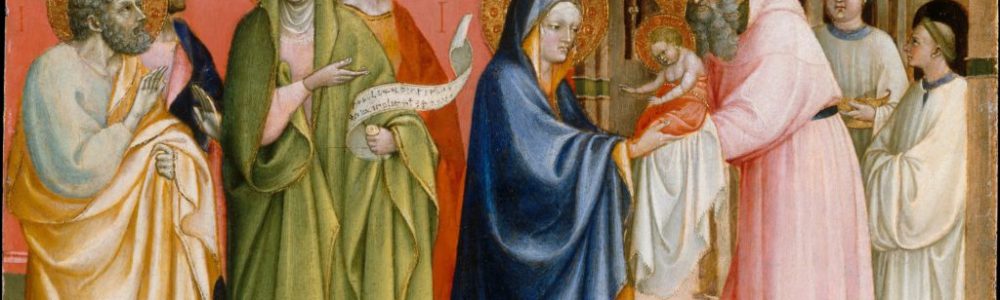
The Feast of the Presentation
D. McManaman
The gospel reading on the Presentation is really about humility. The word humility comes from the Latin ‘humous’, which means dirt or soil. The humble are down to earth; they don’t walk high and mighty. But another English word that is derived from ‘humous’ is humour. Now what’s interesting about humour is that it hinges upon irony. You’ll notice this in the nicknames that kids give to one another. They are full of irony, which is why they are funny. The short kid is nicknamed stretch, the tall kid is given the nickname shorty, the skinny kid is nicknamed Hercules, and when I was a kid, they called me slim.
What’s interesting about the gospel is that it is full of irony, and so it is full of humour–divine humour. St. Gregory of Nyssa calls attention to this divine irony in his sermon on the Beatitudes when he says that the judge of all creatures is subject to the judgment of mere humans, the author and sustainer of life tastes death, the all powerful is hungry for bread and dies on a cross, and so on.
This gospel reading is also packed with irony. Jesus is presented in the temple, because the Torah says that “every male that opens the womb shall be consecrated to the Lord”. Now to consecrate means to ‘make holy’. But Jesus is the fount of all holiness; he is Lord, God the Son. This is irony. So too, Mary undergoes forty days of purification, but she is purity itself, for she is the Immaculate Conception, she is ‘full of grace’, as the angel addressed her at the Annunciation. Not only that, but Mary is, according to the author of the gospel of Luke, the New Ark of the Covenant. The Ark of the Covenant in the Old Testament was the holiest object in Israel, and it contained the tablets of the commandments, manna from the desert, and the staff of Aaron the Levite priest. Mary, the New Ark of the Covenant, contains in her womb Christ the New Law, who is the Bread of Life, and who is the eschatological priest who came to offer himself for the salvation of the world. She is the holiest of God’s creatures, and Joseph is the greatest saint next to her. Nonetheless, both of them submit to the requirements of the old law. That is perfect humility.
But there is more. Simeon is described as righteous and devout, awaiting the Messiah. It was revealed to him that he would not see death before laying eyes on Messiah. He recognized, through the Holy Spirit, that this child was the Messiah, and that he would be a sign of contradiction, and he turns to Mary and tells her that a sword will pierce your soul also. And Mary and Joseph both marvelled at what was being said by Simeon. Furthermore, Simeon blesses both Mary and Joseph. And so Mary, the greatest saint, full of grace, and Joseph, the greatest saint next to her, are amazed, impressed, they marvel at what was said about the child, and both are willing to receive Simeon’s blessing. Moreover, Anna, a prophetess, married and widowed, a woman of prayer and fasting, came forward too and spoke about the child. And one other irony: Mary and Joseph, the richest creatures ever created by God, are poor; for they offer the offering of the poor, two turtle doves instead of a lamb, and yet they hold in their arms the lamb of God who takes away the sins of the world. And Luke, throughout his gospel, depicts Mary as one who “ponders these things in her heart”. In other words, it’s not as if she knows everything. She learns, and marvels at what she learns through others like Simeon and Anna, the prophetess, and ponders what she hears.
It is obvious that Mary and Joseph have no idea of their status before God, no idea of their holiness. Both of them allow themselves to be taught, and to be amazed; although the old law is fulfilled in her womb, Mary does not see herself as superior to the old law, nor as superior to Simeon or Anna, even though she is even higher than the angels.
This says a great deal about what true holiness is. Those who are genuinely holy do not know they are extraordinary; for they don’t compare themselves to others. The truly holy allow themselves to learn from everyone, and they are able to be impressed with others. The proud and envious, on the contrary, are rarely impressed with anyone or anything, unless it is related to them and glorifies them in some way.
And rarely do they speak well of others. Although the true saint is hidden and unknown, because they don’t stand out, pseudo-saints find many subtle ways to make themselves stand out from others around them. Great saints don’t know they are saints, they don’t pontificate, they are not quick to correct others or give advice; pseudo-saints pontificate, are quick to offer correction, are quick to advise. True saints affirm others who go away from them always feeling better about themselves; but pseudo-saints do not allow others to leave them feeling better about themselves, but confused and doubtful about their worth. Genuine saints are very generous, pseudo-saints are stingy, not only with money, but with everything–they rarely praise or compliment others, unless the object of their praise somehow reflects back on them. And as genuine saints are not the least bit aware of their holiness, pseudo-saints are not the least bit aware of their pretension and hypocrisy, but see themselves as superior.
Let me finish by saying that Pope Francis, early in his papacy, derided the notion of a self-referential Church, focused on itself. Many in the Church were distressed by the suggestion, but he continues to call the Church to turn outward, towards the world, to become a more listening Church. This is why he has put so much effort into Synodality; listening to the lay faithful, recognizing their gifts, talents, and expertise. In other words, he envisions a more Marian Church, a Church that, like Mary, listens and marvels at the extraordinary gifts, talents, insights and abilities of unknown men and women who are genuinely influenced by the Holy Spirit, like Simeon and Anna in this gospel.
 A Catholic Philosophy and Theology Resource Page by Deacon Douglas McManaman