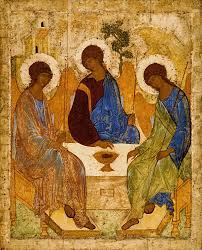
Thoughts on Trinity and Personhood
Deacon Douglas McManaman
In the first book of Maccabees, we read: “In those days Mattathias, son of John, son of Simeon, a priest of the family of Joarib, left Jerusalem and settled in Modein” (2, 1). This kind of description is typical in the bible. The reason is that a person is fundamentally a plurality. That’s why the doctrine of the Trinity is so important, more important than a pure and rational monotheism. God is three Persons in One divine nature, not one in three. “Three” must always precede the One, and the One must be seen in relation to the three, and not within the conceptual framework of a metaphysical oneness. God is a plurality of three equal Persons: God the Father, God the Son, and God the Holy Spirit. The Oneness of God is the Oneness of the three equal Persons: “I pray not only for them, but also for those who will believe in me through their word, so that they may all be one, as you, Father, are in me and I in you, that they also may be in us, that the world may believe that you sent me. And I have given them the glory you gave me, so that they may be one, as we are one, I in them and you in me, that they may be brought to perfection as one, that the world may know that you sent me, and that you loved them even as you loved me” (Jn 17, 20-23).
The human person is created in the image and likeness of God; but God is a Trinity of Persons. It follows that although you and I are individual persons, one being, we are first and foremost a kind of plurality. For example, my own human existence has a place within history, and it is a historically relational existence. I am related to the past; I cannot be understood apart from the past. The human person is born from a mother, and that child has just spent his/her first nine months of life deep within her womb, nurtured and sustained by that mother, placed in her arms immediately after delivery. That child is completely and utterly dependent upon the care of the parents for many years to come, who in turn are dependent upon innumerable others. And so my existence is related to the past in that others before me have made my life possible–I inherited their matter, their proclivities, talents, I’ve been positively influenced by people in my own family and by certain people outside of my family, such as my teachers, many of whom I have forgotten, not because they were insignificant, but by virtue of the limits of memory, which in turn allows me to further depend on others; and my existence influences others who will live after I am gone, who will have been influenced by my life and my sacrifices in some way. And so “my life” is not purely mine. It is not an isolated existence, but a thoroughly relational one. It is the product of the love and labor of countless others.
Our fundamental purpose is to struggle to bring about a universal fraternity, a plurality in unity, a brotherhood that sin destroys. Vatican II points out: “Christians should cooperate, willingly and wholeheartedly, in building an international order based on genuine respect for legitimate freedom and on a brotherhood of universal friendship” (GS 88). Christ came to gather, but sin always divides.
 A Catholic Philosophy and Theology Resource Page by Deacon Douglas McManaman