Creation and Evolution: Two Simultaneous Orders

Deacon Douglas McManaman

After all these years, some people still speak about evolution and creation as though the two stand face to face on a level field, so to speak, and that the two are mutually exclusive. Many also have a tendency to think that stochastic processes and creation are incompatible and thus irreconcilable, insofar as creation is planned, while randomness appears to be unplanned. The following is an attempt to show that this is a misconception.

Evolution and creation are two ideas that belong to two different orders, if you will. Evolution belongs to the essential order while creation belongs to the existential order. Allow me to explain. We speak of the essence of a thing, and the essence describes “what” a thing is, and this includes how it acts and thus how it manifests itself, that is, how it reveals its nature (science is a study of the natures of things). For example, an organism is a living kind of thing, because it self-ambulates, and presupposing evolution we can say that organisms are the kinds of things that evolve via a process of random mutation and natural selection. We can say more about specific organisms than this, but whatever we accurately say about them along scientific lines simply allows us to understand “what” they are more deeply. 

However, we can know “what a thing is” (essence) without thereby knowing “whether or not it exists” (existence). The very act of existence of a being is not included in that thing’s essence–we can know what a dinosaur is without apprehending its existence outside the mind. This is true because whatever belongs to a thing’s nature or essence belongs to it necessarily. For example, the ability to reason belongs to the essence of a human being, and so if there is a human being on the other side of this door, then we can say that he or she necessarily has the ability to reason, at least to some degree. If the act of existing belonged to the essence of a being, such as the being behind this door, then we’d have to say that this being, whatever it is, exists necessarily, and thus could not not exist, and thus would have always existed. We would then say that such a being is a “necessary being”. But if we are talking about a being whose essence is really distinct from its act of existing, then such a being need not exist and can indeed “not exist”, such as this cat, or that person, or that tree, etc. We refer to such beings as contingent (may or may not be), as opposed to necessary.

Aquinas argues that even if we suppose that the universe always existed, it would still require a creator, and the reason is that the universe is the sum of the contingent beings that make it up. In other words, every being in the universe is a contingent being, a being whose essence is really distinct from its act of existing. Furthermore, no contingent being can bring itself into being, for that would require that a being exist before it actually exists, which is absurd. And no contingent being can impart the act of existing on what simply does not exist (creation ex nihilo) because a contingent being can only act within the limited powers of its nature, and existence does not belong to the nature (essence) of a contingent being–otherwise it would not be contingent, but a necessary being (eternal and having always existed). And so it follows that only a non-contingent being, that is, a necessary being, can impart the act of existing and thus bring into being what simply does not exist. 

To impart the act of existing is not the same as reproduction or generation. In order for an organism or two to reproduce or generate offspring, that organism must exist, and it must be sustained in existence–for a contingent being (i.e., an organism) cannot perpetuate its own act of existing any more than it can impart the act of existing. To perpetuate or sustain the act of existing is not the same as sustaining one’s life; I can sustain my life by eating and drinking, but in order to eat and drink, which are activities, I have to first exist and be sustained in existence. Only then can I act. 

This is why creation is not to be thought of as something that occurs at the beginning of time, and thus at the beginning of a horizontal timeline. The evolutionary process began at some point on a horizontal timeline, but not creation. Creation is to be thought of vertically, not horizontally. For example, I decide to run from point A to point B, and that can be depicted horizontally. But in order for me to complete the change from point A to point B, I must first exist and be sustained in existence throughout the change, because activity presupposes being or existence, for it is always a “being” that acts. So too with evolution. In order for an organism to evolve–which tells us something of the essence of the thing–, it must first exist, and an organism is not its existence; rather, an organism “has” a received act of existing. And so evolution requires creation (essence depends on existence). An evolving organism is a contingent being that is a determinate kind of thing (essence), but one which also has a received act of existing, an act of existing that does not belong to that thing’s nature.

Finally, stochastic processes belong to the essential order, not the existential order. For example, popcorn is a certain kind of food, but think of a bag of popcorn kernels spread out on a table. It is not possible for you or me to know which kernel is going to pop first, which one second, third, etc. Their popping is going to be entirely random. However, randomness is order–it is only a disorder relative to us (epistemic disorder, not a real disorder). The reason we say this is that real disorder is unintelligible; it cannot be the object of study, but the random popping of the kernels will follow a normal frequency distribution, which is an ordered and intelligible distribution, and so although we do not know which popcorn kernel is going to pop at any one time, we do know that there is a 68% chance that it will pop within a certain time span, and a 95% chance of popping within a slightly larger time span, etc. Or, we can put it like this: 68% of the kernels will pop within this specified time frame, 95% of the kernels will pop within this wider time frame, etc.[1] If the whole bag of popcorn is nothing other than the sum of its parts and the behavior of the whole is ordered, then the parts are also ordered, but in a way that exceeds our ability to understand at this point–perhaps even forever. 

And so it is perfectly coherent that God (the Necessary Being) would bring into being a universe that includes organisms that evolve as a result of stochastic processes. There is nothing disordered in this. The difficulty in conceiving this results from regarding the two orders, essence and existence, as mutually exclusive or merely on the same plane. The two orders are simultaneous, with the one depending on the other–essence depending on existence. 

Notes

1. If we listen to popcorn popping, we can hear the distribution, which when plotted on paper, looks like a bell curve. After a short time, one kernel will pop, then another, then two others in rapid succession, then three, four, and soon it will begin to sound like machine gun fire, and then it will slowly die down in the same way it began. The standard deviation is calculated using the following formula: √ [∑ (X1 – X)2  +  (X2 – X)2 + (X3 – X)2 + …..  /n], where X stands for the mean (i.e., 73 seconds), while X1, X2, X3, etc., stand for each observed result; for example, X1 is the first popcorn kernel that popped, and this took place at the 30 second mark. So, (X1 – X)2 is (30 – 73)2 + (30 – 73)2 + (35 – 73)2 + etc.,. /173. The standard deviation is the square root of the sum of each observed result minus the mean squared, divided by the total number.    

Thoughts on Time and Dogma

https://www.lifeissues.net/writers/mcm/mcm_410timeanddogma.html
or
https://wherepeteris.com/thoughts-on-time-and-dogma

Deacon Douglas McManaman

The very notion of the development of Catholic doctrine is of course very much in discussion today and will be for a long while yet, but it seems to me that the concept itself is a bit messier than is typically depicted. To illustrate what the development of doctrine looks like, analogies from the realm of art are often employed. Here, the artist begins with a general background and proceeds towards increasingly greater detail and precision; similarly, the Church’s formulated teaching goes from the general and more certain to greater detail and precision as new questions and problems arise throughout the Church’s history.

This is certainly true as far as it goes, but this picture might in some small ways be too neat and thus not entirely true to the facts; an artist will often go back and erase or paint over parts of what he drew or painted, because as it stands, a particular part of the unfinished product will not, if left alone, help to express what the artist intends, and it is only afterwards that he recognizes the incongruity.

Our own individual self-understanding is always, for the most part, imperfect, vague and lacking precision, more or less correct, and it is in time that our self-understanding becomes more explicit and truer to what we are at our most fundamental level. This growth in self-understanding often involves discarding elements of that self-understanding that are inconsistent with our fundamental orientation–I eventually come to the realization that “this is not me”, at least not entirely so. Similarly, the Church is a living organism, and living organisms are self-correcting. This self-correction occurs in history, and it may take centuries for this living organism that is the Church to correct herself with respect to a particular matter, but this self-correcting process can and often does involve erasures of certain parts that distort and thus fail to express or articulate the Church’s deepest self-understanding, which becomes more explicit as time goes on.

For example, consider the following excerpt from the Council of Florence (15th century):

The Holy Roman Church firmly believes, professes, and proclaims that those not living within the Catholic Church, not only pagans, but also Jews and heretics and schismatics cannot become participants in eternal life, but will depart “into everlasting fire which was prepared for the devil and his angels”, unless before the end of life the same have been added to the flock. The unity of the ecclesiastical body is so strong that only to those remaining in it are the Church’s sacraments of benefit for salvation, … and that no one, whatever almsgiving he has practiced, even if he has shed blood for the name of Christ, can be saved, unless he has remained in the bosom and unity of the Catholic Church.

There is here a clear ruling out of the further qualification of a person outside the visible borders of the Catholic Church who sheds his blood for Christ. However, let us compare this with the Second Vatican Council, section 15 of Lumen Gentium:

The Church recognizes that in many ways she is linked with those who, being baptized, are honored with the name of Christian, though they do not profess the faith in its entirety or do not preserve unity of communion with the successor of Peter. For there are many who honor Sacred Scripture, taking it as a norm of belief and a pattern of life, and who show a sincere zeal. They lovingly believe in God the Father Almighty and in Christ, the Son of God and Saviour. They are consecrated by baptism, in which they are united with Christ. They also recognize and accept other sacraments within their own Churches or ecclesiastical communities. Many of them rejoice in the episcopate, celebrate the Holy Eucharist and cultivate devotion toward the Virgin Mother of God. They also share with us in prayer and other spiritual benefits. Likewise we can say that in some real way they are joined with us in the Holy Spirit, for to them too He gives His gifts and graces whereby He is operative among them with His sanctifying power. Some indeed He has strengthened to the extent of the shedding of their blood. In all of Christ’s disciples the Spirit arouses the desire to be peacefully united, in the manner determined by Christ, as one flock under one shepherd, and He prompts them to pursue this end. Mother Church never ceases to pray, hope and work that this may come about. (LG 15)

So, although a person may not be in communion with the successor of Peter, he or she is nevertheless united to the Church by virtue of baptism, grace, prayer, love of scripture, even martyrdom, etc. The possibility of salvation is even extended to the unbaptized, to non-Christians (Jews, Muslims, and certain so called “atheists”):

Finally, those who have not yet received the Gospel are related in various ways to the people of God. In the first place we must recall the people to whom the testament and the promises were given and from whom Christ was born according to the flesh. On account of their fathers this people remains most dear to God, for God does not repent of the gifts He makes nor of the calls He issues. But the plan of salvation also includes those who acknowledge the Creator. In the first place amongst these there are the Muslims, who, professing to hold the faith of Abraham, along with us adore the one and merciful God, who on the last day will judge mankind. Nor is God far distant from those who in shadows and images seek the unknown God, for it is He who gives to all men life and breath and all things, and as Saviour wills that all men be saved. Those also can attain to salvation who through no fault of their own do not know the Gospel of Christ or His Church, yet sincerely seek God and moved by grace strive by their deeds to do His will as it is known to them through the dictates of conscience. Nor does Divine Providence deny the helps necessary for salvation to those who, without blame on their part, have not yet arrived at an explicit knowledge of God and with His grace strive to live a good life. Whatever good or truth is found amongst them is looked upon by the Church as a preparation for the Gospel. She knows that it is given by Him who enlightens all men so that they may finally have life. (LG 16)

The various and subtle ways that a person can be related to the Church, the Mystical Body of Christ the Head, had not, at that point in time, dawned on the fathers of Florence; that will take another 500 years—unless of course there is buried somewhere textual evidence that shows otherwise, in which case the Florence fathers would have been the worst of communicators. It is easy to imagine that had they been given these two sections of Lumen Gentium in writing, the parchment would have ended up in the fireplace rather quickly.

This, I believe, is an example of a genuine development, which involves more than a greater attention to detail, but an erasure of sorts, a restating with parts left out, a “painting over” of a section whose formulation did not quite express the mind and heart of the Church, which was much better expressed at Vatican II. The fathers of the Council of Florence would not have recognized the value of these distinctions at the time, but the mind and heart of the Church is always much larger than the mind of an individual cleric or group of clerics, who although they possess a charism and as a whole constitute the organ of the charism of infallibility, are always limited by matter, geography and time.

Furthermore, the current self-understanding of the Church and her teachings are not solely communicated to us through conciliar texts. We all know the expression: “Actions speak louder than words”. We act on the basis of what we know and profess, and so not only do we often regret what we said in the past, which articulates what we thought was fundamental and true at the time, we also regret what we did in the past. Actions are a universal language. As Christ said: “You will know them by their fruits” (Mt 7, 16). This implies that fruits are indicative; they reveal. The Church does not sanction torture and killing as she once did (i.e., heretics), nor slavery, nor would the Church tolerate a Johann Tetzel today; a modern-day Luther would not fear for his life and would gladly visit Rome to explain himself, and Rome would listen. Every teacher knows that we teach first and foremost by our actions, because actions are words. Every person looks back on his own life and regrets what he or she said at one time or another, or how it was said, and this is true of the Church in the world. Further qualifications are a kind of erasure, that is, an instance of painting over an earlier brush stroke that was heading in the wrong direction.

Piet Fransen S.J. points out that a council is the Church in action at a given time and place in history, and that a dogma is not so much an endpoint as it is a starting point, a new beginning, and that it ought to be interpreted and reinterpreted in dialogue with the sensus fidei. Similarly, a brush stroke is not an endpoint, but a beginning. Dogmas are not free from historical evolution, and conciliar texts, like scripture, must be subject to the same kind of literary criticism, that is, the distinction between assertion and proposition is just as important for conciliar texts as it is for scripture.

In this light, it is a bit more difficult to articulate precisely what infallibility means. It is indeed a charism that belongs to the Church as a whole, and the magisterium is its organ. But, as Piet Fransen writes: “We are also profoundly conscious of the precariousness of human truth. This is all the more so with “divine truth”, since any human formulation of it necessarily falls short of the richness and fullness of the divine reality. If it is permissible to talk of infallibility in relation to man, it must first be a qualification of an activity, and not of a proposition, and that under the guidance of the infallible God. Infallibility is a property of a free person; never of a sentence, since any sentence as such, without its context, can be understood and read in many different ways. Whenever we are allowed a participatory form of infallibility, then this infallibility does not lie so much in the formulation itself but in the concrete intention, the affirmative direction, the so-called “significance” of this particular formulation” (See “Unity and Confessional Statements. Historical and Theological Inquiry of R. C. Traditional Conceptions”, in Hermeneutics of the Councils and Other Studies. Collected by H.E. Mertens and F. De Graeve. Leuven University Press, 1985. P. 279-280).

How this charism works on the ground is thus historical and dialectical, often a struggle that involves the faithful and everyone who is united in some way to the Church, and so it involves dialogue, an ability to observe the Church as a whole and listen, including those who are invisibly united and related to the Church, which in turn requires an openness to the world, a model of the Church hinted at by Pope John XXIII. This dialogue, Fransen writes, “should spread in four concentric circles over the entire world. The first dialogue is with the “members of the household of the faith” (Gal 6, 10), the members of the Church. In the second place, the dialogue with those who sincerely believe in Christ, but are still standing outside the unity of the Church. Next, the dialogue with those who believe in God but have as yet no knowledge of Christ. Finally, the dialogue with all men of goodwill, whatever their persuasion—provided they are sincere and have pity on “man and his woes”. (The New Life of Grace, translated by George Dupont, S.J. London: Geoffrey Chapman, 1971, p. 187)

Many of the faithful, however, are afraid to bend, because they believe that if they bend, they will break, i.e., lose their faith, and that everything which belongs to my faith will now potentially make its way to the sewer. But this is a serious misconception. We have to allow God to bend our faith; for we believe in the gospel and through the gift of understanding we apprehend to some degree, through the light of faith that gives rise to that gift, the gospel that we embrace, but we do not apprehend it in its fullness. There are theological implications to what we choose to believe that have yet to be drawn out, and these implications, which make for a much richer understanding, may not be drawn out in our lifetime. But it cannot be denied that all our thoughts and dogmatic formulae fall short of the divine fullness, the inexhaustible mystery of God.

Why does God allow suffering in our lives?

This question refers more to severe and never ending suffering, such as an infant born with a disability, or severe mental health issues, or the extreme tragedies of war. 

Deacon Doug McManaman

This is the great question, and I deal with this all the time in my ministry to the sick, and there is no simple and straightforward answer. There are two levels on which to deal with this question: on the concrete level, and on a more abstract level. The more abstract the level of discourse, the greater the certainty we possess. As we move to the concrete level of everyday life and individual persons, the less certainty we possess.

So, when I have a person in front of me who is suffering from PTSD as a result of a tragic event (i.e., vehicle accident that ended in the death of a young child), or a person who has been battling depression all her life and has suffered terrible abuse throughout her life, and I am asked: “Why does God allow all this suffering in my life”, my answer is: “I don’t know”. And I’d be a fool to attempt to answer her question, for “Who has known the mind of the Lord or who has been his counselor?” (Is 40, 13; and quoted by Paul in Romans 11, 34). On this level, things are buried in mystery, and mystery has to be revered, not solved.

But, let’s move to a more general level. This is what we can be certain of: First, the God we worship is all-powerful, which means he can do whatever he wills–nothing limits his power. Secondly, God is Love (1 Jn 4, 7), which means he wants your greatest happiness. 

If God was all-powerful, but not pure Goodness Itself (Love Itself), then God could very well bring about your greatest happiness, but he would not necessarily desire it (because God does not necessarily love you, that is, will what is absolutely the best for you). If, on the other hand, God is Love, but he is not all-powerful, then he wills your greatest happiness, but he simply does not have the power to bring it about. Parents typically know this feeling–we want the best for our children, but we are so limited in what we can do for them. However, the God we worship is both all powerful and absolute Love. This implies that whatever God chooses to allow to happen to you and to me in this life, he allows it ultimately for our greatest happiness. That is a conclusion that follows necessarily, but on a very abstract and general level. 

However, why he allowed you to suffer this or that particular trauma, or why he allowed this child to be born with a severe disability, is entirely, completely, and utterly beyond my ken. I have no idea, and because I have no idea, I should not attempt an answer. But I can say that you and I will understand at some point, when we stand before God at the end of time. In fact, we can often look at our own past (retrospection) and discern something of the truth of this, for example, I often look back at my life and notice that my greatest disappointments in life have turned out to be my greatest blessings. I didn’t see that at the time, but I see it now. And so, it is important for us to remember these moments, especially during times of present day disappointments. God is all powerful and he can draw greater good out of the evils that plague us than had these evils never occurred. We know this is true in the case of our redemption. God became flesh in the Person of Christ; God the Son dwelt among us, and we crucified the Son of God. The tragedy of Good Friday was our salvation. As we hear during the singing of the Easter Vigil: “O happy fault, O necessary sin of Adam, which gained for us so great a Redeemer!”

It’s just not possible for me to know all the factors involved in God’s decision to allow this or that to have happened in this or that person’s life. Human knowledge is profoundly limited. We can’t predict the future, and even trained meteorologists are unable to predict the weather beyond 7 days; the weather is a chaotic system, and so is life (a chaotic system is ordered, but too complex for us to grasp in all its details). 

There is another angle from which we can look at this question, and this is more theological. Christ did not redeem us from sin through his preaching, i.e., his sermon on the Mount, nor did he redeem us through his miracles. He redeemed humanity through his suffering and death (the Paschal Mystery). The greatest gift he gives us is the gift of faith, which is the gift by which we are given the capacity to believe him, to know him, to surrender to him, to follow him, and following him is always a sharing in his “way of the cross”. So the greatest gift we can be given is to share in his saving work; we participate in his “saving of the world” through our sufferings. This is hard to explain to people–impossible to explain to those who have little or no faith. But consider the life of any saint in the history of the Church–their lives are filled with suffering, frustrations, set backs, obstacles, and in many cases, the suffering is the result of the actions of the Church–this is true of St. Padre Pio and the sufferings he underwent as a result of the clerical envy of his brother priests of the surrounding diocese of Foggia, who should have known better, or as a result of opposition from the Vatican, who were often misinformed about Padre Pio. He, like other saints, shared in the saving of souls, and he did so to a certain degree through his words and his miracles, but primarily through his sharing in the sufferings of Christ. There are people among us who suffer, and we often know nothing about it, and there is great prosperity in parts of the world, and it is very possible that this prosperity is the fruit of their sufferings, at least in part. Some priests from Africa have said to me that they believe certain African nations, torn by war and constant civil strife, have been chosen to share, in a unique way, in the redemption of the world today. To see this and embrace this requires faith, however. 

The sufferings of this world are all rooted in human sin, i.e., selfishness, the desire for power, hatred, unforgiveness, anger, the inordinate desire for pleasure and ease, indifference to those who are without, individualism, indifference to injustice, etc. So we are the cause of suffering in the world, but as Mother Teresa pointed out, there are innocent sufferers. That’s what sin does, it afflicts the innocent who get swept away in the tide caused by human sin, i.e., children who suffer sexual or emotional abuse from parents or relatives, who in turn abuse because they were abused by their own relatives who suffered from stress related illnesses, and so on and so forth, children born in poverty, children caught in the crossfire, etc. Man is the source of suffering, but God is the source of redemption and healing, and God is “in history”, he acts in history, and God is in control of history’s movement, and we know from the resurrection, which is Christ’s definitive victory over death, that suffering and death do not have the final word over your life and my life. Christ was victorious over evil, sin, and death, and his victory is universal. So, although it seems that evil is victorious here and there, we know through the light of faith, that these are just moments in a larger movement and that in the end, life, grace, and the unimaginable joy of victory will be ours.

Knowledge and Religious Unity

Deacon Douglas McManaman
(Originally published: October 26th, 2018 by the Oblates of Japan)

All of us, Christians and Muslims, live under the sun of the one merciful God. We both believe in one God who is the Creator of Man.… We adore God and profess total submission to him. Thus, in a true sense, we can call one another brothers and sisters in faith in the one God.
Pope John Paul II. 

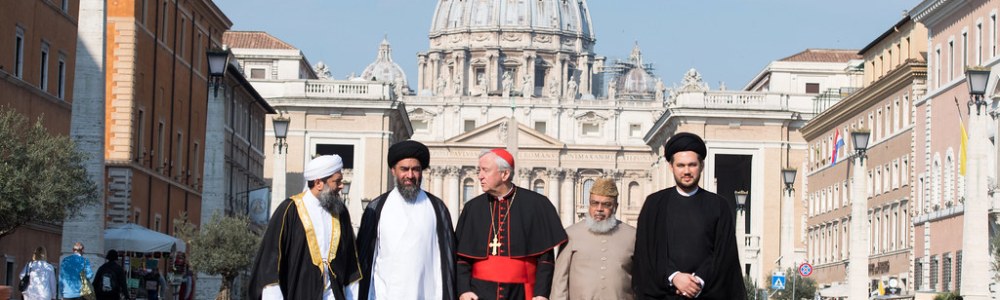
Whenever I speak or write about our Muslim, Hindu, and Sikh brothers and sisters in the context of a talk on Catholic spirituality or quote one of the great Sufi or Jewish mystics in the course of a homily, inevitably someone from the congregation or group of listeners will afterwards pose a question or series of questions at the root of which is a presumption, namely, that these religions really have nothing to offer us that we don’t already possess. There seems to be a suggestion that quoting thinkers of other religious traditions implies relativism, the position that every religion is fundamentally the same as any other. I believe that at the heart of these claims is a knowledge problem. What follows is an attempt to explain this contention.

Generally speaking, we can discern throughout history roughly two ways of conceiving knowledge production. One way – still very much alive today – is to begin with a grand idea and then proceed to implement that idea, either on a multitude or on the society at large; in the process, all corroborating evidence is noticed, collected, and cited in support of the idea. The other way is to begin not on the level of the idea, but on the level of the facts, the data, the evidence of a problem in which we are interested, and to proceed to account for that evidence by putting forth the best or most plausible estimate.

The latter approach is messy, labor intensive, and characterized by uncertainty, because, as the very logic of this method shows, nothing more than a plausible conclusion is guaranteed – i.e., typically, there are many alternative hypotheses that at first glance can, to some extent, account for the same facts in evidence, which is why each one must be tested. This, of course, describes the basic logic of the scientific method. The former approach on the other hand is characteristic of the literary mind, the artist, the poet, etc.; the novelist is inspired by a vision of the entire plot at a glance, and it is later on that the details are filled in to give concrete expression to that idea.

It has always been interesting to witness the reaction of some of my colleagues to grand ideas introduced by school administrators who were former English, Drama, or Art teachers, ideas peddled as panaceas, grand solutions to the problems teachers have been confronting for centuries: it is typically those in the hard sciences who wonder to what extent these ideas have been tested or who will challenge the ideas by citing evidence that strongly suggests these ideas have not produced what was claimed they would inevitably produce.

We see this methodological tension between grand but untested ideas typically supported by anecdotal evidence on the one hand and a more empirical/pragmatic, evidence-first approach on the other in the lives of our religiously diversified student body. I have taught for 20 years at a school with very devout Muslims, Sikhs, Hindus, Catholics, Protestants, etc., and what is particularly interesting is that many of these students have come to conclusions at odds with the religious ideas (dogmas) of their parents, or uncles, grandparents, etc. The data they receive on a daily basis as members of a religiously diverse population does not corroborate the “idea” that a good number of them received from the older generation, namely “we have ‘the truth’, while they walk in darkness”. The young Muslim discovers that the devout Hindu (or Catholic, or Sikh, etc.) sitting next to her or behind her or in front of her is not the infidel, pagan, or miniature monster she was somewhat led to believe he was, and vice versa. The data simply does not support the “idea” (the dogma). And the students realize the reason for the discrepancy is “degree of exposure to information” – the students have data their parents tend not to have, because many of the latter came from religiously homogeneous backgrounds. It is simply not necessarily the case that the “others” (i.e., the non-Catholics or Catholics, depending on who you are) are living in darkness because they have not been baptized, confirmed, or do not profess the Shahada, etc.

I believe the myth of the conflict between “science and religion” perpetuated over the centuries is one of the reasons that many devoutly religious fail to appreciate the logic of the scientific method and are unaware of just how much theology depends on it – biblical hermeneutics is methodologically inductive; it is a matter of plausible reasoning. Moreover, inductive conclusions are never “money in the bank”; the truths that we are committed to and which are the result of a theological reasoning process that is investigative in nature are tentative. For the most part, we are dealing with theses having only a degree of plausibility, and one’s conclusion is only as strong as its weakest link in the chain of premises. Moreover, new data can and often does cause us to discard theses that are inconsistent with the new and more plausible data. Science is an evolutionary process (we speak of the scientific revolution), and so too is theology and philosophy.

There is no escaping our epistemic limitations. Each person is born into a specific tradition; man is a social, political, rational, linguistic, economic and religious animal, among other characteristics. At any given moment, each person understands himself and the world through a conceptual framework made up of epistemic conditions, a host of cognitive data, i.e., first principles, perceptions, deductions, uncertain inferences, ideas embodied in a particular and ever evolving language, the science of the day, cultural myths, biases and prejudices that both blind us to some things and open us up to other things, etc. And so not only is science subject to an evolutionary process, so too is our own personal “knowing” – not even the stubborn dogmatist who refuses to open himself to anything new that would threaten the stability of his comfortable worldview can put a complete stop to his own cognitive development.

So how do we explain the theological aporia that 1) Jesus is the Way, the Truth, and the Life, and 2) there are Muslims, or Hindus, or Sikhs among us who are holier and wiser than I, who am a baptized Catholic? A fundamental axiom of philosophical method is: “Never simply abandon. In the face of insuperable difficulties, introduce distinctions and qualifications that enable you to save what you can of your commitments” (Nicholas Rescher). I believe John Paul II provides a possible avenue to explore this problem credibly: “When we penetrate by means of the continually and rapidly increasing experience of the human family into the mystery of Jesus Christ, we understand with greater clarity that there is at the basis of all these ways that the Church of our time must follow, in accordance with the wisdom of Pope Paul VI, one single way: it is the way that has stood the test of centuries and it is also the way of the future. Christ the Lord indicated this way especially, when, as the Council teaches, “by his Incarnation, he, the Son of God, in a certain way united himself with each man” (Redemptor Hominis, 13).

The Son of God, the Word, is present to every man, because he has united himself in a certain way to each man, and a person does not have to be a member of the visible Catholic Church to respond to that presence, which is a “redemptive presence” within the deepest region of the human person: “The kingdom of God is not coming with signs to be observed; nor will they say, ‘Behold, here it is!’ or There!’ for behold, the kingdom of God is within you” (Lk 17, 20-21). The evidence is clear to anyone who lives among faithful Hindus, Sikhs, Muslims, Jews, etc., that one may respond to that redemptive presence and love that presence without being completely or even explicitly aware of who it is – as a child can love his mother without a properly scientific knowledge of who or what she is (Cf. S.T. I-II, q. 89, a.6).

At a very profound level, the devout Muslim, Sikh, Jew, and Hindu, etc., is our brother, our sister; for it is not possible to love Christ except through the power of the Holy Spirit, so if you, a Christian, live in Christ and Christ lives in you, if you carry in your body the death of Christ so that the life of Christ can be made manifest through you (2 Co 4, 10), and the devout Muslim for example likes what he or she sees in you, or better yet loves what he or she sees in you, that is, your deepest identity, then they love Christ without necessarily being aware of it – given that Christ really does live, act, and speak through you. One day I asked a good friend of mine, a priest of a nearby diocese, to tell me where in the Old Testament can one find the following words: “How can I describe the Greatness of Your Name, O Lord? If I had a hundred of thousands of stacks of paper, and if ink were never to fail me, and if my pen were able to move like the wind, and if I were to read and recite and embrace love for the Lord–even so; I could not estimate Your Value. How can I describe the Greatness of Your Name?”

My friend responded: “The book of Wisdom? One of the Psalms?” No, so I continued: “So many endure distress, deprivation and constant abuse. Even these are Your Gifts, O Great Giver! Freedom from slavery comes only by Your Will. No one else has any say in this. If some fool should presume to say that he does, he shall learn, and feel the effects of his folly. He Himself knows, He Himself gives. Few, very few are those who acknowledge this…Speak of Him continually and remain absorbed in His Love.”

He was sure it came from one of the wisdom books, such as Sirach or Ecclesiastes. Before telling him the answer, I asked him to tell me which mystical theologian in history would have said the following:

Does anyone think that the ocean is only what appears on its surface? By observing its hue and motion the keen eye may perceive indications of that ocean’s unfathomable depth. The Lord’s mercy and compassion are an ocean with no shore, providing endlessly varied vistas for those who sail its surface; but the greatest wonderment and fulfillment is reserved for those “creatures of the sea” for whom that mercy has become their own medium.

The Lord beckons us through a divine love and attraction that has been implanted in our hearts, a love that may be understood and felt consciously as divine by some, and only indirectly as love for His creatures or creation by others. In either case the pull of our heartstrings draws us to those Mercy Oceans, just as our physical bodies feel drawn to a warm and gentle sea.

By means of the revelation of the Scriptures and through the example set by prophets and saints, all human beings have been brought in contact with those oceans. For humankind at large, these revelations serve as vessels, or as “instruction manuals” for building and maintaining vessels that ply those most spacious seas, but for those who have the means to read between the lines, a great revelation emerges: that we are of that sea, that our place, our home is in the depths of that sea, not on its surface.

My friend’s list of possibilities included Meister Eckhart, one of the desert fathers, Pseudo-Dionysius, St. Gertrude, St. Hildegard of Bingen, etc. But the first piece of writing was from the Sri Guru Granth Sahib and the latter is an excerpt, with some modification of vocabulary, from modern Sufi writer Shaykh Muhammad Hisham Kibbani.

Consider the image of a pyramid that is upside down. On the top and widest level represents the level of articulated religious belief (doctrine); here there is a wide range of diversity and difference. But as we approach the “mystical” level of each of these religions, the two sides gradually converge toward one another, so much so that at its deepest level it is very difficult to distinguish them on the basis of the specific religion; they all seem to be speaking the same language; in other words, there is a significant unity at this level. Hindus speak of the need to become aware of the distinction between the unchanging “I” and the passing events of our everyday lives, which they see as Maya, and the need to detach the “I” from that which is fleeting, and we encounter, in Islamic mysticism, the idea of Allah as the ocean that dissolves the individual ego, if we permit such a thing. Christian mystics speak of the death of self, the need to die to oneself in order to rise to new life, a regenerate life, and Islamic mysticism has similar ideas with only slightly different vocabulary. Buddhism speaks of the thickening of the ego and the need to drop all desire, but so too do Christian, Jewish, and Muslim mystics. Hinduism speaks of Atman at the center of the human person, and according to the Vedanta school, Atman is Brahman. But according to Islamic Sufism, Allah is both immanent and transcendent; as immanent, God is that eternal and necessary ground of all being at the very depths of the human soul, and our goal is egoistic annihilation. Kabbala speaks of God as nothingness, the fullest and purest mode of being; Buddhism speaks of the emptiness that is the fullness of Nirvana, etc.

On the most profound level of human religious existence, there is a sense in which we are all brothers/sisters; for we may be operating out of the same subterranean world, if you will, a world in which is present a Person, the Word, who gives us his undivided attention at every moment of our existence. When we begin to understand that “doctrine” (the explicit articulation of what is believed) proceeds from that deepest level of religious experience, it becomes increasingly evident that we need to carefully interpret each other’s doctrine in the light of that mystical understanding, otherwise we run the risk of misinterpreting one another. If we do not possess a mystic sense, we are sure to misinterpret one another, understanding the ‘other’ on our terms, not on their terms.

Individual human beings are continually growing in knowledge and understanding. This is because experience provides us, on an ongoing basis, with new information, and it is in the light of this new data that we re-interpret our current body of knowledge. It often happens that we discover that what we thought was absolutely and definitively true is not so after all, at least not completely. But it is very difficult to know whether our current body of knowledge suffers serious deficiencies – that tends to happen retrospectively. In other words, truth is an idealization. What we possess at any one time is often and for the most part a matter of putative truth. Our information is always incomplete, and new information has a way of changing the plausibility of our current data, causing us to make finer distinctions and to revise our estimates. As we learn from one another, we begin to see the world from a different angle, that is, within a new cognitive framework containing additional information. This angle is not necessarily any better, at least not in any absolute sense, but often we discover that much of that “different perspective” sheds light on what we already know, enabling us to distinguish where we failed to earlier, and enlarges our current body of knowledge, often refining it in some ways. The resulting hybrid is usually better.

From a statistical point of view, if the vast majority of our knowledge at any one time has undergone tremendous revision, enlargement, expansion, serious editing, etc., then it is reasonable to expect this trend to continue; in fact, there are no signs that this is slowing down. But for some reason, many people find it difficult to acknowledge the implications of what they already know implicitly. Uncertainty seems to give rise to fear, perhaps a fear of losing one’s identity. Raimon Panikkar writes:

In the West identity is established through difference. Catholics find their identity in not being Protestant or Hindu or Buddhist. But other cultures have another way of thinking about one’s identity. Identity is not based on the degree to which one is different from others. In the Abrahamic traditions (Judaism, Islam, Christianity), people seek God in difference – in superiority or transcendence. Being divine means not being human. For Hindus, however, the divine mystery is in man, in what is so profound and real in him that he cannot be separated from it, and it cannot be discharged into transcendence. This is the domain of immanence, of that spiritual archetype that is called brahman. In the Hindu system, people are not afraid of losing their identity. 

They can be afraid of losing what they have, but not of losing what they are.

Being afraid is always a bad sign. Christ says, “I give you peace” and “Do not be afraid.” Contemporary Christians feel surrounded and are afraid of being dissolved. But what does the gospel say? “You are the salt of the earth.” The salt has to be dissolved in order for the food to be more tasty. The leaven is there to make the bread rise. The Christian vocation is to lose oneself in others (Eruption of Truth: An Interview with Raimon Panikkar – Religion Online: https://www.religion-online.org/article/eruption-of-truth-an-interview-with-raimon-panikkar/).

The irony here – if what Panikkar says is true – is that the truly “Catholic” approach, in the sense of international or universal, is the latter. As Panikkar writes: 

The whole history of Christianity is one of enrichment and renewal brought about by elements that came from outside itself. Do not Christmas and Easter, and almost all the Christian feasts, have a non-Christian origin? Would it have been possible to formulate the basic Christian doctrines without the hellenic tradition, itself pre-Christian? Doesn’t every living body exist in symbiosis with its external milieu? (Ibid.) 

The authentically Catholic approach to the uncovering of truth is integrative. Nothing good is discarded, but appropriated. Catholics believe Christ is the Way, the Truth, and the Life (Jn 14, 16), “in whom are hidden all the treasures of wisdom and knowledge” (Col 2, 3). But this Scripture is very clear; it is in him that are hidden all the treasures of wisdom and knowledge, not in me. My appropriation of Christ is always deficient, that is, my response to his redemptive presence in the world and within me is profoundly imperfect, and thus my knowledge of him is always deficient. But the more perfect that this appropriation becomes, the more will I be able to recognize him outside of myself, and that is why the more I will discover the treasures, that is, the truths or aspects of the Logos dispersed in the lives and the wisdom of those who truly love him and who are outside the visible contours of the Church.

A Reflection on Marriage as a Work of Beauty

https://www.lifeissues.net/writers/mcm/mcm_408reflectionmarriagebeauty.html

Deacon Douglas McManaman

I’d like to begin this reflection with an analogy. I’m an amateur artist. I love colors, and I’ve always appreciated talented artists and their work. I’m not, however, a talented artist, nor have I been formally trained. The reason I paint is that my spiritual director, in the year of my ordination, told me I should paint. I did not want to at the time, but I decided to follow his instructions–after all, he has a rather extraordinary “word of knowledge” charism. I went out to the dollar store and purchased some cheap pastels and a pad of paper and began to draw and color a picture of some houses in the neighborhood. It was not that good, of course, but I felt as though I had a two-week holiday, just after coloring for an hour. So, I kept at it. I then moved on to chalk pastels, then eventually to pastels on sandpaper, then to acrylics on canvas, and eventually iconography. 

During my pastel phase, I took a workshop with Dave Becket, renowned Canadian pastel artist from Orillia, Ontario. What he would do is paint a picture in front of all of us, so we’d see the work develop and unfold before our eyes. I was rather amazed that throughout the process, at any given stage, the painting looked rough and was not all that pretty, nothing for which any special talent was required. But he kept at it, and at it, and eventually, in the end, we saw the work suddenly come together in all its beauty. 

A marriage can very much be compared to the production of a work of art. A marriage is a process, not a finished product. The product can only be judged at the end, as Aristotle would say of a good life: “for as it is not one swallow or one fine day that makes a spring, so it is not one day or a short time that makes a man blessed and happy” (NE, 1098a18). If one were asked to judge the quality of a marriage at any given time, like the work of art in progress, one might very well say that it is nothing extraordinary, that it is rough and unrefined, certainly not very pretty. We have a tendency to regard marriage within a static frame of mind, as though a marriage is a thing the quality of which one can measure, as in the rather jejune expression “joy-filled” marriage. Anyone reading this who has ever worked on a painting or a sculpture is certainly aware that it is not always a joy, but often tedious; it is work. Similarly, in a marriage, there are moments of great joy, of course, and challenging moments, darkness and struggles; but the joy is really at the end, when we contemplate the work of beauty, as God does at the end of the six days of creation, looking at everything he had made “and indeed, it was very good” (Gn 1, 31). And one only makes it to the end by staying the course, paying attention to details, persisting, refining, and doing the little things the importance of which experience reveals.

This brings me to another point to draw out from this analogy. I have two unfinished paintings in my art room. They are of two beautiful scenes of Uxbridge, Ontario during the fall season, one of a farm and large field below a beautiful sky, the other of a railway crossing in the country. Now, I also studied iconography, but interestingly enough, I do not have any unfinished icons. When writing an icon, one begins with certain prayers, and when finished, it remains unsigned and is blessed with holy oil. The icon is considered a sacramental, not merely a painting. It is a window into the saint who is depicted, a point of contact, and so it is a holy object. I had to ask myself: why don’t I have any unfinished icons, but two large unfinished paintings? I think the reason is that the purpose was different in both cases. My purpose in painting the two that remain unfinished was my own enjoyment. I wanted to capture the enjoyment of those scenes, for myself. The purpose in writing each icon I’d ever done, however, was devotion to the saint depicted, i.e., an angel, Theotokos, or Christ Pantocrator, etc. I certainly finished paintings that were not icons, both acrylics and pastels, but I don’t have them; they were painted for others, for friends and colleagues. I was able to successfully finish them, to persist through the midpoint tedium, because they were not done for me primarily, but for them.

Again, this lends itself well to highlighting an important aspect of married life. When a couple gets married and the purpose is first and foremost their own enjoyment or convenience, the marriage will almost always end in a separation and eventual divorce–like an unfinished work of art. The two simply cannot sustain it. It’s very much like doing a painting so that I may enjoy it: after a time, the labor is often just not worth it, so I stop and move on to more interesting projects. But when it is for another, when it is an icon that I am doing for the sake of satisfying a person’s desire for religious inspiration and devotion, or simply a beautiful scene outside that I want another to enjoy as I did when I saw it originally, I am able to endure and persist. 

The problem is that the vast majority of people, since the early 1960s, sees marriage as primarily an arrangement, one ordered to the pleasure, convenience, and enjoyment of the individuals involved. But marriage is first and foremost about the decision to love another for the other’s sake, completely and totally in all its implications, one of which is that divorce is never an option on the table. One should know that such a decision is not going to be easy, not always a joy, but it is a work in development, a work of beauty. It is not merely a sacramental, but a sacrament, an institution brought into being by God on the basis of the intention of the two involved. It is a sacred sign in motion.

I believe a significant factor in our lack of awareness of the deeply paschal significance of marriage has been a misreading of Paul’s first letter to the Corinthians, chapter 7: 

“Brothers and sisters: I should like you to be free of anxieties. An unmarried man is anxious about the things of the Lord, how he may please the Lord. But a married man is anxious about the things of the world, how he may please his wife, and he is divided. An unmarried woman or a virgin is anxious about the things of the Lord, so that she may be holy in both body and spirit. A married woman, on the other hand, is anxious about the things of the world, how she may please her husband. I am telling you this for your own benefit, not to impose a restraint upon you, but for the sake of propriety and adherence to the Lord without distraction” (32-35).

Because it is a small portion of the entire chapter, taken out of its larger context, it is very easy to misinterpret and come away with the impression that the celibate or consecrated life is genuinely religious, while the married state is not. Such an interpretation, however, would run contrary to Paul’s overall teaching on marriage. In the larger context of this chapter, we see that Paul believes we are in the last period of salvation history. He refers to his own time as a time of distress, which in apocalyptic literature, is said to precede the time of the Second Coming of Christ. Paul writes: “So this is what I think best because of the present distress: that it is a good thing for a person to remain as he is. Are you bound to a wife? Do not seek a separation. Are you free of a wife? Then do not look for a wife…. I tell you, brothers, the time is running out” (26-27; 29). 

Today we would not advise single young people not to look for a spouse “because time is running out”, so what Paul says about those who are married and those who are not must be read in this context, otherwise we come away with the impression that marriage has nothing to do with serving the Lord. And of course, that would contradict what Paul teaches in Ephesians, where he speaks of the mystery of marriage as a sign of the love that Christ has for his Bride, the Church.

Christ’s love for his Bride is a conjugal love, and the love of a baptized husband for his baptized wife is that very same love, and vice versa. Marriage is just as religious a vocation as is the priesthood and consecrated life. Unfortunately, it has not always been understood that way by the faithful, but marriage is a sacred sign that contains what it signifies, and it signifies the paschal mystery. For just as God called Abraham to leave the land of Ur and “go to the land that I will show you” (Gn 12, 1), and just as God called Israel to leave Egypt behind with its pantheon of false gods, and just as Jesus leaves this world behind in order to go to the Father (Jn 17, 19), so too in matrimony, two people are called to leave behind a world closed in upon itself; they are consecrated, that is, set apart, for they are called to leave behind their comfortable world of independence and self-sufficiency, to be given over to another, to belong completely to one another, in order to become part of something larger than their own individual selves, namely, the one flesh institution that is their marriage. The couple relinquish their individual lives; they are no longer two individuals with their own independent existence; rather, they have become one body, a symbol of the Church, who is one body with Christ the Bridegroom.

The lives of genuinely married couples are a witness of the Church’s response to Christ’s love for his Bride; they witness that love in their sacrificial love for one another and for the children who are the fruit of that marriage–and raising children well demands a tremendously sacrificial love. In giving themselves irrevocably and exclusively to one another, without knowing what lies ahead, a young couple die to their own individual plans, they die to a life directed by their own individual wills. In doing so, they find life; for they have become a larger reality.

But when a couple enters a marriage as though this is primarily about their own enjoyment, they inevitably become disillusioned. “Christ, what have I done? What have I done?” said Lynn Johnson, of the Up series, a year after her wedding. She readily acknowledged that her husband probably said much the same thing. She was disillusioned and had to make a decision, thankfully the right one.

When a generation has lost the sense of life as having a transcendent end and has settled for a purely intramundane existence of an epicurean nature, marriage simply makes no sense. It makes far more sense to simply cohabitate and maintain a level of freedom in which one can move on rather easily when things get difficult. It is no coincidence that marriage began to decline in the late 1960s, the age of individualism, which devolved into the hedonism of the 70s and 80s, and the nihilism of the 90s. In a postmodern culture, it continues to decline. But if young people were given a proper vision of the overall work that a married couple are called to create and the heroic virtue required to achieve this end, we might eventually begin to see a reversal.